
Archive for August, 2012
Florida State University class using Klout to determine student grades
Aug 26th
By Todd Bacile, Florida State University
“Thirty-five” was the answer to the following question posed to a marketing agency’s hiring manager: “What is the minimum Klout score a college student can have and still be considered for an internship at your firm?”
I immediately went into a state of shock — Shock that Klout has gone mainstream so quickly, and shock because my digital marketing student’s Klout scores typically range from 15 to 25. As an instructor, I had to ask myself: “Am I doing everything I could to prepare my students for the real world workplace?”
Most people seem to either love or hate Klout, so the notion of assigning a portion of a student’s grade to their respective Klout score may cause some to react … what’s a good word to use here … fretfully. Yet, as an educator teaching electronic marketing at the collegiate level I owe it to my students to introduce them to every and any concept that will help them land an internship or fulltime job.
Klout matters to employers
And here is an inescapable fact. Many firms are sizing up college student’s Klout scores as a quantitative metric to use for job applicant screening. Therefore, I decided to create a class project in which the final grade earned is solely determined by a student’s Klout score.
This class project familiarizes students with Klout by having them engage with others via Facebook, Twitter, LinkedIn, and blogs. Students within my e-marketing class were already familiar with the terminology and nuances associated with various social media sites. By creating an experiential Klout project, students would now be able to apply social media engagement concepts and strategies to raise their Klout score, and ultimately, raise their grade. By the way: this may also help them land an internship.
The results have been phenomenal over this past year. The average Klout score of 16.7 at the beginning of my fall class’s project dramatically improved to 39.1 by the end of this project. Similar improvement was seen in my spring class’s project, with the average Klout score beginning at 19.3 and ending at 43.1. In both sections several students achieved scores well into the 50s, with a high score of 58.
A plan to model social media engagement
How did the improvement in scores happen? I had them game the system! Just kidding – I had to say that to upset some of the anti-Klout people who may be reading this post. In all seriousness, I simply reviewed Klout’s explanation of key scoring criteria and applied basic concepts recorded in the book Return On Influence. The idea is not to just accumulate a large following, but also to get other people to share and respond to content created by the students.
I then lectured and illustrated how the students can engage others via social networks — creating content people will want to comment on, asking relevant questions to key opinion leaders, and other methods used to engage in social conversation with others. These engagement skills are what many firms are seeking in social media marketing interns and entry-level positions that my students are hoping to land, making this an ideal project within the classroom.
An experiential project like this proved to be enjoyable for the students and maintained their attention and enthusiasm throughout the semester. Many students would compare scores and discuss different techniques used to engage with powerful opinion leaders within the social world. Which students had higher scores became a friendly competition causing students to work even harder at engaging others. Imagine that: students wanting to work more to develop skills that current marketing employers are searching for!
Benefits of the project
There are three key benefits this project produces.
1) Improvement to Klout scores that will help students during job application screening,
2) Hands-on experience engaging with others via social media by using specific functionality within different social sites.
3) The project overcomes recent criticism that business schools within higher education often fail to develop relevant skills.
Social media jobs are increasing and this project was a fun, entertaining, and interesting way to get my students to learn social media engagement skills. What are your reactions to this project to immerse students in social engagement?
Note: This blog post created quite a dialogue on both blogs and traditional media. Author Todd Bacile responds to the attention in his own blog post.
Todd Bacile is a doctoral candidate in marketing and the instructor of Electronic Marketing in the College of Business at Florida State University. A ten page research paper describing his Klout project will be featured in Marketing Education Review’s spring 2013 issue on teaching innovations. You can follow or contact Todd on Twitter @toddbacile
Do we regulate social media or use it to stop hate speech?
Aug 24th
After my article this week on the tragic riots in India, purportedly fueled my social media and hate sites, my friend Prasant Naidu offered to write a post with a view from inside the country. I know you’ll enjoy this fascinating and bold blog post.
By {grow} Community Member Prasant Naidu
I am an Indian.
I come from a country that boasts of having the largest democracy and home for four of the world’s major religions. The land that provides shelter to more than 1.2 billion people has been ripped off time and again by opportunists.
At present, India is facing a situation where communal tensions are burning in the North Eastern belt of India. The riots have affected more than 400,000 people and have killed more than 77. The aftermath has triggered rumors that North Eastern people who are living in other parts of the country are not safe. This led them to press the panic button and we saw thousands of North Easterners rushing back to their homes to save their lives.
The Government of India has blamed social media for spreading hate speech and inciting the riots. This is not the first time that the government has done this and they have already taken action – 245 photo uploading websites have been blocked, 80 plus internet pages and Facebook accounts have been blocked, six parody accounts of the Prime Minister’s Office have been blocked. Subsequently, it has pressured social media giants Facebook, Twitter, and Google to obey them. There is nothing wrong in removing hate speech but the bigger question today is:
1. Riots have happened before social networks were known to humans. So is banning or monitoring the only option?
2. Will this trend of hate speech removal also put a lid on freedom of speech?
Banning or monitoring is not an option
The world has seen social media fuel the Egyptian revolution and then the London riots. Sadly India has not learned from these events. It has not only failed in understanding the dynamics of social media but also how to respond to it. Politicians, still on websites to show their online presence, were caught napping during the Lokpal movement last year. After that the government pulled up its socks but only to create a presence that was blowing its own trumpet. It was not just the government officials but all other members of opposition too who were building a social media presence that wanted to broadcast political messages but did not want to “Listen.”
However, social media is a two-edged sword and things go viral like wildfire. But can’t the government use this viral feature of social media as a weapon against hate? The PMO India is present on Twitter and it can very well use the account to try and kill rumors and boost confidence. There are so many influential Indian celebrities and politicians with whom the government can join hands and start a positive campaign, the way brands these days sell their products on social media via an influential celebrity. Alas the PMO’s Twitter handle is busy tweeting about the Prime Minister’s mundane work schedule!
It’s not that the Indian government is unaware about the positive side of social media. For example, Nirupama Rao, India’s Foreign Secretary used Twitter during the evacuation of Indians at the time of the Libyan crisis.
Are we going to see a new definition of Freedom of Speech in India?
The government is reportedly trying to frame new IT laws where content could be monitored. Earlier in the day, the government had blocked Twitter accounts of journalists and there has been a daylong uproar on Twitter via #GOIBlocks. People are questioning whether the government intends to suppress voices against them under the pretext of hate speech.
So the coming days are going to be interesting. Social media, which has already become a national debate here in India, will see much more happening. The mood can be judged by this tweet from popular author and Twitter celebrity, Chetan Bhagat
Welcome to a world that is rapidly changing the way we look at social media.
Prasant Naidu is Founder and Blogger at Lighthouse Insights – a site that exclusively talks about Indian social media news. Loves to experiment in social media and believes social media is a game changer for SME’s. Twitter- @LHInsights.
Illustration: Photo of Delhi’s Red Fort by Mark Schaefer
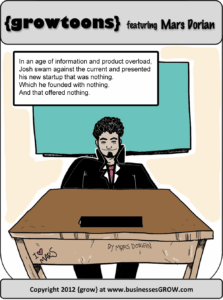
The keys to the kingdom. A {growtoon}.
Aug 24th
Join the growtoonists each Friday for a humorous take on marketing, social media, and current business events.
Joey Strawn is a social media strategist that loves enjoying a good book and then drawing in it. Check him out on Twitter: @joey_strawn
Five steps to re-invent your social media business networking
Aug 23rd
By Srinivas Rao, Contributing {grow} Columnist
Chances are you’ve never heard of Oliver Starr. But you’ve probably heard of many of the people below:
This may seem odd to you, but Oliver, a successful blogger and Michael Arrington’s first employee at Tech Crunch, had never heard of these people when I mentioned their names. The only reason I learned who he was is because he’s the product evangelist for Pearltrees, a tool for organizing information that I really love. My interaction with Oliver was eye-opening because I just assumed that if you’re in “the biz” you would have heard of most of these folks.
It made me realize just how narrow our view of the web is.
A few weeks ago Mark Schaefer wrote about his observation that there is nothing new in blogging. I’m willing to bet if most of Mark’s readers put the names of the blogs they read on a regular basis into a hat, they would all have a very similar list. Our natural tendency is to gravitate towards people similar to us, and the result is a self-imposed lens through which we view the social web. Maybe it isn’t that there’s nothing new in blogging, but that we’ve been stuck in an incestuous circle of social media marketers, lifestyle designers, and personals development bloggers. Just so we’re clear, I’m not pointing fingers. I fall into those same incestuous circles!
Innovation and new ideas can’t diffuse throughout the social web when experts spend all their time talking to experts. That’s why I believe it’s important we not only embrace new and emerging talent, but also take steps to get outside of our comfort zone and expand our horizons. Here are five ideas on how to do that …
1. Purge your blog reader and start from scratch
Every few months I literally unsubscribe from nearly every blog I read. This enables me to accomplish a few things. First I’m able to prioritize which blogs have become the most important to me. Second, it forces me to look for new blogs and creates an opportunity to connect with new people. As a result my network continually expands. Subscribe to a few blogs that have nothing to do with your industry but that you just find interesting.
2. Pick 5 new people to follow on Twitter and build a relationship with them
I’ve never particularly cared too much about the number of followers I have on Twitter which might seem sacrilegious, but it’s been a big part of my philosophy on building relationships. What I’m more interested in is who is actually following me. Every few days I read the bios of my new followers and pick a few to engage with. The amazing people I’ve found by doing this include successful entrepreneurs, artists, published authors, literary agents, and many other people who are doing amazing things online. This has been a great way to broaden my own horizons and connect with exciting new people.
3. Attend a conference outside your industry
One of the best pieces of advice I ever received about leveraging public speaking was from Michael Port. He said that rather than speaking at a social media conference go speak to an association of dentists because in that environment you’ll be the go-to person on your subject matter. This could lead to additional speaking engagements and consulting opportunities. By attending or speaking conferences outside your industry, you not only have an opportunity to grow your network substantially, but you could also tap into a significant source of opportunities. Additionally you may find that you’ll be exposed to a wide variety of new ideas.
4. Go to smaller conferences
Our general tendency is to attend the biggest industry conferences each year so we can see as many people as possible. This creates a highly competitive environment for people’s attention and limits what we can get out of the conference. I think conferences like Social Slam, which is devoted to opening up speaking and networking opportunities for diverse new talent, drives opportunities to meet thought leaders outside the echo chamber. One additional suggestion I have for conferences – don’t hang out with the people you already know. Seems obvious, but not always easy to do.
5. Don’t go to conferences. Attend a retreat instead
A 5-minute conversation and business card exchange during happy hour at a conference has its limits in terms of building long-term relationships. This is why I think a 5-6 person retreat of some sort that involves more than just talking about business could be much more powerful than a typical conference. Imagine how well you’d get to know each other if a small group of people spent three or four days together.
If we’re going to discover what’s new in blogging and social media marketing, then we have to keep opening up ourselves to new people and new experiences by trying things we’ve never tried.
Please leave your ideas in the comment section about how you are energizing your network and feel free to leave the names of a few non-social media experts you enjoy learning from!
Srinivas Rao writes about the things you should have learned in school, but never did and his the host-co founder of BlogcastFM. You can follow him on twitter @skooloflife
Illustration courtesy of BigStock.com


You’re in marketing for one reason: Grow.
Grow your company, reputation, customers, impact, profits. Grow yourself. This is a community that will help. It will stretch your mind, connect you to fascinating people, and provide some fun along the way. I am so glad you’re here.
-Mark Schaefer