
Archive for March, 2013
The best digital business idea that just never worked
Mar 26th
A paperless society? Not if the recent SXSW conference was any indicator.
I know this sounds crazy, but paper is still the preferred communication method at the world’s biggest interactive gathering. Every attendee is handed a printed program guide as big as a phone book. Start-ups and filmmakers paste posters on every column and leave flyers on all the tables. Everybody still wears a paper name tag.
But the strangest hold out of all is the business card.
I probably passed out (and received) 250 business cards at the event. Nobody offered a “digital” card and nobody asked for one, even though that “bump” technology of transferring from one mobile device to another has been around for a few years.
I found this so odd … especially when I returned home and manually had to enter all that information into my contact list. Doesn’t that just seem like the biggest waste of time? “Bumping” a business card is such a great idea. But it never worked. Why?
It interested me to the point that I posted the issue on Facebook. Some of the responses were illuminating. Here is what a few {grow} community members had to say about the obvious staying power of business cards:
Gary Schirr YEARS ago businesspeople used to exchange info electronically using their Palm organizers…what happened???
Ahna Rebekah Hendrix I prefer business cards at this point because they remind me of the individual versus just putting a number/name in my phone. The apps where you take a picture are still odd to me – I’m not trying to snap the picture of a new contact just to remember them.. We are somewhere in the middle, but I much prefer b-cards still.
Jason Falls I actually prefer going through the cards I collect when I get home. Helps me remember who the people are and to follow up with them. (Just finished doing that a few minutes ago!
Kristen Margo Daukas At least with physical cards, you can flip thru them and if you don’t know the person, if you’ve written a note it will jog your memory. Once you put it in the phone and trash the card, it’s even more lost in a sea of data. Personally, I like that are one or two things that are still tangible.
Brian Vickery I’ve mentioned just getting a custom QR code for the phone that folks could scan – but it would be so foreign to most people. Secondary consideration is to then include one on the business card to at least save the tech-savvy folks from having to type in the information.
Craig Lindberg Wonder how the etiquette for the card exchange like that in Japan can be updated to mobile? Or maybe they have already. Important rituals sometimes don’t translate into digital.
When I think about the future, I usually assume we will be surrounded by a digital layer that we will literally be able to absorb and record at will with some device. But I wonder if we will always have business cards?
SEO Ethics and Content Marketing: Spammers vs.Thought Leaders
Mar 25th
By {grow} Community Member Andy Crestodina
Blogging is work. Finding time is hard, and pushing back deadlines isn’t easy. 29% of B2B marketers report that “producing enough content” is a challenge (source: B2B Marketing Survey). So why not outsource it?
Great! Let someone else do the work. But delegators beware. Ethical issues pop up when you outsource your blogging, especially when the goal is SEO. As usual, search is on the front lines of marketing ethics.
The ethics of outsourcing content isn’t black and white. There’s a spectrum of SEO ethics, ranging from the easy (but shady) to the difficult (but pure).
Link Spammers
The last few years have been tough for SEOs, especially those who relied on link networks, article spinning, and directory submissions to build links. Google’s rank-crushing (but cute-sounding) algorithm updates, “Panda” and “Penguin,” changed everything. So SEOs turned to guest blogging as a reliable, repeatable way to build links to client websites.
But when the search pros start writing, things get weird. For the first time, clients are able to review the work and not just the rank. They want to read the content for which they paid. And since SEOs care more about the links than the writing, the quality of the writing is low. All too often, the content and the host blog look suspiciously irrelevant, even if they are good for rankings.
It’s unethical because the writer doesn’t care about the writing. In fact, they don’t care if the content is ever seen by human eyes. All that matters is GoogleBot and the juice that the link provides.
The Ghost Writer
The next step on the spectrum is the ghost writer. Since the idea for the content actually originates from you, it’s more legitimate. In this case, you write the topic sentence, the opening paragraph, and/or an outline.
Yes, it takes time to discuss topics, but the SEO vendor does most of the work, researching the topic, finding host blogs, writing, and editing. In the end, they may put your name on it, which is where ethics come into play. The topic is yours, but not the tone. Although it’s not written in your voice, you’re signing your name to it.
The Co-Author
This approach is a true collaboration between you and the SEO partner. You know the industry, so you provide the ideas, but you also do the research and write the first draft. The quality is higher, but quality takes time. The post is two-thirds done when you hand it off.
The SEOs do the editing and optimizing. They’re good at this because they know how to research keywords and SEO best practices. They also know (hopefully) where and how to pitch the piece as a guest post.
In the end, it might make sense to give writing credits to both authors. But only one can get credit in Google as the author. Google Authorship doesn’t allow for more than one author. If you want full social media benefit, put the rel=”author” tag on the link to your own Google+ profile.
Thought Leaders
You know the subject. You know your audience. You care the most. This means you have the best opportunity to find the right topic and shape it with your voice. Through your content, you can become respected for your ideas. That’s what a thought leader is.
It’s the highest quality content. It’s the well-researched articles, the passionate op-eds, the detailed reference guides. This is time-consuming, “cornerstone” content. Not the kind of thing you write everyday.
As a thought leader, you’ll get all the social benefits: a growing following, better traffic through sharing, and new connections. You’ll be an author in the eyes of Google (you’re ready for Authorship and Author Rank) and in the eyes of your peers (you may end up getting invitations to speak at events).
The trick is to find the time…
Take the high road (or the highest road possible)
No one likes a link spammer. So go as far to the right of the chart as time will allow. I suggest combining your options.
- Be a thought leader …when you can. Set aside time to write every week. If inspiration strikes, carry the idea all the way through to completion. Let your SEO or marketing partner help you promote it. If you don’t manage to finish the piece…
- Leverage your SEO partners …but collaborate. Leverage your own time by sharing ideas, information, and connections with them. Let them finish the work so you can keep the content wheels turning.
I’m sure you’ve got a few thoughts by now. What do you think? Should SEOs even try to create content? Will brands ever find the time to write? I’m looking forward to the comments on this one…
Andy Crestodina is the Strategic Director of Orbit Media, a web design company in Chicago. He’s also the author of Content Chemistry, An Illustrated Guide to Content Marketing
Top image courtesy BigStock.com
“Dongle incident” proves we live in a world with no room for error
Mar 23rd
Perhaps you have heard by now of the “dongle incident.”
Adria Richards of SendGrid attended a tech conference and overheard a private joke between two guys behind her referring to a “big dongle.” She was offended by the sexual innuendo, took a picture of the guys, tweeted it, and asked the conference organizers to remove them from the room, which they did.
The man issued an apology, but was fired by his company. A firestorm erupted, criticisizing both parties.
An entire article is available here. I am not going to pass judgment on anybody. I wasn’t there and I’m not going to open a can of worms about the behaviors and reactions on either side.
The hivemind speaks
But here is the part that was chilling to me, and it is in black and white.
Someone claiming to know plans of the hacker group Anonymous posted a note saying that it had acquired SendGrid’s client list and was going to attack the company’s infrastructure and harass its customers if the startup didn’t fire Richards.
Adria Richards engaged in malicious conduct to destroy the another individual’s professional career due to what she perceived as an affront to her own extremist views from a comment that was not directed at her, not meant for her to hear, and certainly not for her to provide unwarranted input on. As such, she should have her professional career destroyed just like her victim in order for justice to be rendered and balance restored to the universe. The hivemind’s judgement is final and there is no appeal. No forgiveness, no forgetting remember?
Later that day, SendGrid acknowledged that they had suffered a denial of service attack. And then, they fired Adria Richards, a move “in the overall best interests of SendGrid, its employees, and our customers.”
This is an ugly, ugly episode. But here is the single statement that chilled me to the bone: “The hivemind’s judgement is final and there is no appeal. No forgiveness, no forgetting remember?”
An unknown number of anonymous cyber punks speaking for the “hivemind” dictated the actions of companies and helped crush personal careers. What kind of a world is this leading to? The “unforgiving hivemind” is now our judge and jury?
If this new cyber dictatorship can bully a company with 130 employees, can they bully a Fortune 500 company? A government? Perhaps it is already happening behind closed doors and firewalls.
No room for error
What does this mean for those of us who make mistakes … meaning, everybody?
A few years ago, I was at a pre-conference networking event and one of the men who was to be keynoting the next day was very drunk and groping just about anybody that walked by. While this behavior was repugnant and wrong, chances are everybody at some time or another has done something that is repugnant and wrong.
The good news is, since then, this fella has cleaned up his act. In fact, he’s stopped drinking and seems to have re-discovered his life. But in that moment of drunken stupor and poor judgment, his life, family, and career could have certainly been ruined via a 10 second smartphone video. Would he have any chance for redemption or recovery? Perhaps the crisis of a humiliating public spectacle would have driven him further to drinking. Maybe it would have driven him over the edge.
One of the most interesting talks at SXSW last year was provided by Billy Corgan of the alternative rock band Smashing Pumpkins. In the talk, Corgan hypothesized that artists take less risks today because of a realization that one embarrassingly human moment will get tweeted and go viral — and possibly kill a career. Before the social web, these moments might be laughed about and become part of band legend, but today it can be career-defining. He wondered aloud about a world where artists would be nothing more than politically-correct robots.
A one-way ticket
There is no going back to an era of redemption, private repentance or second chances. A public speaking gaffe, a stage stumble, an innocent moment of human weakness can end in permanent disaster.
What are the implications?
Will this relentless and unforgiving world actually drive better behavior?
Will it discourage risk-taking and openness?
Will it drive people away from having any sort of public persona at all?
Will it end up in a world that is ruled by the anonymous hivemind that is eager to destroy people who don’t conform to their ideals and values?
Are we living in a world where there is no room for error?
Illustration: Tightrope Walker by Forain
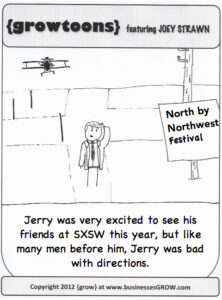
March Madness. A {growtoon}.
Mar 22nd
Join the growtoonists each Friday for a humorous take on marketing, social media, and current business events.
Joey Strawn is a social media strategist who loves enjoying a good book and then drawing in it. Check him out on Twitter: @joey_strawn


You’re in marketing for one reason: Grow.
Grow your company, reputation, customers, impact, profits. Grow yourself. This is a community that will help. It will stretch your mind, connect you to fascinating people, and provide some fun along the way. I am so glad you’re here.
-Mark Schaefer