
Archive for year 2013
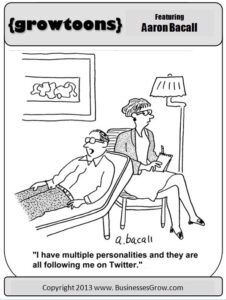
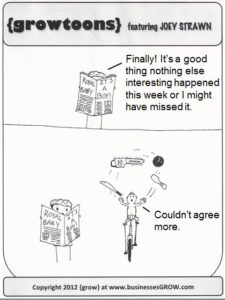
Text irony. A {growtoon}.
Mar 29th
Join the growtoonists each Friday for a humorous take on marketing, social media, and current business events.
Mars Dorian describes himself as a creative marketeer with a moon-melting passion for human potential and technology. You can follow his adventures at www.marsdorian.com/
NASA turns innovation over to its fans (video)
Mar 28th
Please click here if you cannot see my interview with Jason Crusan of NASA.
I had a chance to have a fascinating talk with Jason Crusan, NASA’s Director, Advanced Exploration Systems Division. In addition to having the coolest job in the world, Jason is involved in some of the most far-reaching and creative crowd-sourcing projects on earth. Or in space, for that matter.
Watch this short interview for some out-of-this-world insights on turning innovation over to “the crowds.”
What a blog post will look like in 2020
Mar 27th
By Mars Dorian, {grow} Contributing Columnist
I believe that if you want to have success in the present you must anticipate the future. No crystal ball required.
Why? Because you want to sniff out trends to ride them. If you only act on what’s already happening, you’re getting sidetracked to second, third or even worse, fourth place. Like driving a Ferrari with two feet slammed on the brakes. Screeeech.
So, how can one even try to predict how content marketing, in this case blog writing, will look in the future ? Well, we have to remember the fundamental laws:
- Nature is lazy, hence, we’re lazy. We want maximum results with minimum effort.
- Content in the future will be based on this principle: Consume the maximum amount of content with minimum effort, whatever, whenever, wherever we want.
The following predictions represent my opinion and not the truth, so if there’s a time traveler from the future in the audience, don’t eliminate me with your ray gun because my predictions didn’t all come true in 2020. Cool?
Let’s roll. Six possible futures of the blog post in 2020:
1) High-end, low-end blogging styles.
I believe the normal 500 – 1000 word blog posts will enter oblivion because content will serve one of the two emerging reader camps:
Snippet readers – According to FastCompany, Facebook updates make for the most memorable writing. Strange, but it makes sense. With the ever-increasing battle for attention, people crave minimalistic, write-it-like-you-say-it content. Mini-blog posts that can be consumed like fast food, not rich in nutrition, but they give you the essentials.
Long-form essay readers – On the other site we’ll larger sized articles (1000 – 7000 words and more). These are going to be evergreen, in-depth articles, almost mini ebooks, that require more sitting and attention but reward you with more brain nutrition (aka valuable information!). They can be offered for a minimal fee, let’s say .99 cents or 2 dollars (think Kindle-single) or will be infrequently published in longer time intervals.
2) Mobile optimized content psychology.
I’m not talking responsive design and bigger fonts. I mean writing specifically for the mobile person in mind.
In Japan for example, cellphone novels are all the rage. They are romance and paranormal based stories in messaging style, created in a way that makes them readable on the go. Smirk all you want, but these sell up to 400,000 units per digi-novel. Even if you don’t plan on writing e-novels, this comes with mass inspiration for possible blogging ideas :
One thought one paragraph. Wayyy more white space to allow eyes to breathe. Simpler structure and bite-sized chapters so people can read between breaks / commute / waiting. And even more white space.
America’s best-selling fiction author James Patterson already implements this style. Maybe we should too.
3) Real time blogging.
This is the old model: Write a blog post, publish it, share on social media, wait for comments = clumsy and time-consuming. In the future, live blogging could be the alternative.
A content creator could say: Real time blogging from me, every Monday and Thursday. At a specific time, people show up online and interact live with the creator.
Baratunde Thurston did something like this with his last book. Fans could go online and see the words on the screen as he was in the act of writing.
4) Co-created content creation (alliteration ahoy!)
Like the example above, the idea of the author writing “to” their audience will be outdated. It’s going to be more of a dialogue. Mark Schaefer has often said the comment section on {grow} is better than the original posts. Well, now the comments can BE the post, as he could live-write a killer post, and YOU, the audience, could participate and share your info and expertise directly into it, in real-time. Think of it as valuable commenting live-embedded into the post.
5) True global blogging.
Most native English speakers don’t understand how few people in the world actually speak and understand English.
I live in the so-called European Startup hub Berlin, and even here most people can’t understand English that goes beyond High School level. Meh.
The advancement of online translation will change that. Every person with zero English skills will be able to instantly AND perfectly translate your blog post into their native tongue. And I mean perfectly, not awkward Google translate style.
Forget about only Europeans and North Americans commenting on your blog. The next comment will come from a Nepalese village girl that digs your article on advanced social media metrics.
6) Blog posts will be screen independent.
In a few years, people (including our future selves) will look back and laugh at our midget screens. In 2020, only savages will use static screens. Blog posts and digital content won’t be read on your portable screen, but everywhere “on” your surrounding.
How?
Well, you use your micro-chip infused glasses (like Google Glasses) and / or contact lenses to project the required information straight into your environment. Walls, streets, storefronts, heck, even your car could be used as a background for your digitally projected content. Information is going to be (screen) free.
Do you see where all this is going?
In a few years the blog post you know and love will no longer exist. Au revoir.
Just like diary-like journaling turned into blogging, blogging will turn into a different content style that will fit our ever-changing attention span and habits.
Forget how people do content marketing now and focus on how it will be done in the future. It’s time to blog back to the future.
Mars Dorian describes himself as a creative marketeer with a moon-melting passion for human potential and technology. You can follow his adventures at www.marsdorian.com/
Original illustrations by the author.
The best digital business idea that just never worked
Mar 26th
A paperless society? Not if the recent SXSW conference was any indicator.
I know this sounds crazy, but paper is still the preferred communication method at the world’s biggest interactive gathering. Every attendee is handed a printed program guide as big as a phone book. Start-ups and filmmakers paste posters on every column and leave flyers on all the tables. Everybody still wears a paper name tag.
But the strangest hold out of all is the business card.
I probably passed out (and received) 250 business cards at the event. Nobody offered a “digital” card and nobody asked for one, even though that “bump” technology of transferring from one mobile device to another has been around for a few years.
I found this so odd … especially when I returned home and manually had to enter all that information into my contact list. Doesn’t that just seem like the biggest waste of time? “Bumping” a business card is such a great idea. But it never worked. Why?
It interested me to the point that I posted the issue on Facebook. Some of the responses were illuminating. Here is what a few {grow} community members had to say about the obvious staying power of business cards:
Gary Schirr YEARS ago businesspeople used to exchange info electronically using their Palm organizers…what happened???
Ahna Rebekah Hendrix I prefer business cards at this point because they remind me of the individual versus just putting a number/name in my phone. The apps where you take a picture are still odd to me – I’m not trying to snap the picture of a new contact just to remember them.. We are somewhere in the middle, but I much prefer b-cards still.
Jason Falls I actually prefer going through the cards I collect when I get home. Helps me remember who the people are and to follow up with them. (Just finished doing that a few minutes ago!
Kristen Margo Daukas At least with physical cards, you can flip thru them and if you don’t know the person, if you’ve written a note it will jog your memory. Once you put it in the phone and trash the card, it’s even more lost in a sea of data. Personally, I like that are one or two things that are still tangible.
Brian Vickery I’ve mentioned just getting a custom QR code for the phone that folks could scan – but it would be so foreign to most people. Secondary consideration is to then include one on the business card to at least save the tech-savvy folks from having to type in the information.
Craig Lindberg Wonder how the etiquette for the card exchange like that in Japan can be updated to mobile? Or maybe they have already. Important rituals sometimes don’t translate into digital.
When I think about the future, I usually assume we will be surrounded by a digital layer that we will literally be able to absorb and record at will with some device. But I wonder if we will always have business cards?


You’re in marketing for one reason: Grow.
Grow your company, reputation, customers, impact, profits. Grow yourself. This is a community that will help. It will stretch your mind, connect you to fascinating people, and provide some fun along the way. I am so glad you’re here.
-Mark Schaefer