
Archive for year 2013
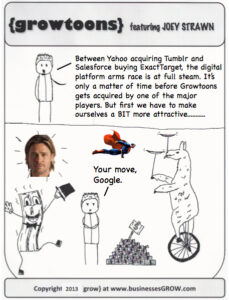
North by Northwest. A {growtoon}.
Mar 8th
Join the growtoonists each Friday for a humorous take on marketing, social media, and current business events.
Joey Strawn is a social media strategist who loves enjoying a good book and then drawing in it. Check him out on Twitter: @joey_strawn
Time, attention, and the content creation curve
Mar 7th
By Srinivas Rao, Contributing {grow} Columnist
If you’ve read any of my previous posts here on {grow}, you know that I view attention as a form of currency on the social web. In fact it’s the most valuable form of currency because it’s the start of every single relationship. However as the supply of attention decreases, the demand increases, and the mass attention myth becomes more prevalent, we need to give some thought to how we’re going to get people to spend their attention with us.
The Cost of Attention
“A link, a funny photo, a famous quote, or even a recipe or coupon are legitimate types of content, but these are not the types of content that will optimize your social media presence and bring you powerful, lasting results.” - Mark Schaefer
Interactions on the web occur across multiple channels and the amount of attention that people spend at each channel varies greatly. For the sake of this post, let’s use a rating system that assigns an attention cost (i.e. how much of their attention somebody spends with you). let’s take a journey together up the content creation curve:
Tweets/Status Updates
Attention Cost: 1
You’ll rarely hear anybody say “that status update changed my life.” As my friend Charlie Gilkey brilliantly pointed out, tweets and status updates don’t change lives, they interrupt them.
At best we might pique somebody’s curiosity with a status update. We might gain a new follower or fan. We’ll have their attention until the next shiny thing in the clickstream grabs their attention. The world of tweets and status updates is like a virtual flea market. People move from stall to stall spending tiny bits of their attention.
Blog Posts
Attention Cost: 3
A blog post is where your fans may linger but the attention is probably transient. A rule of thumb is that 80 percent of your visitors have never been to your blog and probably will never be there again.
Most people scan blog posts. But consistent blogging does create a valuable body of work that can lead to dedicated fans and a base of content that can establish a voice of authority. And blog posts can create conversations and engagement like no other content form.
Newsletters
Attention Cost: 3
Newsletters cost more of your attention because you made a choice to receive them. You gave somebody your email address. Access to your inbox is a bit like breaking out your wallet at the flea market and saying you’ll buy something small. Even Scott Stratten who is a self proclaimed social media “fanboy” once told me that “social is a terrible pull mechanism.” Don’t underestimate the power of email as a way to get people spending more of their attention with you.
Ebooks/Manifestos
Attention Costs 4
“Every major religion has a text. Your manifesto or free e-book is that for your blog.” – Jeff Goins
Marcus Sheridan is quickly becoming a guru of marketing through this form. He doesn’t sell ebooks. He gives away a 250 page bible on content marketing. It’s resulted in clients, speaking engagements, and much more. In his words “I’d rather land a $10,000 client or speaking gig than sell a ten dollar e-book.”
But the more important thing to observe is why this works. It requires a significant investment of somebody’s attention to read a 60 page manifesto or 250 page ebook. It gets them invested in your worldview. It also filters out the people who don’t resonate with your ideas. Here are a few other ebooks/manifestos that have catapulted people to prominence:
- Chris Guillebeau’s World Domination Manifesto has been downloaded over 100,000 times. Since publishing it, he’s gone on to publish two wildly successful books.
- AJ Leon wrote The Life and Times of a Remarkable Misfit. It’s been downloaded over 87,000 times since he published it just 5 months ago. The result is a fanatical fan base.
Podcasts/Videos
Attention Costs 5
95% of communication is non-verbal. When somebody hears your voice or sees your face you go from being words on a screen to being a real person. Consider the average time spent on most blogs. For me it’s roughly 2-3 minutes. Contrast that with somebody listening to a podcast for roughly an hour and it’s clear that it requires much more of their attention. It’s difficult to “scan” a podcast. As attention becomes scarcer and mobile devices become more prevalent, it’s no surprise that some of our greatest minds on the web are diversifying their content efforts.
Books
Attention Cost: 6
When we talk about how someone uses words to impact a tribe, what a manifesto or book book does is show that you’re serious. It makes a prolonged consistent argument. It demonstrates a point of view. It’s a whole river not a drop of water. – Seth Godin
Why are books so special? A book requires much more effort on the part of the creator and of the reader.
When you write a book it causes people to take you seriously. While there are plenty of people declaring the death of the publishing industry, getting a book deal with a mainstream publisher is still a huge credibility builder. There’s something about walking into a bookstore and seeing your book on the shelf that gives it a very special quality. Many authors will tell you their books don’t’ make money, but rather serve as a business card.
A book cements their authority on a subject. C.C. Chapman said when he asked an organization why they called him, they replied “because you wrote the book on the subject.”
The Relationship Between Attention and Effort
As you look down this list there is another important correlation. Each step on the attention ladder represents more commitment to attention, but also more effort on the part of the content creator.
- A blog post requires more effort than a status update
- An ebook/manifesto requires more effort than a blog post
- A traditional book requires more effort than both of the above
When I submitted this post to Mark the first time, he sent it back. He holds us to excruciatingly high standards. But it’s tough love because his high standards have resulted in some of my best work. That’s the trade-off — The more effort you give something, the more attention it gets. In Mark’s email to me he said something that could really summarize the entire the point of this post:
“The most important thing is to create something exceptional, even if it takes a little more time.”
Now, I’ll leave you with a question. Are you creating something that’s going to matter over the course of a lifetime? Are you willing to do the work?
Srinivas Rao writes about the things you should have learned in school, but never did and his the host-co founder of BlogcastFM. You can follow him on twitter @skooloflife
Do you have to cheat to be successful on the social web?
Mar 6th
I spent a great part of my career in B2B marketing positions and the part I loved most was traipsing around the factory floor. I loved watching things work and being with people who were actually “making stuff.”
There was one manufacturing manager I knew who seemed to be a wizard. The guy always led the pack and found a way to hit his production numbers no matter what was thrown at him. He seemed too good to be true.
That’s because he was. He was a cheat.
Turns out, he would invest to improve his plant’s productivity and then purposely understate the manufacturing capacity of his equipment. So he was always holding back — in essence, lying and cheating the company so he could “make his numbers” and get that big bonus check. Of course he was fired.
He moved on to another Fortune 100 company, did the same thing, and was fired again.
You see, it’s not just about making your numbers. HOW you make the numbers matters too.
It’s all about cheating
This has been one of those weeks when I get really disgusted about the questionable games people play in business. For example, there has been a significant debate about the number of well-known authors who allegedly hire specialized companies to buy bulk copies of their books to nudge them on to the New York Times bestseller list.
I understand why people do this. They cheat, bump themselves on to The New York Times list for a day, and then claim that badge of social proof for their career forever. But it’s kind of like calling yourself an “award-winning author” for that third-place trophy you received in high school for the Kiwanis Club essay contest. What did you really accomplish?
The publishing companies apparently approve of this because it moves books. Even the New York Times seems to condone cheating. This blows my mind. I mean, it’s the New York freaking Times, the most respected newspaper in America. And they’re allowing the editorial section of their paper to be gamed? The fact is, it is possible — maybe necessary — to buy your way on to this prestigious list.
An addiction to social proof
I’ve written extensively about this idea of “social proof.” An indicator like “New York Times bestseller” is a short-cut indicator of quality when we are overwhelmed in a decision process. But this is a two-edged sword. It is undoubtedly a powerful indicator of influence, but it is also increasingly meaningless because nearly every “badge” can be faked.
Today, anyone can manufacture their own image of personal power. In Return On Influence, I wrote about a colleague who admitted to me that his entire social media presence had been faked. He bought his massive Twitter audience. He had somebody ghost-writing his blogs. He made up his client list. And people bought into it.
Another person I know created their own social media award and presented it to themselves so they had something to display on their blog. Nearly every day I get requests from people to vote for them for some crazy, made-up award. What the heck does winning a “Shorty Award” mean? Are you really the “best” of something?
The sad reality is, what you do may be less important than how you appear on the Internet. In a social media world that barks “Authenticity! Authenticity!” … there is precious little of that, in reality.
There was a time I was too concerned with social proof. I didn’t cheat, but I spent too much time comparing my “numbers” with other people. It was driving the wrong behavior for me and my business because instead of just doing good work, I was thinking about doing work that increased these meaningless metrics. The social proof on my blog included badges about the awards I had won, Ad Age Power 150, etc. I took them all down about a year ago (which means I am not even following my own advice about the importance of social proof!), but it was the right decision for me because today I am concentrating on business metrics that make a difference.
Leaving success on the table?
I do wonder if the world will pass me by if I don’t cheat. Will I ever have a bestseller? Will my publishers even support me any more if I’m not willing to pay a third party to buy my own books? Is it more important to write a great book or have the financial resources to make it look like a great book?
Will my blog readers eventually be more attracted to bloggers who display their awards and badges like a a five-star general?
Will clients hire speakers for conferences and workshops based on the number of Twitter followers or Facebook Likes they manufacture?
Does it matter that I don’t make “best of” lists or win social media awards because I don’t lobby my friends for votes?
Despite the business realities of social proof, life is too short to compromise myself to make a book list or fake my way to stardom. I feel like I am in a shrinking minority, but I still believe the lesson I learned on the factory floor so many years ago — How you make the numbers is important too. Even if other people can’t tell what is real, I know what is real.
Thanks for reading my post today. I would love to hear your thoughts on cheating and social proof in the comment section!
5 reasons you should be in social media, even if the boss says “no”
Mar 5th
Boss driving you crazy? Having a hard time selling the idea that you need to be on the social web?
I know first-hand that there are still many naysayers out there who don’t understand why they need to have a social media presence. Here are five reasons that should convince even the last hold-out to get on board …
1. Social impact on search
What percent of your business starts with a search on Google? For many businesses it may be as high as 90 percent. And if any of your business comes through search or your website, then social media is inextricably linked to your future success.
One of the most important and significant changes the search engines have made to deliver meaningful and personal results is to incorporate social media results as part of the validation process for content. Social validation and “authorship” are guiding more search results. To be part of this, you need to be creating and igniting content. Establishing authority on the web through your social media content will dramatically help you improve your organization’s search rankings over time. And almost every business can benefit from that.
2. Facebook is the Internet
A common question I receive in my classes and workshops is, “What will be the next Facebook?” A point I try to make is that the emotional switching cost to moving away from Facebook is enormously high. That’s where you have all your friends, photos, videos, and family members. It’s where you have your Farmville farm for goodness sake!
I’ve made the argument that it might be easier to change your house than to change your social network.
Research from The Social Habit, a division of Edison Research, reveals that more than 80 percent Americans between the ages of 13 and 24 are on Facebook and more than half are active every day. There is no other brand in the world that boasts that kind of market penetration. To this demographic, who either are, or soon will be, your customers, Facebook IS the Internet.
And the popular social network is rapidly spreading across every demographic and every region of the world. It is the largest media entity in history.
One interesting and significant trend is that the amount of search on Facebook has been rising dramatically, and of course Facebook’s new search engine development will further serve this trend. Increasingly, Facebook will be the way people find and connect with goods, service, companies, and brands. It probably makes sense to stake your claim there, right? Who knows where the future will lead us?
3. Social proof
When we don’t know the truth, we look for clues from our external environment (like number or “badges” on a website) to help us make decisions.
In our information-dense world of the Internet, we’re starved for clues to help us determine leadership and authority and we readily turn to “badges of influence” like number of Twitter followers or even a Klout score as convenient indicators of power.
Perhaps the most prestigious symbol of social proof today is the Facebook “Like.” Among many companies, there is a Facebook arms race in progress as competing brands do anything necessary to gain the upper hand on this important metric. I recently wrote a post describing a company who has an internal marketing metric of “cost per like.” On the surface, this seems ludicrous but it demonstrates how strategically important this symbol has become.
This might seem a little “icky,” but it’s real. Don’t overlook social proof of authority as a legitimate reason to have an active social media presence.
4. The Trade Show Dilemma
Have you ever had to sit at a booth during a boring industry trade show?
I did, and I hated every minute of it. It was nice to network with people in the industry and maybe even chat with customers, but it was certainly not a very effective use of my time! Despite spending tens of thousands of dollars on this marketing event, we rarely sold anything, learned anything, or created any new value beyond handing out nice pens.
So why did we do it?
Because if we weren’t there, people would think something was wrong. We would be ostentatiously absent.
In this day and age, not being on Facebook or Twitter sends the same message. “Ajax Printing isn’t on Facebook? I guess they just don’t get it.” Even if you DO get it, it tells a story that you don’t get it. Having those social sharing buttons on your website is the new trade show. You better be there, even if it may not be the best use of your time.
5. Social media is the future of communications
The Net Generation – your next pool of employees, customers, and competitors – prefer to use text messaging and the social web over any other form of communication. It is the natural evolution of communications. You might enjoy reading a paper copy of The Wall Street Journal each morning, or even looking at an online version of your favorite news site. Nearly half of Americans under the age of 21 cites Facebook as their primary source of news.
The social web is where a generation is going to connect, learn, and discover. Ignore this at your peril!
So there you have it. If your CEO is still haggling with you because you can’t prove the ROI of social media (don’t get me started) show her this article and say, it’s not just about ROI … it’s about relevance!
I’d love to hear your comments about these observations. Fire away in the comment section!
Illustration courtesy Toothpaste for Dinner


You’re in marketing for one reason: Grow.
Grow your company, reputation, customers, impact, profits. Grow yourself. This is a community that will help. It will stretch your mind, connect you to fascinating people, and provide some fun along the way. I am so glad you’re here.
-Mark Schaefer