A plan to challenge the Facebook monopoly
Mar 17th
A very frequent question I am asked is “What will be the next Facebook?”
For many people, the logical assumption is that a better product will come along to replace Facebook because MySpace bumped AOL and Facebook bumped MySpace and so it is inevitable something will bump Facebook in the foreseeable future. That logic is incorrect and I will explain why. However I do think Facebook has a seam of vulnerability and could be trounced, and I will riff on that too.
But before we get to that, let’s first explore why Facebook is seemingly invincible, despite rumors to the contrary. Let’s look at Facebook’s obvious flaws … and why they don’t matter.
1) Somebody will build a better technology. But who cares?
What you must first understand is that technology did not make Facebook the biggest media entity in the history of the world.
Facebook is not a “technology.” Facebook is not a website. Facebook is a lifestyle. So you need to shatter your image that some technological tweak is going to unseat Facebook. Arguably Google Plus is a better mousetrap and it has not made a dent in Facebook’s growth.
To unseat Facebook you have to focus on creating a lifestyle alternative that is cooler than Facebook. Now, how hard is it to change somebody’s lifestyle, their daily habit? Just about impossible. It is easier for people to move to a new house and a new city than to move away from their social network. So the first idea is, this is not about technology.
2) Privacy violations will be their undoing. Wrong.
Many people are waiting for a backlash against Facebook because of their arrogant approach to privacy. My question is, “why hasn’t it already happened?” Facebook was found guilty of misconduct by a U.S. congressional investigation and even this did not mitigate Facebook’s growth.
Privacy in our culture is like a lobster being boiled in pot. If you drop it in a hot pot, the animal will try to get out. But if you drop it in a cold pot and turn up the temperature slowly, it will allow itself to be boiled without a fight. This is what is happening to us all now. Unless some privacy violation affects us monetarily in this moment, there will be no critical mass of unrest to unseat Facebook because of privacy concerns.
3) People need choice so alternatives will appear. Not.
Choice is desirable for most consumer goods. We enjoy having choice on the breakfast cereal or shampoo aisle of the shopping center but not so when it comes to social media platforms. We don’t have the bandwidth to desire two Twitters or an alternative to LinkedIn. We already have platforms in those spaces that work just fine. And the social networking space has also been fulfilled for most people and we don’t need another one.
In fact, day by day Facebook’s stranglehold on the social networking space grows tighter. As they scale, add new features, win new patents, and solve the complex problems of serving a billion people, they are creating further distance between themselves and any challenger. In general, people don’t want choice in this space, which is why the monopoly persists.
So where will the competition come from?
Let’s go back and see where this powerful emotional attachment to Facebook came from in the first place. How did it become a lifestyle?
It’s hard to imagine but not long ago, Facebook used to be a very exclusive club. It was only used on college campuses by college students. You had to have a college email address to even have access and if that went away, you went away too.
So it was this limited, exclusive connection, this college coolness that first ignited the Facebook fever. And that is exactly what could unseat them now.
Facebook is now a public company trying to be everything to everybody. They are gaining ubiquity across every demographic and every corner of the world. And as they are working hard to be the social media channel for everybody (and their shareholders), they are creating something supremely excellent for almost nobody.
The only way to unseat Facebook is to go back to the beginning and create a platform so exclusive and amazing that it will attract the “cool kids” and thought leaders in junior highs, high schools and college campuses. That is where a new network will be born and I believe that is the only way a new idea will “tip.”
The biggest complaint I hear is that Millenials don’t like Facebook because their parents and even grandparents are on it now. Perhaps the time is right to give the cool kids what they want. An exclusive place of their own, limited to their own group. And by the way, when you hit your 25th birthday, you get kicked out.
Here’s the game plan if you’re a willing entrepreneur:
- Create an interface that is bold, conversational, and truly user-centric.
- Commit to serving the 25 and under crowd exclusively.
- Spend every marketing dollar you can muster aligning yourself with the under 25 crowd and their culture, sports, music, and Hollywood idols. Be the definition of cool.
- Don’t become a public company. The moment you do, your focus is on serving shareholders and quarterly financial results instead of customers. Your cool would be doomed.
So that’s it. Your plan to unseat Facebook. Now, who’s ready to get started?
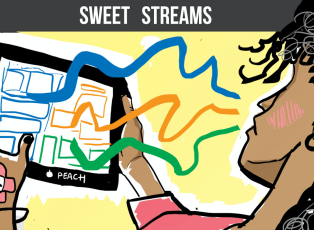
Social Media Excuses. A {growtoon}.
Mar 15th
Scroll down to see the rest of the story!

Join the growtoonists each Friday for a humorous take on marketing, social media, and current business events.
Kacy Maxwell is a guy who loves his work, family and a good challenge. See more of his cartoons at everything is media.
What’s next for Klout? Turning a “blunt object” into a useful tool?
Mar 14th
Click here if you can’t see this interview with Klout CEO Joe Fernandez.
Klout seems to be the little company that could. From a perilous journey to attract investment to its early PR controversies, it has sometimes been a hard company to love.
But with a more stable scoring process, a flurry of high-profile deals with companies like Microsoft and ESPN, and record revenues from some of America’s best-known brands, Klout seems to have turned a corner.
In this video interview, the company’s founder lets us sneak a peak at his company’s journey, the “tip of the iceberg” of data that we see, and a vision of turning a “blunt object” of the current scores into something that will ultimately become more interesting and useful to social media enthusiasts. Will Klout become the “Page Rank for people?”
“You’re Creeping Me Out!” The Dark Side of Social Networking
Mar 13th

By Kerry Gorgone, {grow} Contributing Columnist
Things are about to get personal.
Social media has made it easier than ever to connect: Facebook, Twitter, LinkedIn, Instagram and other services have greatly amplified everyone’s personal brand message. This is fun, and beneficial inasmuch as we can get a sense of someone’s professionalism, character, and personality before we ever meet them in person.
Recently, though, I’ve had some less than pleasant experiences with people who seem to be interested in professional networking, but ultimately just wanted to use me to sidle up to someone else I know. Here are some tips from me and some of my social media friends on how to connect with people (as opposed to using them):
Don’t be creepy. If we’ve had a professional phone call, don’t use my number later for personal reasons. Texting me at 10 p.m. to ask “what’s up” is going to make me uncomfortable. My significant other won’t appreciate it, either.
If I accept your friend request on Facebook, don’t message me telling me I forgot to post to your wall for your birthday, as though I should have remembered. My mother didn’t call me on my birthday. Get over it.
Don’t come on too strong. I appreciate when people are helpful, and offer to share my posts or promote my upcoming appearances. This kind of professional support should show that you value my work and share my passions. Unless we’ve met in person, however, please don’t ask for my home address and, say, mail me gifts. That’s a little too personal.
You don’t owe me anything, and sending unsolicited gifts to me or my kids makes me feel as though you want me in your debt for some reason. Maybe this is unfair, but the fact is, it creeps me out, and I’m probably not the only one. Social gifting via Facebook and other networks has started to change public perception. A small token of appreciation given via Facebook is probably fine, since it won’t require that you know my home address or other vital information, but don’t go overboard.
Let things unfold naturally. That’s the only way a genuine, lasting relationship can begin.
Don’t ask for favors immediately. Nothing says “I’m using you” like friending me, then immediately asking how you should go about getting my close friend, Mr. New Media Celeb, to endorse your forthcoming project. Immediately, I will realize that you only wanted to step over me. That’s not a pleasant feeling, and will actually undermine your ultimate goal of “getting in” with my close friend, who is sure to value my opinion about pitches from “mutual connections.”
Consider how well you know someone before asking for any favors at all. As travel blogger and social media consultant Ann Tran observes, “I’m not automatically your friend when you need your book promoted or reviewed. ”Controlling the influx of pitches is a challenge when you have 300,000 followers on Twitter, as Ann does (@AnnTran_), but she remains open to connecting with people in a genuine way. “Social Media is all about collaborating and cultivating relationships, just like you would in any real-life situation.”
Don’t overstate our relationship. Please don’t send my high-profile friend a request to connect, indicating that you and I are good friends. We aren’t. Calvin Lee, designer, Twitter personality (@MayhemStudios), and Klout phenomenon, has more than 80,000 followers on Twitter, and has some experience with people overstepping boundaries. “They try to friend you online and IRL, talking you up like you’re the best friends in the world. They try getting on your good side by commenting, liking, sharing, or retweeting your posts and updates on all your social networks. “They’ll also friend everyone in your circle of friends on your social networks, adding as many as possible, then try to be their best friend. The next thing you know, this person will have snaked and faked their way into your network.”
I agree with Calvin that frantically friending my friends is a no-no. It’s fine to say that you know me, if that’s the case, and ideally to explain how. For instance, “I met Kerry at the NASA Social in D.C. last week and she had some great things to say about you. I’d love to connect, if you’ve a mind to.” This gives an accurate representation of our connection, and my friend can decide whether or not they want to accept your request based on what they know about you, rather than thinking I’m “vouching” for you without having been asked.
An emoticon is just an emoticon.
Don’t assume that someone you know on Twitter wants to take the relationship offline just because he or she engages with you or your posts. Actress Casey McKinnon recommends maintaining appropriate boundaries when connecting with the opposite sex on social networks. “The best way not to be creepy online is to treat every female on the internet like she’s your sister… unless you’re into incest, then you should just stay off the web altogether.” So before you send that friend request or ask for a “shout out,” think about how you’d feel if the tables were turned. If you’d be creeped out or annoyed, chances are I will be too.
Kerry O’Shea Gorgone, JD/MBA, teaches New Media Marketing in the Internet Marketing Master of Science Program at Full Sail University in Winter Park Florida. Follow her on Twitter: KerryGorgone


You’re in marketing for one reason: Grow.
Grow your company, reputation, customers, impact, profits. Grow yourself. This is a community that will help. It will stretch your mind, connect you to fascinating people, and provide some fun along the way. I am so glad you’re here.
-Mark Schaefer