Facebook: The Happiest Place on Earth?
Feb 10th
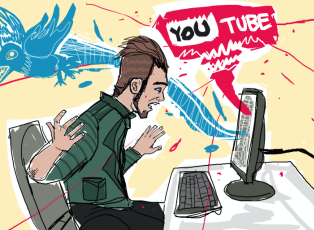
OK, OK, so I read this report this week that a guy up the road from me killed his neighbor because his daughter was un-friended on Facebook. And then this story is buzzing around about the guy who shot his daughter’s computer and posted it on YouTube because she whined about doing her chores in a status update. Sure … there is just a little bit of anger that can show up on the interwebs!
But despite this weirdness and angst, the data would suggest that people who frequent social networks are a pretty happy bunch. I recently had a post that showed the emotional boost from Facebook was similar to something you would get by being married!
Now, a new study from Pew Research shows that the overall social and emotional climate of social networking sites (SNS) is a very positive. Adult users get personal rewards and satisfactions at far higher levels than when they encounter anti-social people or have ill consequences from their encounters. A nationally representative phone survey of American adults finds that:
- 85% of SNS-using adults say that their experience on the sites is that people are mostly kind, compared with 5% who say people they observe on the sites are mostly unkind and another 5% who say their answer depends on the situation.
- 68% of SNS users said they had an experience that made them feel good about themselves.
- 61% had experiences that made them feel closer to another person. (Many said they had both experiences.)
- 39% of SNS-using adults say they frequently see acts of generosity by other SNS users and another 36% say they sometimes see others behaving generously and helpfully. By comparison, 18% of SNS-using adults say they see helpful behavior “only once in a while” and 5% say they never see generosity exhibited by others on social networking sites.
At the same time, notable proportions of SNS users do witness bad behavior on those sites and nearly a third have experienced some negative outcomes from their experiences on social networking sites. Some 49% of SNS-using adults said they have seen mean or cruel behavior displayed by others at least occasionally.
Does this match your experience? Do you “get your happy on” when you go to Facebook?
Frankenstrategy. A {growtoon}.
Feb 10th
Join the growtoonists each Friday for a humorous take on marketing, social media, and current business events.
Joey Strawn is a social media strategist that loves enjoying a good book and then drawing in it. Check him out on Twitter: @joey_strawn
Is social media contributing to political paralysis?
Feb 9th
I’m a student of history … probably half the books I read are biographies or something to do with a past era. So today I’d like you to oblige me while I connect the dots between the social media revolution and what appears to be increasing political paralysis in the U.S., India, Greece, and other nations.
My impression is that political leaders of past decades were no less competitive, egotistical, or power-hungry than the politicians of today. They were probably less demographically-diverse, less educated, and less in tune with constituents because of the lag time in communications before the Internet.
It’s hard to compare apples to apples, but for the sake of argument, let’s assume that there has indeed been a shift, and politicians today are less able to find compromise that helps keep a country moving in the right direction. How might we explain the change?
Could there be a paralyzing effect of social media?
Last year I had a fascinating discussion with a bright young man who devised a way to compare the political sentiment on the social web in Iceland with the public positions taken by his country’s politicians. He could then match the data to see which politicians had positions that most closely compared to the sentiment of the nation.
Once the politicians found out about this, they started stopping by his office frequently to compare scores … and change positions if necessary. Today of course, this is possible to do on a minute-by-minute basis.
There is a certain beauty in this. Politicians in a democracy are supposed to be representing the will of the people. Isn’t this real-time feedback exactly what they need?
But I wonder about the possible advantage in a political process 50 years ago when politicians had to use their best judgment instead of real-time “polling” to make a decision. I can imagine leaders in the 1950s locking themselves behind a door and pounding out a compromise without the shifting sands of social media sentiment to contend with.
Wouldn’t it be easier to keep their focus on an issue instead of jockeying for position on Twitter every day?
Wouldn’t it be easier to take an unpopular position (like cutting entitlement programs to balance a budget) if you only had to deal with the outfall every four years instead of every day?
So I could see both sides of this argument, but the one thing we do know is that the social web is not going to go away.
What do you think? In the long-term, will the constant “polling” of social media sentiment analysis contribute to debilitating political paralysis or more enlightened political accountability?
The evolution of a blogger
Feb 8th
By Srinivas Rao, Contributing {grow} Columnist
As I’ve observed bloggers from all walks of life, writing about every subject imaginable, and as I’ve taken the journey myself, I’ve found that there is an evolution that takes place. In each phase of the evolution we develop essential skills, but without the courage to stay the course and go through all the phases of the evolution, we’re unlikely to unleash the creative genius within all of us. While it’s tempting to see ourselves as marketers, what we’re really doing is creating art. Through our digital footprints we’re attempting to create our personal masterpieces and leave a mark on humanity.
The Novice
As a novice you look to experts, mentors, and those who have come before you for advice. You follow that advice, almost to the letter and it actually works. You also bring to your work a naiveté and a much needed fresh perspective that comes with a lack of experience.
The Mechanic
As a mechanic you’ve mastered the basics. You can do things with a certain precision and you’re sold on the notion that repetition is the mother of skill. So, rinse, wash and repeat is the formula you follow. And this formula works to a certain degree, until you realize that being a mechanic isn’t particularly unique and you’re just part of the echo chamber. The response to your work is either lukewarm or positive. It’s not long before the formula that allowed you to make the transition from novice to mechanic stops working and you’re forced to evolve into the next phase.
The Artist
As an artist you start to find a voice. You stop looking to the mentors, experts and people who came before you. You realize that to be seen as an artist you must become one of those people. You realize that following formulas and prescriptions designed to create a similar result for every person who uses them is a recipe for mediocrity. The linear process which you have followed to the letter falls apart and you finally come to terms with the fact that creativity is not a linear process. You take bigger risks with your content and the response is polarizing. People either love you or they hate you.
The Entrepreneur
The entrepreneurial evolution takes place when you realize that simply being an artist isn’t going to pay the bills or turn your blog into a business. Everything that came before was necessary to get to this point, and now you embrace experimentation because it’s at the core of growth. You detach from outcomes, focus on process and let the chips fall where they may. You find it inside yourself to watch everything fall apart, pick up the pieces and start all over again, now as, part novice, part-mechanic, part-artist, all of which combined turn you into an entrepreneur.
So, now I have a question for you? Which one are you and what are you going to do to make it to the next phase in your evolution?
Srinivas Rao writes about the things you should have learned in school, but never did and his the host-co founder of BlogcastFM. You can follow him on twitter @skooloflife


You’re in marketing for one reason: Grow.
Grow your company, reputation, customers, impact, profits. Grow yourself. This is a community that will help. It will stretch your mind, connect you to fascinating people, and provide some fun along the way. I am so glad you’re here.
-Mark Schaefer