How do you develop a strategy when the target keeps moving?
Apr 28th
I was watching a basketball game between a bunch of 8-year-olds the other day. The “red” team was winning 18-0, an insurmountable lead at that age. The “blue” team was exhausted and disheartened from the pummeling.
But within a heartbeat, blue’s luck changed. A speedy player intercepted a pass and steamed down the court, for a wide open lay-up.
The crowd held its breath as the young player effortlessly flipped the ball up and into the hoop. Of the wrong basket.
The crowd gasped. Tears welled up in the stunned player’s eyes as he realized his team’s humiliation was complete. He had scored a basket for the other team.
This sad little episode seems an apt analogy for one of the costliest mistakes you can make in a business: Having brilliant execution against the wrong goal.
When I first started out in business, my company actually required us to create five-year plans. That seemed like a difficult exercise back then and today that is simply impossible. And yet, it is easy to get locked into annual goals and work beautifully against them, never realizing they’re already out of date.
Business today is not like a basketball player trying to shoot at the right goal. It’s like a basketball player shooting at a goal that is moving.
I think this problem is especially acute for small companies and start-ups. I once had an entrepreneur tell me that the nature of his company changed every three months. It’s true. Simply adding a new employee or a new customer can radically alter the direction of the company. The nature of my work has changed dramatically in the past 12 months.
If you are still heads-down, working like crazy without taking the time to assess the world around you, you might be making a deadly business mistake. Here are five questions to reflect on:
- How am I spending my time today compared to a year ago? If there is a dramatic change, why? Is this a sign that the market is changing or have I lost focus on what makes me profitable?
- What is the biggest internal threat to my business? Is it resources? Keeping up with change? A lack of focus? Turnover?
- What is the biggest external threat to my business? New competitors? New expectations? Problems with the economy?
- How have my competitors changed? Do I even know who my competitors are right now?
- What are my customer’s under-served or un-met wants and needs? Do I think I know, or have I really asked them?
Spending just a little time reflecting on these questions could save you months of heartache down the road. What do you think? How are you coping with the constantly moving target of your business?
This post was written as part of the IBM for Midsize Business program, which provides midsize businesses with the tools, expertise and solutions they need to become engines of a smarter planet. I’ve been compensated to contribute to this program, but the opinions expressed in this post are my own and don’t necessarily represent IBM’s positions, strategies or opinions.
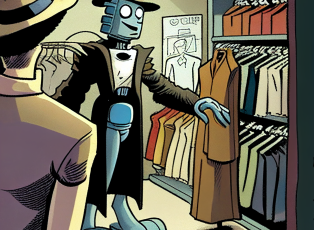
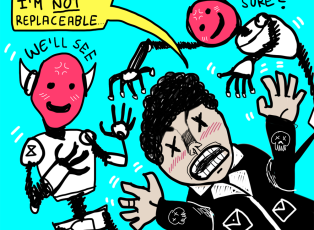
Tree S(app). A {growtoon}.
Apr 26th
Join the growtoonists each Friday for a humorous take on marketing, social media, and current business events.
Joey Strawn is a social media strategist who loves enjoying a good book and then drawing in it. Check him out on Twitter: @joey_strawn
Five reasons Europeans are behind in social media marketing
Apr 25th
By Mars Dorian, {grow} Contributing Columnist
I’ve noticed something strange here in Europe that I couldn’t wrap my head around. At first.
Whether you look at the number of online job postings, the best viral marketing campaigns, or the world’s most respected social media marketing thought leaders, almost all of the innovation seems to come from the US of A.
There are exceptions of course, There always are. But why is it that a modern society like Western Europe — which has similar or better access to technology and creative minds, lacks so much in the social media innovation game ?
So I asked few professionals in the field, and I’ve found a couple of conjectures that may surprise you.
Disclaimer: Of course, I cannot speak for all of Europe, but as a German living in the thriving European start-up city Berlin, and knowing many tech friends from Madrid, London and Paris, I have a pretty good overview of what’s lacking in (Western) Europe, and more important, what YOU can learn from it!

Let’s find out what’s going on here.
1) Clinging to the past
Gosh, people are obsessed with the past over here. Western Europe is at least 2-3 years behind the US in terms of technological adaptation. And that’s seeing it positively, with glowing rainbow glasses on. Blink blink.
Example: eBook sales in 2012 the US were 22.5% of the overall market, yet only 5% in Europe. From personal experience, that comes with no surprise. When I look around in the subways, I see more people reading deadwood books that eReaders.
But it’s not just eReaders. Smartphones, tablets, heck, any kind of new technological device arrives with years of delay in social acceptance. The minute it’s “old” for Americans, it’s “new” to Europeans.
Lesson: No matter how alluring the past may seem, you can’t cling to it. Content consumption moved from desktop to mobile, who knows where it will move to in the future ? You need to adapt to stay relevant.
2) General disinterest in (new) online networks
The fuel of any social media marketing campaigns are social media platforms.
We need a variety of networks to share our message to make it spread. Americans crave new networks and ideas : yester-yesteryear’s Foursquare becomes yesteryear’s Pinterest becomes this year’s (insert upcoming hit-startup here).
Most of my European friends, even the tech-savvy ones, primarily use Facebook. Seriously.
Twitter? Why would anyone be interested in me taking a crap and tweeting about it?
Google+? Is that a professional Google account?
LinkedIn? Is that some kind of link-building service?
It gets worse. When I visited my mother teaching graphic design at her Uni, and asked her students whether they had a blog or social media presence … no one said “yes.”
But three asked: “What’s a blog?”
Welcome to Europe’s future.
Lesson: in order to spread your content online, you need to try a variety of different online platforms to access your ideal target audience. If it’s just one platform you use (and know about), you’re shooting yourself in the social media foot.
3) Lack of relevant education, lack of thought leaders.
Compared to the US, we have no culture of conferences, other than Loïc Le Meur’s LeWeb event … but even this French guy decided to settle in the U.S.
And with this lack of industry events, this lack of critical networking and conversations, the knowledge doesn’t meld into public mind.
Thought leaders and ruckus makers like Gary Vaynerchuk, Seth Godin and Tim Ferriss change the status quo with their ideas and shine a light on what’s possible now.
Since they’re all American, Europeans seem quick to dismiss their ideas, claiming that what they say will only work in America. Europe lacks role models and mavericks that inspire equally.
Lesson: If you want to level up the innovation in your market and area, you have immerse yourself and become educated. Be it through your blog, network or physical conferences, find a way to bring your knowledge and thought-leading ideas to the public mind.
4) Fractured markets.
Jonah Lehrer wrote in his book ”Imagine: How Creativity Works“ that innovation happens in densely populated areas — our cities — because creatives bump more into each other and exchange their ideas. That’s why Silicon Valley is America’s hotbed for major online innovation. With so many digital creatives in one tight spot, the constant exchange of new ideas is inevitable. When an idea catches fire across the Valley, it can easily spread around the nation. Whooosh.
Unfortunately, there’s no comparative hotspot in Europe. We have great start-up cities like London, Madrid, Paris, and Berlin, but these are cities that are cultures and countries apart. An app or social media campaign therefore tends to spread only across its culture, especially considering language barriers. French online media doesn’t invade German consciousness, and vice versa.
Lesson: Working remotely from creative hubs is a bad way to innovate. If you want to create more fresh and relevant social media content, you have to be closer to the source.
5) Fear of the future.
It’s no coincidence that in Germany, venture capital is called Risikokapital (“risk capital”).
Throughout Europe, if there’s an unusual idea for a social marketing campaign, people shoot it down first and ask questions later. If it’s unprecedented, it’s viewed as dangerous. Better safe than sorry.
The common mindset seems to be: Let’s see what those crazy Americans are doing, and if it works, maybe we’ll copy it.
M-a-y-b-e.
Hence all the Europe-based copycats of successful American marketing campaigns and online businesses. Obviously, you don’t innovate with that kind of mindset.
You just cope.
Lesson: If you spend your time coping with things, you will never thrive. It’s a requirement to fail with some ideas so you know what works in the future.
Conclusion
The overarching reason Europe is behind has nothing to do with money or resources. It’s more about mindset.
Most of the lack of creativity in the European online space stems from fear – Clinging to past technologies, fear of the future, fear of failing. At least that’s what I found in my interviews and observations.
What do you think?
Mars Dorian describes himself as a creative marketeer with a moon-melting passion for human potential and technology. You can follow his adventures at www.marsdorian.com/
Original illustrations by the author.
Trash talk: 5 business lessons from a 10-year-old entrepreneur
Apr 24th
By Ryan Hanley, {grow} Community Member
In my small hometown, Thursday was recycling day. Every Wednesday night the town folk would collect all their bottles and cans and walk them out to curb in a blue recycling bin to be picked up the next morning. Dirty and cracked by years of abuse from weather and indifferent garbage collectors, the blue bins were nothing more than an eyesore in our quaint town.
Yet to me, a 10-year-old boy of humble beginnings, those blue bins represented opportunity!

My town was 30 minutes from the nearest grocery store and most people were too lazy to make that long drive to return their bottles and cans for the five cent deposit. That’s were I come in.
Our brains work differently as a child. We don’t consider what other people think. We know what we like and the majority of our day is spent thinking of ways to get it — without regard to outside judgement, criticism, or questioning.
In my child brain every single bottle and every can was a little piece of opportunity. Opportunity to NOT be the poor kid in the neighborhood. We forget as adults that opportunities are made of our own doing, they’re never given … and at 10 years old, living in a small town in Upstate New York, a couple extra dollars in my pocket meant LOTS of opportunity.
Trash talk
So every Thursday I’d wake up at 4:30 in the morning, get bundled up, and head out with a pocket full of garbage bags to collect that valuable trash.
I saw myself as industrious and entrepreneurial, however, the disapproving looks I received through the blinds of my neighbors windows told a different story. I didn’t care. I saw opportunity at the bottom of every dirty, sticky, broken blue plastic bin.
As the weeks passed I began to see patterns. I knew who the drinkers were, I knew who put the most cans and bottles in the containers. This made my stop at a particular house more efficient. I started to ride my bike through the neighborhoods during the day and plot out my course so I could cover more ground and optimize profits.
On a good day I was collecting three to four garbage bags full of bottles. Dragging the full plastic bags behind took too much time, so I paid a friend a dollar for his old toy wagon and my collection numbers went even higher through this supply chain innovation. At the height of my bottle collecting career I was making 20 dollars a week, averaging 400 bottles on a single collection run.
A business is born … and lost
These days, a 10-year-old with 20 dollars in their pocket isn’t that impressive, but in 1991, I felt rich. Do you think my friends made fun of my career in garbage when I was buying them all bubble gum and baseball cards? Heck no.
A couple of them even offered to go into business with me so I franchised my bottle collection routes into a couple promising neighborhoods that I didn’t have time to reach on my own. I had started my first business.
After eight months of fat pockets and escalating revenues, my neighbors began to catch on to what I was doing. Whether from their own greed or disapproval in my line of work, the bottles started to dry up. Blue bins in front of houses I used to bank on for large stashes of bottles began to turn up empty … and just like that my first career was coming to an end.
To make matters worse, I had my first competition. An adult in town figured out my game and began collecting bottles himself. He had a car. I was scorched by superior technology.
It was time to find an adjacent market.
I had bought so many baseball cards with my bottle earnings that I was now hustling them back to friends and schoolmates for a profit. My second business was born!
Five fantastic lessons
Here are five entrepreneurial lessons you can learn from my 10-year-old self:
- Stay focused on the opportunity. If I had been self-conscious and allowed the public perception of a kid walking cold streets collecting garbage dissuade me from the opportunity, how many future opportunities would I have missed out on?
- Don’t buy into this “You only get one opportunity” nonsense. You get as many opportunities as you make for yourself. Opportunities are made, not given.
- Every opportunity isn’t sexy or popular, but success has a way of washing clean the dirt of humble beginnings.
- Don’t romanticize opportunity. In my case, opportunity was waiting at the bottom of a dirty blue recycling bin. I just had to reach down inside and take it.
- Know when to hold ‘em. Know when to fold ‘em. I couldn’t beat out an adult in the car but my second business was creatred from that disruption.
So that’s my story. Where is the strangest place you’ve found opportunity? Have you ever NOT taken on an opportunity because of what people would think?
Ryan Hanley is the Director of Marketing for the Murray Group Insurance Services, Inc. You can connect with Ryan on Google+ or visit his blog Content Warfare.


You’re in marketing for one reason: Grow.
Grow your company, reputation, customers, impact, profits. Grow yourself. This is a community that will help. It will stretch your mind, connect you to fascinating people, and provide some fun along the way. I am so glad you’re here.
-Mark Schaefer