
Marketing, Journalism, and Truth as Competitive Advantage
Nov 27th
I had a very interesting question come across my desk from {grow} community member John Bethune:
In the minds of most people, journalism and marketing were once diametrically opposed. Has that changed in the social media era?
A great question! And, in fact, I think the social web has brought these disciplines together in a number of surprising ways.
The ideal of journalism is a quest for truth. Marketing is the quest for a product’s “truth.” By that I mean the best marketers are on a journey to know how their company’s goods and services exist in the hearts and minds of their customers. Then, their job is to express that consumer truth to the best of their ability. So in this way, the disciplines are unexpectedly similar, although the end product is quite different!
But the social web has created an important shift for both disciplines. What does it even mean to be a journalist today? Through blogging and technology like smartphone video cameras, journalism has been democratized. Anybody can report, anybody can publish. Jeff Jarvis of City University of New York recently defined a reporter today as simply somebody who can say, “I was there and you weren’t.”
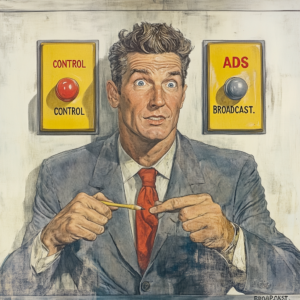
The democratization of marketing
To a great extent, marketing has been democratized, too. Remember last year when Gap changed their logo and there was such an outcry? I felt empathy for the company because they are probably good marketers who followed a traditional protocol — work with graphic designers, test it, get feedback, and roll. That system has worked for decades and changing a logo is not an easy or flippant decision for a consumer product company to make. I’m sure they had done their homework … or at least they thought so.
But a few vocal people thought the new logo was stupid (perhaps people who were not even customers!). Through Twitter and Facebook, they created an anti-logo movement. and suddenly it became an embarrassing meme. I can imagine the Gap marketers waking up to this one morning and thinking “Wait … what?”
So something as important as an adjustment to your brand image may not even be in the hands of marketers any more. The Gap’s marketing strategy had essentially been crowd-sourced! Like journalism it seems, marketing has also been democratized.
Content as power
The production of content has also been an output of the marketing process, usually in the form of advertisements. But now content is at the very centerpiece of many strategies as companies fight to attract attention on the crowded social web. The journalism schools are full of new applicants. Why? Because content is big business now and the new media channels have an insatiable need for it. Companies need story-tellers as much as marketing graduates.
I have recently been working with the president of one of my B2B customers on a blog and a series of how-to videos to demonstrate their new robotic technologies. I’ll bet five years ago he never would have dreamed he would be in the publishing business!
So this idea of content and storytelling is another way that journalism and marketing have been brought together. For both fields, content that moves virally through the social web represents success and power.
Truth as a strategy
I think expectations of “truth” and transparency is another way the social web have brought journalism and marketing together. For a brand to have integrity and to be successful, it can’t be spinning the truth around any more. There are a million watch dogs out there now and any one of them can sniff out a fake.
A few weeks ago, I was working with some marketers for a hotel chain and we were discussing negative hotel reviews. “We don’t mind them,” they told me. “It makes us more real.”
Interesting. Truth as a marketing strategy.
My hunch is that a few years ago, that is not necessarily what their reaction would have been. In marketing, truth is the new black.
Maybe journalism and marketing are getting closer than we thought? What do you think?
Note: John Bethune’s full interview with me can be found here: “Content is Power: A Q&A with Mark W. Schaefer.”
Has BP learned NOTHING about PR and communications?
Sep 27th
I saw some beautiful ads on TV promoting tourism for the U.S. Gulf Coast. But after the heart strings were sufficiently plucked, who is identified as the sponsor? BP — the company that caused the mess in the first place! This really pissed me off.
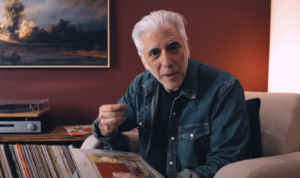
Luckily I was in Memphis at the time and had the chance to have PR Expert Amy Howell calm me down, as you will see in this short video discussion.
Did BP do the right thing with these ads? What were the alternatives? Am I right to be venting over this?
I think you’ll enjoy the conversation and hope you’ll add your views on the subject in the comment section! Thanks!
P.S. You know what else pisses me off? If you “Google” BP tourism ads, all you get is BP PR fluffy stuff. They have their SEO machine working overtime, don’t they?
P.P.S. Grrrrr.
Twitter amid true chaos
Sep 11th
September 11, 2001. That was a day many of us experienced a single emotion for the first time — horror. Not the movie kind. True, real-life, gut-wrenching, nauseating horror. I will never forget it.
And as I watched the tenth anniversary news coverage, I had this weird thought.
I’m so glad we didn’t have Twitter back then.
“Nine eleven” was a day of complete chaos. Planes were falling out of the sky. We didn’t know what was happening or why. And maybe most profound, we didn’t know what was going to happen next. Agents of terror had seemingly used the nation’s infrastructure at will to kill thousands of innocent people on our own soil.
What would be the next target? The water supply? A nuclear power plant? The air that we breathe? You’ll recall that within the week there was an anthrax letter attack on the nation’s capital too. Did we need to lock ourselves up in our homes? Prepare for a nuclear or biological attack?
Can you imagine having Twitter on top of that confustion? What would Twitter be like in the midst of terror and chaos? Although there might be ways that Twitter connections can help in an emergency and maybe even save lives, certainly, when applied to the scale of the 2001 attack, it would also magnify the terror.
When every confused eye witness with a cell phone becomes a reporter and the most ridiculous innuendo can become a viral “fact” today, I shudder to think how much more emotional and psychological damage could have been done had we been following a Twitter stream that day. How would terrorists use social media to spread misinformation to make the situation even more dangerous? It would have been another layer of chaos on top of chaos, horror on top of horror.
Instead, we had to rely on “traditional” media. And for all its faults, there was probably some psychological and emotional advantage in waiting for official statements from emergency services and the government.
Think back to that terrible moment. Would social media accounts of that day have made the situation any better? Or like me, do you think it would have just added to your fear and confusion? Any lessons or thoughts on this?
Photo: AP Photo/Suzanne Plunkett


You’re in marketing for one reason: Grow.
Grow your company, reputation, customers, impact, profits. Grow yourself. This is a community that will help. It will stretch your mind, connect you to fascinating people, and provide some fun along the way. I am so glad you’re here.
-Mark Schaefer