
Twitter best practices
Your company’s single biggest mistake on Twitter
Jan 17th
Let’s start this post with a little quiz. I’ve assembled a few Twitter avatars from my Twitter stream. Take a look at the line-up and think about which company you would most likely follow and relate to …
I’ve used this example in many of my classes and the answer is usually unanimous — Megan Parker at GE. It’s disarming isn’t it? A massive multi-national B2B company represented by the welcoming and smiling face of Megan. But I think that’s just what makes this a best practice.
Your company is not choosing just a picture. You’re choosing a voice for the account, a personality, a strategy!
If you’re like me, it’s extremely difficult to connect to a logo. I think it puts a company at an immediate disadvantage. Now I’m making a big assumption here — that your company WANTS to connect. If all you want to do is broadcast press releases, than go ahead and “go logo.” But if you want to create some authentic connection with your audience, I strongly recommend you put a face on the account.
Handling multiple stores/accounts
Here’s an example of how this can work to create brand loyalty, even on a local basis.
A regional manager for Chik-fil-a (a large U.S. restaurant chain) told me she was setting up individual Twitter accounts for her restaurants. She was thinking of putting pictures of the store front as the avatars. Umm … “No,” I said. How about the iconographic cows used in the restaurant ads? No again. Why not feature the store managers who are actually doing the tweeting? Wouldn’t it be cool to establish a Twitter relationship with a real person and then get to say hi to them when you visit? Wouldn’t this build a connection and loyalty? This seems like such a basic concept but it’s ignored by almost every company. Just puzzles me.
Tweets in transition
A logical next question is, what happens when your Twitter face-to-the-world leaves?
I think this is best answered through a comment from Bert DuMars, Vice President E-Business & Interactive Marketing at Newell Rubbermaid. A few months ago, I wrote a post about Twitter branding, wondering what would happen when popular Susan Wassel, the wonderfully-entertaining Sharpie Susan on Twitter got a new job? Here’s how Bert answered this:
“The ID @sharpiesusan is owned by Newell Rubbermaid and the Office Products Division. If Susan were ever to leave Newell Rubbermaid, we would keep that ID and she would be free to re-establish herself on Twitter or any other social network as herself.”
This is happening before our eyes at GE. Yes … Megan has a new job! To my horror, she was replaced on Twitter by:
Sean Gannon GE’s managing editor for digital media explained how they are handling the transition: “Megan is on another team, so we are now ‘tag-teaming’ our Twitter account. On any given day, it may be a different person tweeting. Rather that give the illusion that it’s one person, we went back to a logo until we hand over the Twitter keys to just one person.”
(sigh of relief)
Let’s look at personalization under one more scenario. A company such as Coca-Cola may choose to have one main corporate (and they do). Certainly they’ve earned that right because as one of the world’s great brands, people are interested in their tweets even if it is merely a broadcast of press releases. One way to personalize is to add the initial of the Tweeter at the end like this:
Whether you’re a person or mega-brand, let’s move away from trying to create a personal connection with a picture of an office building or a truck. It’s time to get personal.
Do you agree?
Is it OK to fake your tweets?
Jan 11th

The other day a prominent Twitter celebrity was kind enough to re-tweet one of my blog posts. It was not Kim Kardashian. At least that time. Any way, because of his power and influence, my link was promptly re-tweeted by 12 of his followers. Wow, that’s influence right?
Only problem is, in that period of time, my server was down. None of them could have possibly read my blog post.
Welcome to the world of fake tweeting.
How often does this happen?
I’m guessing more than we could possibly realize. How many people are either tweeting without reading … or not even tweeting themselves at all?
Tweeting — The Industry
I recently was asked by a well-known business professional to help them get started on Twitter. The person had been flailing about and frustrated, simply broadcasting news about their business and products. It was mind-numbing.
After a couple of hours of training and re-setting her social media mindset, her tweets were transformed and the engagement was much more successful. Then suddenly the whole thing flopped again. She went back to broadcasting mindless self-serving tweets. I scolded the person and asked what happened. “Oh I went on vacation and turned my tweeting over to the ad agency.”
This is happening everywhere. Fake tweeting for people has become a cottage industry. I think it’s safe to say that a high percentage of tweets are disconnected from real people, broadcasting links that were never read and are little more than the results of automated programs.
Again, it’s impossible to have data on this, but based on my experience, I think the problem is also growing exponentially.
And maybe I contribute to the issue, too. I do “blind tweet” under one circumstance: If somebody I know well and trust completely asks me to tweet a link as a favor, the link is time-sensitive, and I simply don’t have time to read it first. So yes, in a way, I’m part of the problem.
Does anybody care?
Or is it a problem at all? Isn’t there a place on Twitter for everybody? Who made the “rules” any way?
Don’t you always have the option to un-follow people who are obviously not engaging as themselves? Are we simply being close-minded and elitist by claiming that Twitter is all about “the conversation” and “authenticity?” Do you tweet without reading? Fake your tweets?
I have my own views, but I’d like to hear your take on it. The comment section is yours …
Oh, and if you’d like to read about my stormy relationship with Kim Kardashian, click for the scoop! : )
Social scoring and the business case for blocking Twitter spammers
Dec 27th
Judging by her school-issue personal photo, Twana Florance appears to be a mild-mannered, middle-aged matron from Twin Falls, Idaho. But there is no Twana Florance. Twana is probably some teenager in a Third World country hired to propagate and populate fake Twitter accounts that will later be sold on eBay.
Twitter has done a good job clearing out most of the porn stars and MLM hacks who almost brought the service to its knees by mid-2009. But the new breed of spammer is hiding behind a tender smile like Twana.
For the time being, it’s the stupid tweets that give it away but the spammers will probably get around that soon too. What does it hurt? What does it matter if spammers trick you into following them? Believe it or not, blocking spammers like “Twana” might actually lead to important business benefits in the future. Here’s why.
Social influence and spam
A few months ago my friend Steve Dodd made an interesting observation. Chris Brogan, one of the top five social media bloggers in the world who currently carries enough Twitter followers to form a small nation, tweeted out about a specific issue … and I did too. Steve — who has a great analytical mind — noticed that my message, sent out at the same time, was re-tweeted about the same number of times as Chris. However, the number of RT’s compared to my number of followers was a vastly larger ratio compared to Chris.
“If a higher percentage of people re-tweet your message, wouldn’t this indicate that you are more influential than Chris?” Steve asked.
At first I dismissed this as a mildly-interesting aberration but the more I thought about it, the more I think Steve might be on to something.
One of the reasons Chris has so many followers is that he typically doesn’t block any one. Chris stated at a speech I attended last year that “half the people who follow me are spammers and porn stars.”
In the old days (six months ago) of social influence, having a large number of followers — no matter who they are — was a status symbol. But in this age of algorithms and Klout scores, simply having large numbers of non-human followers could work against you because that “conversation ratio” is going to be a measure of influence.
Here is what the new social scoring systems are reflecting: Spammers don’t engage. Spammer don’t re-tweet. Having spammers among your list of followers will drive your social influence score DOWN.
Ethics of blocking spam
From the beginning, I have done my best to look at the profile of every person who follows me to determine whether I should follow back, just let them follow me, or if I should nuke them. I probably block about 25 percent of the people who try to follow me because I attract a lot of crap I guess! Yes, this takes a little extra work, but the 18,000 people who follow me are legitimate, real people to the best of my knowledge.
When I adopted this strategy, I didn’t have social scoring systems like Klout in mind. Ejecting spammers was just the right thing to do (and still is) for four reasons:
- My Twitter Tribe matters. If I follow you, I choose to do so. No auto-follows, ever. Before I follow, I have read your bio, some of your tweets and probably clicked your link. I have a quality audience and it’s staying that way.
- I want an audience to be proud of. This probably sounds old-fashioned but I don’t want to do anything in my life that I wouldn’t be proud to disclose to my children. And if they examined my Twitter audience, I would not want them to see a bunch of nymphs peddling their videos. Anybody can see who you’re following. What does your audience say about you?
- I want to protect you. If I block the spamaholics I keep them from my tweets and I keep them, in a small way, from you. I see so many of these folks who copy “Follow Friday” lists trying to lure followers. No. Stay away from my friends dammit.
- Because I just do not want to play that game. I’m not going to be passive and imply that what they’re doing is OK.
The business case for blocking
Blocking sends a message and that’s important. But I increasingly believe that having a quality list of followers who actually exist and care about you is going to make a difference because measures of social scoring are going to be a big deal. I recently wrote about the importance of Klout scores and other systems that will emerge. If you missed it, please read it because it’s an important trend that is even having an impact on SEO strategies.
And by the way, Chris (with 167,350 followers) has a Klout score of 84.
Me? I currently have just 10 percent of the followers Chris has but have a Klout score of 76. My hypothesis is that the quality of my followers is one contributor since I do not pretend for a minute to have the reach or power of Chris Brogan.
I don’t want to turn this into a debate about Klout or its social scoring competitors. Whether you or I philosophically agree with what they do is irrelevant because these systems exist, are growing in importance, and we need to deal with this fact dispassionately.
My point is that there might be a legitimate business case to support a strategy of blocking spammers, as well as an ethical one. What’s your take on it? Does this make sense to you?
Twitter strategy smack-down with Mitch Joel
Nov 21st
Blogger and business leader Mitch Joel and I have clashed on several occasions and most recently had an opportunity air our opposing views on Twitter strategies.
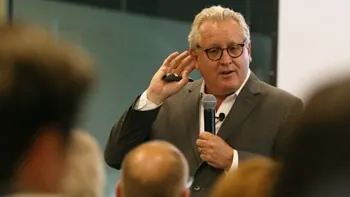
Mitch advocates a more elitist view of Twitter and when he published his post Being A Twitter Snob Is A Good Thing I had a very negative reaction. I followed with my own post Bringing Down The Twitter Snobs because I really think he was missing one of the biggest values of Twitter — the opportunity to give everybody a chance to interact and create value. So I dusted off my Mitch Joel sexy glare (above) and took him on.
Our podcast on this subject (as well as other interesting blog community strategies) just went live:
Six Pixels Of Separation – The Twist Image Podcast – Episode #229
Our previous engagement was over ghost blogging and can be found here: The Ghost Blogging Debate With Mark W. Schaefer.
I think you will really enjoy this discussion and as always, I’d love to hear your comments on the subject!


You’re in marketing for one reason: Grow.
Grow your company, reputation, customers, impact, profits. Grow yourself. This is a community that will help. It will stretch your mind, connect you to fascinating people, and provide some fun along the way. I am so glad you’re here.
-Mark Schaefer