

5 reasons you should be in social media, even if the boss says “no”
Mar 5th
Boss driving you crazy? Having a hard time selling the idea that you need to be on the social web?
I know first-hand that there are still many naysayers out there who don’t understand why they need to have a social media presence. Here are five reasons that should convince even the last hold-out to get on board …
1. Social impact on search
What percent of your business starts with a search on Google? For many businesses it may be as high as 90 percent. And if any of your business comes through search or your website, then social media is inextricably linked to your future success.
One of the most important and significant changes the search engines have made to deliver meaningful and personal results is to incorporate social media results as part of the validation process for content. Social validation and “authorship” are guiding more search results. To be part of this, you need to be creating and igniting content. Establishing authority on the web through your social media content will dramatically help you improve your organization’s search rankings over time. And almost every business can benefit from that.
2. Facebook is the Internet
A common question I receive in my classes and workshops is, “What will be the next Facebook?” A point I try to make is that the emotional switching cost to moving away from Facebook is enormously high. That’s where you have all your friends, photos, videos, and family members. It’s where you have your Farmville farm for goodness sake!
I’ve made the argument that it might be easier to change your house than to change your social network.
Research from The Social Habit, a division of Edison Research, reveals that more than 80 percent Americans between the ages of 13 and 24 are on Facebook and more than half are active every day. There is no other brand in the world that boasts that kind of market penetration. To this demographic, who either are, or soon will be, your customers, Facebook IS the Internet.
And the popular social network is rapidly spreading across every demographic and every region of the world. It is the largest media entity in history.
One interesting and significant trend is that the amount of search on Facebook has been rising dramatically, and of course Facebook’s new search engine development will further serve this trend. Increasingly, Facebook will be the way people find and connect with goods, service, companies, and brands. It probably makes sense to stake your claim there, right? Who knows where the future will lead us?
3. Social proof
When we don’t know the truth, we look for clues from our external environment (like number or “badges” on a website) to help us make decisions.
In our information-dense world of the Internet, we’re starved for clues to help us determine leadership and authority and we readily turn to “badges of influence” like number of Twitter followers or even a Klout score as convenient indicators of power.
Perhaps the most prestigious symbol of social proof today is the Facebook “Like.” Among many companies, there is a Facebook arms race in progress as competing brands do anything necessary to gain the upper hand on this important metric. I recently wrote a post describing a company who has an internal marketing metric of “cost per like.” On the surface, this seems ludicrous but it demonstrates how strategically important this symbol has become.
This might seem a little “icky,” but it’s real. Don’t overlook social proof of authority as a legitimate reason to have an active social media presence.
4. The Trade Show Dilemma
Have you ever had to sit at a booth during a boring industry trade show?
I did, and I hated every minute of it. It was nice to network with people in the industry and maybe even chat with customers, but it was certainly not a very effective use of my time! Despite spending tens of thousands of dollars on this marketing event, we rarely sold anything, learned anything, or created any new value beyond handing out nice pens.
So why did we do it?
Because if we weren’t there, people would think something was wrong. We would be ostentatiously absent.
In this day and age, not being on Facebook or Twitter sends the same message. “Ajax Printing isn’t on Facebook? I guess they just don’t get it.” Even if you DO get it, it tells a story that you don’t get it. Having those social sharing buttons on your website is the new trade show. You better be there, even if it may not be the best use of your time.
5. Social media is the future of communications
The Net Generation – your next pool of employees, customers, and competitors – prefer to use text messaging and the social web over any other form of communication. It is the natural evolution of communications. You might enjoy reading a paper copy of The Wall Street Journal each morning, or even looking at an online version of your favorite news site. Nearly half of Americans under the age of 21 cites Facebook as their primary source of news.
The social web is where a generation is going to connect, learn, and discover. Ignore this at your peril!
So there you have it. If your CEO is still haggling with you because you can’t prove the ROI of social media (don’t get me started) show her this article and say, it’s not just about ROI … it’s about relevance!
I’d love to hear your comments about these observations. Fire away in the comment section!
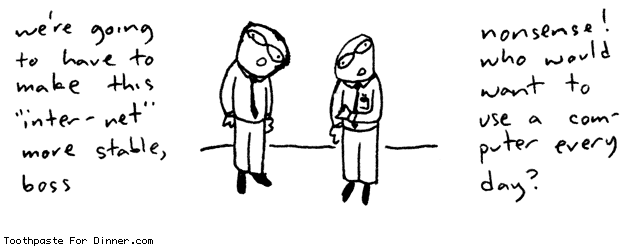
Illustration courtesy Toothpaste for Dinner
Social media “engagement” is not a strategy
Jan 6th
Back in the early days of the social web, the leading “gurus” were actively anti-business.
They made fun of measurement, strategy, objectives and any hint of trying to monetize a social media effort. I know that sounds weird today, but it’s true. The mantra was “Social media is not about your stupid company. It’s all about the conversation.”
We’ve come a long way and even the “purists” have relented. Today, social media is being mainlined into the traditional marketing, PR and advertising initiatives, for better or for worse.
But despite this progress, every now and then I catch a whiff of the old days hanging around. Such was the case on a recent blog post when commenters vigorously defended the “true goal” of social media as being “engagement.”
I am sufficiently disturbed by this conversation that I think it’s time for a reality check. Here we go.
Engagement is not a strategy
A strategy is a direction that ideally capitalizes on a unique value proposition that serves un-met or under-served customer wants and needs. In other words, are you creating something that would be difficult or impossible for your competitor to copy? Is it possible to truly be strategic by “engaging” with customers in a singularly unique way? Difficult, I think.
I do believe it is possible to create strategic advantage by delivering great content and executing a social media initiative well. But the entry barriers to creating a Facebook page and initiating engagement, for example, are so low, I think it is unlikely that this can truly be “strategic.” Engagement should more likely be viewed as a tactic that supports an over-arching marketing strategy, unless you truly have some super-human community management skills that consistently bring customers in the door.
Social media’s place in the marketing mix is to provide consistent, small provocations and conversations through content that lead to engagement and interactions. Skillfully done, that engagement ultimately results in consumer interest, and hopefully loyalty and meaningful activity (like a purchase).
Engagement must lead to stakeholder value
The most valuable brand in the history of the world, Apple, has no social media engagement. By comparison, Dell, the gold standard of social engagement, is floundering and has a stock price hovering near a five-year low. So “engagement” in and of itself is not a predictor of success, is it? That’s why “engagement” is not a valuable activity unless it is tied to some organizational goal such as:
- Customer acquisition
- Brand awareness/defense
- Investment
- New product development
- Registrations
- Service
- Employment/recruiting
I would not invest in a company that is driving engagement as a goal without tying it to some business objective that moves the needle. Engagement, yes. But only in the context of business results!
You can talk yourself broke
One commenter on my blog argued that a company’s goal should be to drive engagement ever upward and pointed to her success in moving a brand from a 10% engagement level to 25%.
Again, without the tying this to a goal, that seems like a silly way to describe success. In fact, you could be hurting your customer.
Let’s not forget that all that engagement comes at a cost! We have to be careful that we’re ready to staff-up to effectively meet those demands. And for some companies, that may not be a good business decision.
Let me give you a micro-example. Last week I wrote a blog post that had more than 100 comments. As a small business owner, if I had this level of engagement every day, I would not have time to work on the consulting and teaching activities that feed my family.
Now if I really wanted to, I could pump up this level of engagement all the time … but it would be foolhardy for me to do so. I need to strike the proper balance of commercial activities across my customer base that optimize my business results. In fact, I purposely plan my blog postings to DEPRESS engagement on days when I don’t have the time to properly handle it.
In other words, if you’re not careful, you can talk yourself broke.
There is a level of diminishing returns to any economic activity and engagement is no different. Having a goal to “increase engagement” for every customer in the absence of strategy is irresponsible.
The conversational brand
Finally, a successful engagement level must also be considered in the context of the type of company and product. An engagement level which would be disappointing for Disney might be thrilling for a niche B2B chemical manufacturer because it is not a very conversational brand. There are no absolutes in this business.
Likewise, not all conversation is created equal. A company may drive an artificially high engagement level simply by posting inane polls and cat pictures that don’t contribute to business objectives in the least.
So if you’re striking out on a new social media strategy, I hope you’ll consider these take-aways:
- “Engagement” needs to be evaulated and supported in the context of company objectives
- Engagement level alone is not necessarily a meaningful indicator of marketing success or financial performance
- Engagement comes at a cost and must be considered as balanced part of an optimized marketing mix
Those are a few observations on engagement but I would welcome your views, dissent, and additions in the comment section! It’s your turn (and yes, I want the engagement!).
Illustration: “Conversation” statue in Calgary
Your 2013 Social Media Strategy: Grow a Pair.
Dec 2nd
First I would like to explain this strange headline to my international readers. “Grow a pair” (not to be confused with “grow a pear”) is American slang for stepping up to be tough and bold. Now, on with the show.
There is an infection overwhelming social media strategy development and the virus is fear.
I just read a number of reports all showing how CMO’s are still confused about what to do about social media. Really? It’s been on the table for at least 3-4 years now. Isn’t it time to figure things out?
I’ve had the true honor of working with some of America’s most beloved brands over the past few years. And I can report that the overwhelming reaction to social media by many successful companies is: “Can we please just make this go away!”
Once they learn that they can’t make it go away, they do the next best thing: Shove it off to an advertising agency.
The fact of the matter is, “fear of change” is always the biggest obstacle to progress. Many of today’s CMO’s did not cut their teeth in the digital world, have not immersed themselves in the social web, and simply do not understand it.
It’s time these business leaders stop whining about social media, shatter the status quo, and grow a pair for the new year.
- Stop abdicating leadership to advertising agencies who just made Timmy from Accounting your community manager because he’s 23 and enjoys Facebook.
- If you still have a firewall to keep employees from the social web, grow a pair. Are you shaking your employees down for crossword puzzle books when they punch the time clock?
- Quit fighting over who owns social media strategy. It’s Marketing. Glad to be of help.
- Stop hiding behind your legal department as an excuse to not do anything. If you help them understand what’s at stake, they will help you. Lawyers care about your business too.
- Quit whining about how much time it takes to do social media. Take a little of that newspaper ad budget you’re wasting and re-direct some resources to the digital space.
- If you’re in pharma or another highly-regulated industry, stop waiting for guidance from the FDA or whatever agency and just figure it out. Whoever finally does that is going to have a remarkable competitive advantage.
- If you’re in the insurance, banking or wealth management industries, grow a pair and stop treating your employees like idiots who could not manage to send out a tweet without violating a freaking SEC regulation.
- Stop following a soul-less, cookie-cutter social media playbook devised by your agency. Learn enough about this new channel so you can ask the right questions and be a real leader in this space.
- If you are overwhelmed about social media and don’t know where to start, bring in help. If you want to find an advisor you can really trust, call me. I know a few I could recommend! Also, I recommend the Rutgers University CMD program (where I teach). In this remarkable executive program, you can get up to speed on the digital marketing landscape in one week.
- And most of all, please, please, please quit asking about the ROI of social media when this is simply code for: “If I keep asking for spreadsheets I can stall this thing until I hit retirement.”
So there. (Taking deep breath).
Please. Look around you. Which companies are creating new value today and achieving breath-taking business results? Which companies are declining quickly, and why? You’ll discover that if you don’t have a digital strategy, you are most likely on a path to irrelevance. Don’t go there.
In 2013 it’s time to do this thing. How are you going to integrate social media and digital marketing so that you’re not just checking a box. It’s time to master these platforms to make them work for you. Are you with me?
How do you budget for social media marketing?
Oct 9th
I had a long discussion this week with an analyst trying to figure out how companies should be budgeting for their social media marketing efforts.
It’s always frustrating trying to answer a question like this because of course there is no cookie-cutter answer. A marketing strategy — and the appropriate budget — is going to be determined by your organization’s goals and the competitive structure of your industry.
However, to optimize the opportunities behind a social media effort, I do believe organizations need to commit to budgeting in a consistent and patient way. Here’s a traditional view of funding an advertising or promotional program:
Of course this is a very simplified view, but in a traditional media spend, you might run an ad campaign and, after some lag, awareness increases and then abruptly drops when the ad campaign spending is over. Of course this could be repeated over and over again and the persisting level of awareness would eventually increase because of the long-term commitment to advertising.
When approaching social media or content marketing, the commitment should be for the long haul. It’s unlikely that you’re going to strike lightning with your first few blog posts or Facebook updates. The idea is to drive relationships through consistent small engagements that eventually lead to awareness and bigger interactions, like a sale.
The idea behind this graph (again, very simplified) is that there is a start-up cost to build a social media competency but that it should become more efficient over time. Your costs will be level or perhaps even go down as you get into a groove. At the same time, there is no immediate affect on awareness like you might get with an aggressive advertising campaign. Unless you are already a well-established brand, it takes time to build an audience that trusts you and looks to you for meaningful content and engagement.
It’s likely that your company will invest in both paid and earned media and that the two will be integrated in some way. In that case, the expense of the integration and the effect on awareness would be blended:
So that is a basic framework to consider if you’re in the middle of your annual budgeting process. Again, there is no one-size-fits-all strategy or budget that you can apply uniformly across every company but I hope some of these fundamental ideas will help point you in the right direction. Make sense to you? How do these basic strategies differ in your company?


You’re in marketing for one reason: Grow.
Grow your company, reputation, customers, impact, profits. Grow yourself. This is a community that will help. It will stretch your mind, connect you to fascinating people, and provide some fun along the way. I am so glad you’re here.
-Mark Schaefer

