Posts tagged future of blogging
What a blog post will look like in 2020
Mar 27th
By Mars Dorian, {grow} Contributing Columnist
I believe that if you want to have success in the present you must anticipate the future. No crystal ball required.
Why? Because you want to sniff out trends to ride them. If you only act on what’s already happening, you’re getting sidetracked to second, third or even worse, fourth place. Like driving a Ferrari with two feet slammed on the brakes. Screeeech.
So, how can one even try to predict how content marketing, in this case blog writing, will look in the future ? Well, we have to remember the fundamental laws:
- Nature is lazy, hence, we’re lazy. We want maximum results with minimum effort.
- Content in the future will be based on this principle: Consume the maximum amount of content with minimum effort, whatever, whenever, wherever we want.
The following predictions represent my opinion and not the truth, so if there’s a time traveler from the future in the audience, don’t eliminate me with your ray gun because my predictions didn’t all come true in 2020. Cool?
Let’s roll. Six possible futures of the blog post in 2020:
1) High-end, low-end blogging styles.
I believe the normal 500 – 1000 word blog posts will enter oblivion because content will serve one of the two emerging reader camps:
Snippet readers – According to FastCompany, Facebook updates make for the most memorable writing. Strange, but it makes sense. With the ever-increasing battle for attention, people crave minimalistic, write-it-like-you-say-it content. Mini-blog posts that can be consumed like fast food, not rich in nutrition, but they give you the essentials.
Long-form essay readers – On the other site we’ll larger sized articles (1000 – 7000 words and more). These are going to be evergreen, in-depth articles, almost mini ebooks, that require more sitting and attention but reward you with more brain nutrition (aka valuable information!). They can be offered for a minimal fee, let’s say .99 cents or 2 dollars (think Kindle-single) or will be infrequently published in longer time intervals.
2) Mobile optimized content psychology.
I’m not talking responsive design and bigger fonts. I mean writing specifically for the mobile person in mind.
In Japan for example, cellphone novels are all the rage. They are romance and paranormal based stories in messaging style, created in a way that makes them readable on the go. Smirk all you want, but these sell up to 400,000 units per digi-novel. Even if you don’t plan on writing e-novels, this comes with mass inspiration for possible blogging ideas :
One thought one paragraph. Wayyy more white space to allow eyes to breathe. Simpler structure and bite-sized chapters so people can read between breaks / commute / waiting. And even more white space.
America’s best-selling fiction author James Patterson already implements this style. Maybe we should too.
3) Real time blogging.
This is the old model: Write a blog post, publish it, share on social media, wait for comments = clumsy and time-consuming. In the future, live blogging could be the alternative.
A content creator could say: Real time blogging from me, every Monday and Thursday. At a specific time, people show up online and interact live with the creator.
Baratunde Thurston did something like this with his last book. Fans could go online and see the words on the screen as he was in the act of writing.
4) Co-created content creation (alliteration ahoy!)
Like the example above, the idea of the author writing “to” their audience will be outdated. It’s going to be more of a dialogue. Mark Schaefer has often said the comment section on {grow} is better than the original posts. Well, now the comments can BE the post, as he could live-write a killer post, and YOU, the audience, could participate and share your info and expertise directly into it, in real-time. Think of it as valuable commenting live-embedded into the post.
5) True global blogging.
Most native English speakers don’t understand how few people in the world actually speak and understand English.
I live in the so-called European Startup hub Berlin, and even here most people can’t understand English that goes beyond High School level. Meh.
The advancement of online translation will change that. Every person with zero English skills will be able to instantly AND perfectly translate your blog post into their native tongue. And I mean perfectly, not awkward Google translate style.
Forget about only Europeans and North Americans commenting on your blog. The next comment will come from a Nepalese village girl that digs your article on advanced social media metrics.
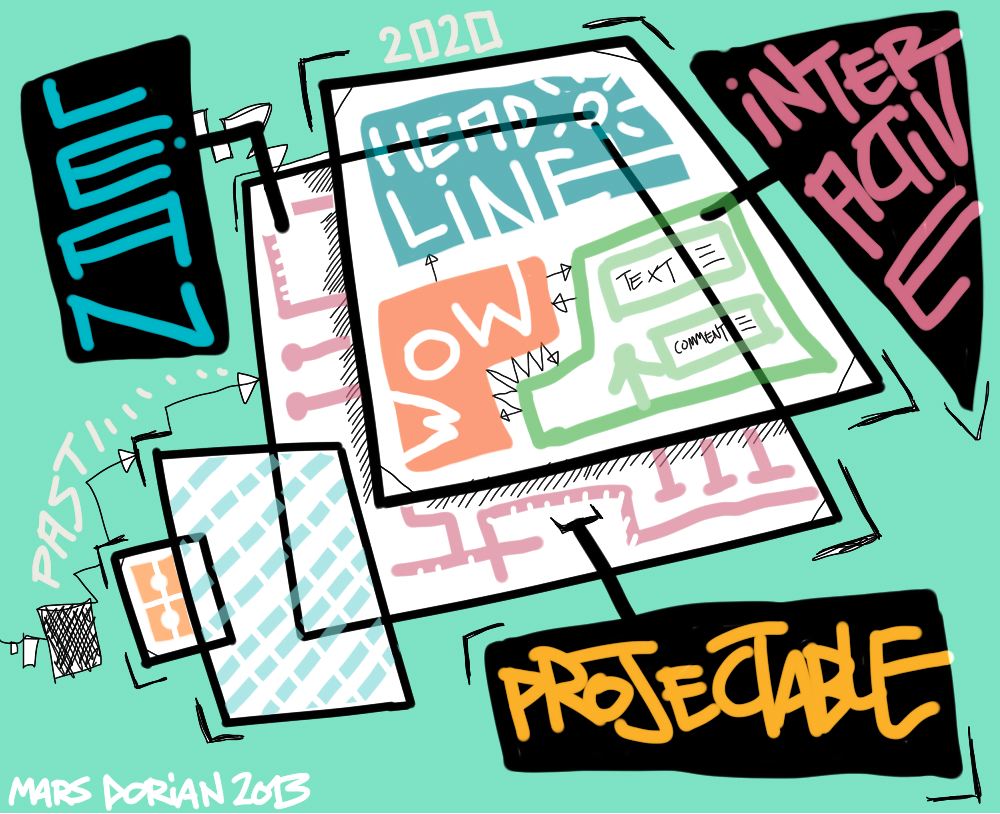
6) Blog posts will be screen independent.
In a few years, people (including our future selves) will look back and laugh at our midget screens. In 2020, only savages will use static screens. Blog posts and digital content won’t be read on your portable screen, but everywhere “on” your surrounding.
How?
Well, you use your micro-chip infused glasses (like Google Glasses) and / or contact lenses to project the required information straight into your environment. Walls, streets, storefronts, heck, even your car could be used as a background for your digitally projected content. Information is going to be (screen) free.
Do you see where all this is going?
In a few years the blog post you know and love will no longer exist. Au revoir.
Just like diary-like journaling turned into blogging, blogging will turn into a different content style that will fit our ever-changing attention span and habits.
Forget how people do content marketing now and focus on how it will be done in the future. It’s time to blog back to the future.
Mars Dorian describes himself as a creative marketeer with a moon-melting passion for human potential and technology. You can follow his adventures at www.marsdorian.com/
Original illustrations by the author.
Is there anything new in blogging? No.
Jul 31st
I walked away from the recent Blog World and New Media Expo a bit depressed and I haven’t been able to shake it.
Running concurrently with this conference — in the same convention center space — was the National Book Expo. Here is a rough comparison of the two events:
Blog World attendance: Maybe 2,000?
Book Fair attendance: 20,000
Blog World keynote: Chris Brogan
Book Fair Keynote: Neil Young
Blog World space: In the basement of the convention center, next to the taco stand
Book Fair space: The top level (with windows!), taking up tens of thousands of square feet of display space
Blog World schwag: Free frozen ice cream treat
Book Fair Schwag: Lunch with John Grisham
Blog World Tech: No wi-fi and maybe 30 exhibitors
Book Fair tech: Interactive exhibit produced by Disney and hundreds of industry exhibitors.
Weren’t books supposed to be dying? Isn’t new media supposed to be overtaking traditional publishing?
To be fair, this is probably not comparing apples to apples and the SXSW event is probably bigger and more star-studded than any book show. But it did drive home a point for me. I didn’t see anything ( repeat: anything) new or exciting at Blog World, one of our industry’s signature events.
Now of course I could not attend every session but I attended as many as I could and even looking through the program, I could not find anything that I had not heard many times before. Like …
What is the ROI of social media? Gag me.
How do I build a blog audience? This was a new topic in 2007.
How do I monetize a blog? Just Google it and find the 14.8 million hits on this topic, Bub.
My five keys to blogging success. If you read Chris Brogan’s blog, you would know the main points of his keynote speech by heart.
I interviewed Mike Stelzner about the biggest thing in blogging and he named “podcasts,” a technology that was introduced in 2001.
Instead of being inspired, I walked away with a sinking feeling that was only made worse by the pulsating energy and glitzy production values of the book event. I understand that for those who are trying to set out as a blogger for the first time, these are really important sessions to attend. But as somebody who has been around for awhile, I’m trying to distill some meaningful trend from this conference and I’m just not grasping it.
Is there ANYTHING new to be excited about in blogging? I’m not talking about a tweak to a commenting platform, a new way to schedule tweets, or a WordPress plug-in. What is going to change the game in blogging? What is going to take us to the next level? What IS the next level? What will replace blogging as a means to provide rich content and ideas to our audiences?
If we stagnate, we die. What’s next?
Community note: This post prompted a follow-up dissenting article by Mitch Joel and a subsequent podcast on the future of blogging where we debated this topic. This debate is not to be missed!
Let’s not have a Quor-gasm
Jan 14th
I don’t like Quora.
As far as I can tell I stand alone in this sentiment. Every blogger this side of Silicon Valley has lined up behind Robert Scoble’s opinion that Quora is the future of blogging.
I am an unabashed fan of The Scobelizer. He is usually right, and much smarter than me. Most people are. And I understand some of the potential personal and business benefits of Quora.
But at the end of the day, any social platform has to connect with people in a consistent, meaningful way and on a personal level — even an emotional level. And the emotion I feel when I’m on Quora is anxiety. I’m not sure that’s the emotion they’re looking for. Why does this creep me out?
It’s already too crowded
When I first visited Quora (pre-buzz), I thought it was a breath of fresh air. It was so empty and wonderful! I could connect to some good conversations, contribute, follow along, and learn a few things.
The next time I visited, I had 380 followers. Huh? And 20 messages in my inbox, most of them crap from people I never heard of before — the Quora equivalent of an automatic direct message. But wait there’s more. I also had five notifications and “241 items related to you.” WTF?
Look I don’t need that in my life. I don’t need more freaking messages, notifications and items. I’m happy to answer a few questions to help people. Then leave me alone.
I already have too much to read.
Many popular questions have 10, 20, maybe even 50 answers. Long answers. Who has time for that? On a daily basis? ZZZzzz.
It’s too disorganized
There is already such a flood of questions that the site is a jumbled mess. People are asking the same questions over and over and over. There is no good way to sort through the goo to find something worthwhile.
Big buzz, little value.
So I’ve answered a few questions. I like answering questions because it makes me feel useful. One question I noticed was, “What makes a Twitter snob?” Now there’s a subject right up my alley! So I answered it and included links to my blog post, and Mitch Joel’s post which were directly relevant to this question. Apparently these links served as a red flag for the Quora gestapo who “collapsed” (erased) my answer. What a great way to build loyalty.
If you really want great answers to your questions without all the Quora flubber, join some LinkedIn groups related to your industry. With 600,000 varieties, you should be able to find a few you like. I’m constantly floored by the experts in those groups who give quality spam-free advice. Without collapsing answers.
A new channel for spam
Poor little Quora. It’s already like a little guppy in an oil spill gasping for breath. The spammers, SEO playas, and back-link re-sellers are probably circling like vultures. How to keep them out? I’m sure people will soon be selling us ways to build “massive traffic on Quora!!”
Obviously there is value to sharing information on Quora. I mean, how can you argue with that? There have already been a dozen posts written about the business benefits. If you have the time. If you have the energy. If you have the resources to respond to your 241 items.
I don’t.
But I’m a teacher, blogger, and consultant. When somebody asks me a question about Quora I better be ready to answer from a place of experience. So for better or worse I’m going to stick around and hope they develop an option for “I’m just here to visit, please don’t send me items.” And heck, let’s hope Quora can address some of these issues and make it. I always cheer for the guppy.
Look, I’m sure you have a much better bead on this platform than me. Have you tried it? What do you think? Am I missing the boat? What IS the future of blogging?


You’re in marketing for one reason: Grow.
Grow your company, reputation, customers, impact, profits. Grow yourself. This is a community that will help. It will stretch your mind, connect you to fascinating people, and provide some fun along the way. I am so glad you’re here.
-Mark Schaefer