Posts tagged futurist
Carving a path through leadership “hell” with Mitch Joel
May 21st
Click here if you can’t see this video interview with Mitch Joel.
Mitch Joel has a new book out and it made me so damn uncomfortable! It is an eye-opening, sobering view of what it is going to take to compete … not just in the future, but right now. And it’s not going to be easy.
Mitch is a brilliant strategist, visionary, and business leader and his new book, Ctrl Alt Delete: Reboot Your Business. Reboot Your Life. Your Future Depends on It, is brilliant too. It’s so … honest. Uncomfortably honest!
I was happy to catch up with Mitch and talk to him about the new release. Be sure to watch the insightful interview I have posted above to understand why Mitch thinks we are in a period of “leadership hell.”
In his book, Mitch emphasizes that we need to act NOW to adjust to five converging forces:
#1 – Direct relationships with consumers – The real opportunity of social media connection. Don’t abdicate the personal relationship to a third party or big box retailer!
#2 – Utility – We have too much of everything on the web. Be useful to cut through the clutter. He also features an all-time great case study for Charmin Tissue! If toilet paper can have a useful digital presence, can’t you?
#3 – Active media – Create media that provokes consumers to interact.
#4 Sex with data – Not just data mining. Data understanding, This is what leads to discoveries and action.
#5 – One Screen Marketplace – It’s not three screens — marketing is only about the screen that is currently in front of your consumer at that moment.
As I mentioned, CTRL ALT Delete is unnerving in its scope but ultimately practical in that it provides solid advice on how to deal with these cataclysmic changes, both on a personal level and a business level.
Some of the urgent scenarios he presents seem daunting. That’s why you need to keep this book in front of you for the next 12 months as a reminder to “deal with it, deal with it, deal with it.” This is not some pie in the sky prognostication. It is already here, it is already happening.
We simply must adjust or risk obsolescence. You see, Mitch is more than smart. He’s also right.
Disclosure: Book link is an affiliate link
What a blog post will look like in 2020
Mar 27th
By Mars Dorian, {grow} Contributing Columnist
I believe that if you want to have success in the present you must anticipate the future. No crystal ball required.
Why? Because you want to sniff out trends to ride them. If you only act on what’s already happening, you’re getting sidetracked to second, third or even worse, fourth place. Like driving a Ferrari with two feet slammed on the brakes. Screeeech.
So, how can one even try to predict how content marketing, in this case blog writing, will look in the future ? Well, we have to remember the fundamental laws:
- Nature is lazy, hence, we’re lazy. We want maximum results with minimum effort.
- Content in the future will be based on this principle: Consume the maximum amount of content with minimum effort, whatever, whenever, wherever we want.
The following predictions represent my opinion and not the truth, so if there’s a time traveler from the future in the audience, don’t eliminate me with your ray gun because my predictions didn’t all come true in 2020. Cool?
Let’s roll. Six possible futures of the blog post in 2020:
1) High-end, low-end blogging styles.
I believe the normal 500 – 1000 word blog posts will enter oblivion because content will serve one of the two emerging reader camps:
Snippet readers – According to FastCompany, Facebook updates make for the most memorable writing. Strange, but it makes sense. With the ever-increasing battle for attention, people crave minimalistic, write-it-like-you-say-it content. Mini-blog posts that can be consumed like fast food, not rich in nutrition, but they give you the essentials.
Long-form essay readers – On the other site we’ll larger sized articles (1000 – 7000 words and more). These are going to be evergreen, in-depth articles, almost mini ebooks, that require more sitting and attention but reward you with more brain nutrition (aka valuable information!). They can be offered for a minimal fee, let’s say .99 cents or 2 dollars (think Kindle-single) or will be infrequently published in longer time intervals.
2) Mobile optimized content psychology.
I’m not talking responsive design and bigger fonts. I mean writing specifically for the mobile person in mind.
In Japan for example, cellphone novels are all the rage. They are romance and paranormal based stories in messaging style, created in a way that makes them readable on the go. Smirk all you want, but these sell up to 400,000 units per digi-novel. Even if you don’t plan on writing e-novels, this comes with mass inspiration for possible blogging ideas :
One thought one paragraph. Wayyy more white space to allow eyes to breathe. Simpler structure and bite-sized chapters so people can read between breaks / commute / waiting. And even more white space.
America’s best-selling fiction author James Patterson already implements this style. Maybe we should too.
3) Real time blogging.
This is the old model: Write a blog post, publish it, share on social media, wait for comments = clumsy and time-consuming. In the future, live blogging could be the alternative.
A content creator could say: Real time blogging from me, every Monday and Thursday. At a specific time, people show up online and interact live with the creator.
Baratunde Thurston did something like this with his last book. Fans could go online and see the words on the screen as he was in the act of writing.
4) Co-created content creation (alliteration ahoy!)
Like the example above, the idea of the author writing “to” their audience will be outdated. It’s going to be more of a dialogue. Mark Schaefer has often said the comment section on {grow} is better than the original posts. Well, now the comments can BE the post, as he could live-write a killer post, and YOU, the audience, could participate and share your info and expertise directly into it, in real-time. Think of it as valuable commenting live-embedded into the post.
5) True global blogging.
Most native English speakers don’t understand how few people in the world actually speak and understand English.
I live in the so-called European Startup hub Berlin, and even here most people can’t understand English that goes beyond High School level. Meh.
The advancement of online translation will change that. Every person with zero English skills will be able to instantly AND perfectly translate your blog post into their native tongue. And I mean perfectly, not awkward Google translate style.
Forget about only Europeans and North Americans commenting on your blog. The next comment will come from a Nepalese village girl that digs your article on advanced social media metrics.
6) Blog posts will be screen independent.
In a few years, people (including our future selves) will look back and laugh at our midget screens. In 2020, only savages will use static screens. Blog posts and digital content won’t be read on your portable screen, but everywhere “on” your surrounding.
How?
Well, you use your micro-chip infused glasses (like Google Glasses) and / or contact lenses to project the required information straight into your environment. Walls, streets, storefronts, heck, even your car could be used as a background for your digitally projected content. Information is going to be (screen) free.
Do you see where all this is going?
In a few years the blog post you know and love will no longer exist. Au revoir.
Just like diary-like journaling turned into blogging, blogging will turn into a different content style that will fit our ever-changing attention span and habits.
Forget how people do content marketing now and focus on how it will be done in the future. It’s time to blog back to the future.
Mars Dorian describes himself as a creative marketeer with a moon-melting passion for human potential and technology. You can follow his adventures at www.marsdorian.com/
Original illustrations by the author.
Why Human Competition is the Least You Have to Fear
Jan 29th
By Mars Dorian, Contributing {grow} Columnist
This headline may seem like a hoax, but I assure you, it’s not.
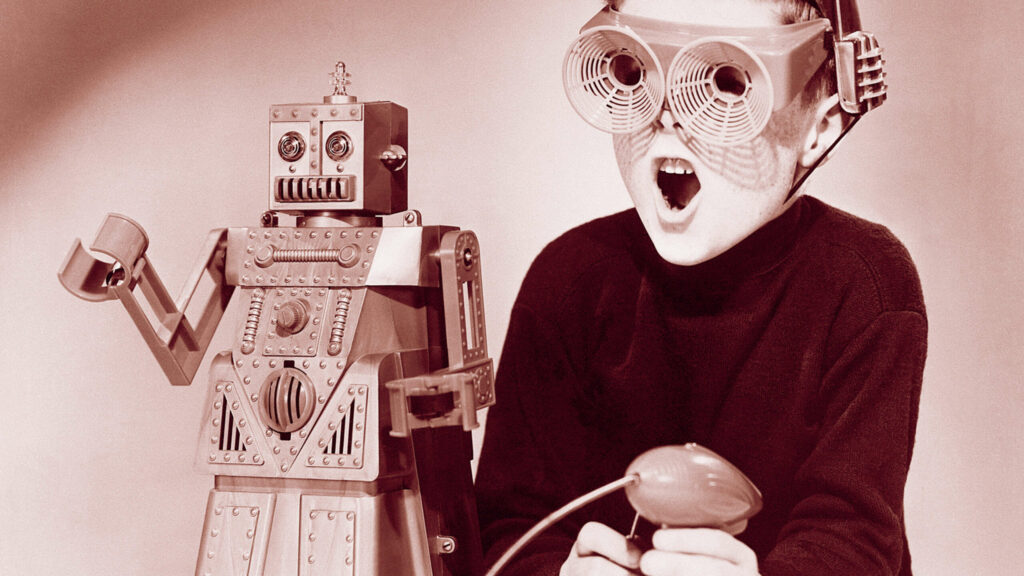
We all know the times are changin’, but most of us don’t realize what those changes mean to YOU and your career. We also know that competition is on steroids in the online age, but most of us think only about human competition. But it’s not humans you have to rival, but artificial agents, also known as robots.
Heh.
I can read your thoughts already – yeah, yeah, that’s some fun sci-fi you gobbled up there, but that won’t replace ME because I’m unique / incomparable / one of kind / or whatever one gloriously thinks of her/himself.
Impossible? Let’s look at where technology is today:
- Google launched the driverless car. In the near future, you may not need a driver’s license because you’ll never have to drive again. The car is first on the automation control list, ships and aircraft will be next. Wait for it.
- Philip M. Parker, a professor of management science in France received worldwide coverage. Why? Well, he used a robotic algorithm to write and upload over 200,000 (!) eBooks to Amazon. Talking about prolific writing. Granted, it’s not Shakespeare yet, but if a robot can already write correct reports, how long till they create your content marketing plan?
- According to this short CBS documentary about robotization, we’re beginning to see robots (yeah, real robots) entering the workforce. The short feature includes two renowned MIT professors who predict that robots will completely replace every job known to mankind by the beginning of the next century.
- In this three-part series from The Associated Press, experts warn that if you add up all the jobs that technology (like robots) can take, the world is going to see unemployment on a scale that we haven’t begun to imagine. The article quotes software entrepreneur Martin Ford, who foresees a computer-dominated economy with 75 percent unemployment before the end of this century, and questions whether human beings will have anything left to do as robot and computers get smarter.
Boom.
Still think you’re irreplaceable? That’s also what horse sellers thought when Henry Ford introduced the first affordable automobile to the general public. They probably laughed their hooves off.
Yeah, I think we all know how that story ended.
Listen – technology has already put a death strike on many businesses- especially the traditional media. Book publishers and newspapers have to face extinction if they don’t adapt. But it’s not just the big corporations that have to adapt, you have to, too.
The more replaceable and “mediocre” your service and offer, the easier and faster you will be replaced by an algorithm / app / software that does the job better than you at a fraction of your cost.
But hey, I don’t want to paint the future black. There’s a lot of opportunity before the robots (mis)use us as human batteries and trap our minds in a virtual reality version. What other people see as crisis I see as opportunity. (BTW – the Chinese symbol for “crisis” consists of the signs “danger” and “opportunity,” and I want to focus on the opportunity part.)
If more and more of our work can become replaceable, what can you do to stay relevant?
Here are my top tips that I obsessively follow myself:
Define your edge and go there.
If you create work that’s easy to replicate, you will attract copycats. And if a human can copy your style / tactic / method, so can a robot algorithm. Bad for business. Baaad for you.
You want to make it challenging to replicate the value you give, and that’s why you have to go the edges your competition isn’t willing to approach. You should do something extreme with your biz that makes it stand out. I for example will include more and more images and graphics into my online presence – creating a color-bombed visual marketing blog experience you haven’t seen before.
I believe: Over-the-top in your market shouldn’t be a one time thing, it should be your mantra.
Creating caring connections.
Business is made of humans. No matter how technical it gets, it’s still about humans serving other human beings, at least in this century.
Your network is your only job security – the more and better you’re connected with people from around the globe, the more opportunities will arise. I currently get 70% of my work through referrals and recommendations. Am I the only one that can solve their problems? No. But because they know me through a common friend they trust, they automatically trust me. And trust can lead to collaboration. Eventually.
If you offer value with your service and you create heartfelt connections, word-of-mouth will bring you work. No robots required.
Make art and change your client’s life.
Making art is the opposite of creating a commodity. That’s why bowling is so boring – it’s limited by a perfect score people can reach, which means getting good at it is no big value. Not so with “art.”
In essence, making “art” means creating value that’s hard to put a number on. You can feel it, but you can’t compare it. It’s unique.
You’re touching a human (and remember, all business is still about humans ) in a way s/he hasn’t been touched before. And I don’t mean in the dirty sense.
It can be your personality, your enchanting customer service or something else that only YOU can bring to the table. Drop the corporate speech. Lose the artificiality. Infuse the human touch. And when you make customers emotionally glued to you, there’s no need to fear a C3PO taking away your job. At least for now.
Conclusion:
The robot revolution won’t come in the form of Terminators with German-Austrian accents that annihilate you. Noooo. It will quietly creep into your life, eventually replacing you if you’re unwilling to adapt and make your work emotionally-essential. Maybe it’s already happening. Prove that you’re human and make “art” work that only you can make.
What do you think?
Mars Dorian describes himself as a creative marketeer with a moon-melting passion for human potential and technology. You can follow his adventures at www.marsdorian.com/
Original illustrations by the author.
Thought-provoking social media trends
Feb 4th
The Economist is one of my favorite magazines. I usually read it cover to cover. So imagine my excitement when I saw their special report this week, Social Networking: A World of Connections.
After I read the report, I concluded — to my surprise — that there was really not much new in the report. This is not a negative reflection on The Economist. I believe it’s a positive reflection on the efficiency of Twitter to stream the most important news and trends my way before they get summarized by a business periodical.
Nevertheless, there were a few interesting nuggets I wanted to pass along:
>>Follow me on Twitter signs are appearing on the doors and windows of small businesses around the world. Asurvey found that 17 percent of Britain’s small businesses were using Twitter. They saved an average of $8,000 a year by cutting out other forms of advertising.
>> A survey of 1,400 chief information officers conducted last year by Robert Half Technology, a recruitment firm, found that only 10 percent of them gave employees full access to social media networksduring the day, and that many were blocking Facebook and Twitter altogether. The executives’ biggest concern was that social networking would lead to “social not-working.” Some bosses also fretted that the sites would be used to leak sensitive corporate information.
>> An astonishing amount of time is being wasted on investigating the amount of time being wasted on social networks. One study estimated that personal use of social networks during the working day was costing the British economy almost $2.3 billion a year in lost productivity. Another concluded that if companies banned employees from using Facebook while at work, their productivity would improve by 1.5%.
>> The magazine described Facebook’s “hacker culture.” Their head of engineering’s motto is “move fast and break stuff.” What matters is getting fresh products out to users quickly, even if they do not always work as intended. To generate new ideas, they hold all-night hack-a-thons to at which engineers work on their pet projects. This Red Bull culture maybe why Facebook has just one engineer for every 1.2 million users.
>> Survey of 300,000 Twitters users showed more than half tweeted less than once every 74 days and 10 percent of all users account for 90 percent of all tweets.
>> Facebook’s audience is bigger than any TV network that has ever existed on the face of the earth.
>>In Asia several social media companies such as Japan’s GREE, South Korea’s Cyworld and China’s Tencent, are already making healthy profits from sales of games, premium personalization options, virtual goods, and custom backgrounds.
>>Salesforce.com predicts that demand for corporate internal social networking services will riseas managers realize that they now know more about strangers on Twitter and Facebook than they do about the people in their own companies.
>>Intel estimates it has saved millions of dollars a year in fees by recruiting senior managers through LinkedIn rather than using headhunters. US Cellular said it saved more than $1 mm last year by using a LinkedIn system that produced good candidates faster than traditional recruitment channels.
>> Social networks have made the labor market more transparentin another way too. A survey by CareerBuilder.com of 2,700 executives last year found that 45 percent of them looked at job candidates’ social network pages as part of their research, and more than a third of those had unearthed information that put them out of contention. Time to turn up those privacy settings?
Some interesting stuff! Of these facts and trends, which jumps out for you as having an impact on the way you do business?


You’re in marketing for one reason: Grow.
Grow your company, reputation, customers, impact, profits. Grow yourself. This is a community that will help. It will stretch your mind, connect you to fascinating people, and provide some fun along the way. I am so glad you’re here.
-Mark Schaefer