Is it time to embrace the social media faker?
May 13th
By Matt Ridings {grow} Community Member
There’s this guy. He’s become very popular in the “social business” space. He annoys the crap out of me. He tweets nothing unique, mainly just quotes and platitudes of the type that are very retweetable. He writes nothing original, mainly just articles geared to appeal to the masses but without much actual substance.
He has a PR mission for the company he works for, to become known and by proxy make his company be perceived as a social business. He preaches authenticity and transparency but then has all of the employee Twitter accounts set to automatically tweet links to his posts and retweet him. The PR machine gets him onto the right lists, the right panels, the right interviews, the right blogs. They create progressive stunts to get attention.
Why does this bother me so much?
Am I jealous of that attention? I can honestly say “no” to that. What does bother me is that people buy it. Hook, line, and sinker.
It seems crazy to me that someone who has actually done very little for his company in regards to actual change, or even progressive thought for that matter, can become a leading voice for the movement of which I’m a part. It makes me feel like the things that actually matter to me, like the hard work of organizational transformation, are being belittled or devalued.
But here’s the thing. I tend to analyze the things that annoy me, and I can’t help but wonder if maybe I’m wrong about this “charlatan” view that I have.
First off, by all accounts he is a nice guy. People I know and trust seem to like him at least.
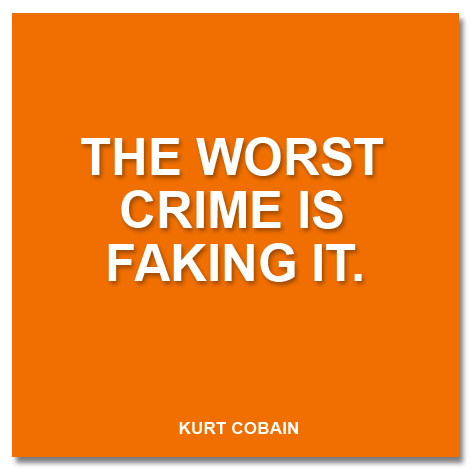
Second, there’s no question that this is an “inauthentic” approach, but maybe this is one of those situations where if you say something loud enough, and long enough, you begin to create change by the very fact that you then are forced to become the thing that you say you already are … or risk exposure? The whole “fake it till you make it” thing?
Is faking it OK?
Is there value in that? Am I being too harsh in my judgment of this guy and others like him? Sure, he seems more concerned about image than reality at the moment, but maybe that will help to create a better reality later on?
I’ll never be in love with this approach, and yes it will probably always annoy me when people value what I consider the “wrong” things in this profession. But that’s just life, and I can’t apply my own values to everyone else. It can’t be my mission to be the white knight out there trying to protect the masses from the snake oil. There are already plenty of those people out there and frankly I find them just as annoying. Let’s face it, even this post it can be taken as a form of condescension and elitism. “I’m smarter than you so let me warn you away from your own stupidity”.
The bottom line is that there are things that I wish didn’t work. There are things that make me question my own values and what I’m willing to sacrifice in the name of “success.”
Cognitive dissonance is a bitch, isn’t it? What are your thoughts on the subject?
Matt is a co-founder and CEO of Sidera Works, a marketing and organizational development consulting practice. His work over the last 10 years has focused primarily in developing innovation cultures, change management initiatives, and specialized market research. Follow Matt at @techguerilla.
The hinge to social media success? It might surprise you.

Feb 26th
By Matt Ridings, {grow} Community Member
Since my company, SideraWorks, was formed, I’ve had the chance to work with a range of companies on their social business transformation and discovered a common hinge to social media success. And to be honest, it surprised me.
I never imagined that our work in developing social media policies (and the related processes and governance models to support them) would become so popular. That was shortsighted, perhaps even naive on my part, but as a company focused on social business culture and change management it just didn’t stand out to me as one of the more important things. It didn’t feel “serious” enough. Boy was I wrong.
For many companies, this has become their ignition point to social media success. Today, we’ve built a specific toolkit and methodology just for this purpose and now teach it to others at a few publicly available workshops (like Social Slam). Let’s explore this critical component more closely. Why is the social media policy such a critical component in becoming a social business?
Social Media Policies – The Hinge to Success
- Social Media Policies Are Universal – Whether a company is heavily engaged in external social media or not, its employees and stakeholders are, and it needs to account for that. This makes it a good entry point for beginning social business initiatives. As we’ve seen with the recent hacks and takeovers of social accounts, no one is immune.
- Social Media Policies Are An Ideal Introduction Into Social Business Mentality– You can’t create meaningful social media policies and situational playbooks without involving Legal, HR, and the edge related functions like Marketing, Customer Service, and Sales. Developing these policies, processes, and governance models using a scenario based approach gets people out of their silo’d viewpoints and makes them view the impact points of social media across the organization more holistically. It allows you to begin the process of getting these varied groups on the same page and become more involved in what the organization is doing where social is concerned. That exposure through this process helps immensely when it comes to easing adoption of social business throughout an organization.
- Social Media Policies Directly Address Culture – We use a process called Social Scenario Modeling™ to build policies and related playbooks from real-world scenarios. These range from PR crises to employee engagement concerns and opportunities, and all points in between. The approach has become key for in helping to establish a mentality in organizations that this is a “give and take.” Policies aren’t only about risk mitigation they can also be about enabling desirable behavior that benefits the organization. Finding that balance requires an open dialog across the social ambassadors, Legal, and HR. How these policies are written, the language they use, and the way they are communicated can either have a positive or detrimental effect on the organizations culture. It’s a direct expression of an organizations viewpoint and value structure on something (social media) the individuals within it associate with at a very personal level.
- Social Media Policies Create A Foundation For Education Programs – Distributing knowledge about social media policies is about more than just having an employee sign off on a form. It’s an opportunity to build education programs that develop social judgment and alignment within the workforce. With an increase in judgment comes a commensurate increase in employee empowerment. That empowerment and judgment allows an increase in an organizations agility.
Beyond The Basics
As you can see, social media policies can be about far more than employee paperwork to mitigate risks. If handled properly they can serve as a powerful point of entry to becoming a true social business. SideraWorks is proud to have partnered with forward thinking events like Social Slam to help bring our methods to the public, but regardless of whether you take our approach or come up with your own, I hope you’ll go beyond the basics and take advantage of the opportunity that something as ‘simple’ as a social media policy can present.
I would be curious to know — Are you also seeing an important role of the social media policy in your company? Join me in the comment section!
Want to learn Social Scenario Modeling™ for yourself? Come visit Matt at the upcoming open workshop on this topic including the Implications of Social Business & Crisis Preparation: at Social Slam Plus on April 4 in Knoxville, TN. Social Slam Plus is a series of intimate workshops available before the main Social Slam event on April 5. The workshop is also being held at Explore in Scottsdale, AZ on April 13.
Matt is a co-founder and CEO of Sidera Works, a marketing and organizational development consulting practice. His work over the last 10 years has focused primarily in developing innovation cultures, change management initiatives, and specialized market research. Follow Matt at @techguerilla.
Hinge image courtesy fontplaydotcom, creative commons license


You’re in marketing for one reason: Grow.
Grow your company, reputation, customers, impact, profits. Grow yourself. This is a community that will help. It will stretch your mind, connect you to fascinating people, and provide some fun along the way. I am so glad you’re here.
-Mark Schaefer