Can you adapt to radical social media marketing change?
May 29th
The other day I was enjoying a warm spring and decided to eat my lunch outside on one of the many public plazas in New York City. Pigeons strutted around me waiting for a speck of food to drop. As I was balancing my plate of chicken and rice, a pigeon dive-bombed my plate, sending half my lunch to the sidewalk … and into the beaks of his swarming cousins.
After my initial pissed-offed-ness, I marveled that this stupid little bird had learned a highly effective new behavior to gather food. It had adopted to its urban environment and surely was setting itself up to be the founding father of a race of hawk-like super pigeons.
It was a lesson that in any environment, those with the ability to adapt to changing conditions will win. I think with the frenzied rate of change we are now seeing on the social web, this will be an important lesson — and life skill — for marketers.
A hypothesis: Personal “technological networking and adaptability” is going to be an increasingly important characteristic valued by corporate recruiters. The ability to use the web to network, improve productivity, and find answers will be a highly-prized part of a personal skill portfolio. In fact, there is some research to back it up
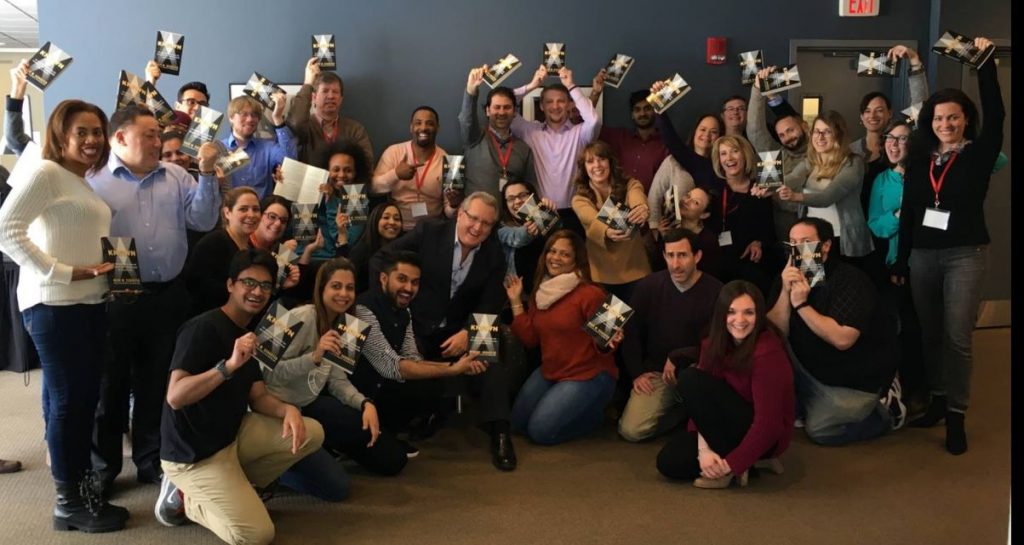
A few years ago, I was in a graduate leadership program at Carnegie Mellon University and took a class from a talented educator and author named Robert E. Kelly. Dr. Kelly had just written a book called How to Be a Star at Work: 9 Breakthrough Strategies You Need to Succeed. Honestly, I thought it was going to be one of those kick-your-feet-up, blow-off kind of classes, but it ended up being one of the most interesting sessions of the program.
We all know that certain people tend to rise to superstar level at work. They may not be smarter or harder working than others, but they have a certain “something” that seems to push them up the corporate ladder.
Dr. Kelly had a research grant to determine the factors that these high-fliers had in common. After all, if you could actually test for these factors, wouldn’t that have a powerful impact on corporate recruiting and training? Turns out it wasn’t that simple, but after years of investigation he eventually found the magic formula.
According to Dr. Kelly’s research, one of those key characteristics of a corporate rock star is an ability to effectively network and find information quickly. Let’s say you had two employees — Tom and Tammy — equally well-educated, enthusiastic and nattily-attired. But Tammy had just one advantage — she knew how to use technology to rapidly find the people and resources she needed to accomplish a task while Tom picked up a phone and started calling people in the company directory. The research showed that Tom had no hope of ever catching up and the more complex the task, the further Tammy would outshine him.
It makes a lot of sense.
Dr. Kelly’s research seems to indicate that expert networking skills like an ability to navigate the social web can also be a crucial differentiator in your career.
So there. Now you can explain to your spouse that all that time you’re wasting on Twitter is actually a career-advancement opportunity! You may be just 140 characters away from the tweet smell of success.
I would be interested to know … how are you seeing this play out in your own workplace and your own life? And if you agree that this ability to adapt to technological change is important, how would you measure something like that?
LinkedIn: A goldmine of business opportunity
Feb 3rd
This is the third and final (for now) personal case study on how the social web delivers unexpected business benefits. This story features LinkedIn, a powerhouse generator of business connections.
Making connections
I’ve made some of my best business contacts through LinkedIn Group Q&A forums. One example is my relationship with Dr. Ben Hanna, now VP of Dex Interactive. In a casual response to one of my answers in a forum, he mentioned that he was documenting his company’s progress on social media marketing month by month. I thought this was fascinating and asked if I could feature him on {grow}. This led to a number of articles which remain some of the most popular posts I’ve done. Ben and I have continued to support each other on various web-related projects.
Human Resources 2.0
Second example of a business benefit: One of my customers was looking to hire a new technician with highly specialized skills. I suggested doing an advanced search on LinkedIn using the zip code (to narrow the location) and keywords indicating the skill set. He followed my advice, identified three viable candidates and he just hired one of them. I helped my customer with an important personnel issue in one 60-second phone call!
New customers
Another example led to a direct business opportunity. An account executive from GIS Planning read some of my answers on a LinkedIn Group Forum and became curious enough to click my icon, which took her to my website … which took her to my Twitter account … and my blog. Of course I had not connected to her directly at this point but that was about to change.
After a couple of months, she called me up out of the blue: “Mr. Schaefer, I’ve been reading your comments on LinkedIn, Twitter and your blog and I’m convinced you are the voice of marketing we need for or company. Can you take on a new account?”
Well, THAT was a nice surprise!
This led to subsequent phone calls with her executive leadership and it resulted in a business partnership with GIS Planning, an amazing company that produces software for economic development institutions. It pulled me into a whole new industry and allowed me to learn from some wonderful marketing pros. And, it has helped my bottom line, which is what this is all about, right?
So let’s see how this real-world experience relates to my formula for creating business benefits on the social web:
Connections + Meaningful content + Authentic helpfulness = Business benefits
- By being active on LinkedIn forums, I was building important new business connections. In the GIS case, I didn’t even realize it.
- The content Ben Hanna provided spurred dialogue and cooperation between us. Meaningful content in the form of LinkedIn Group answers provided enough value for GIS to take action to learn more about me. Meaningful content comes in many forms!
- When I was participating in the forums, I was genuinely offering help with no intent that I would get anything out of it. Similarly, I enjoy supporting Ben’s projects becuase I always learn something and I truly believe in his vision.
I believe this formula represents the core value of the social web — providing an opportunity to use your life’s blessings to connect to others in a meaningful way. We are living in a historic moment. We are the first generation to have access to free, instantaneous, global communication. If you use this gift well, the benefits can be astounding.
Don’t you agree?
This is the third installment of the unexpected benefits of the social web. You might enjoy these other articles:
Part 1: How to become a CMO in 10 tweets or less
Part 2: On Twitter, even casual connections can lead to business benefits
On Twitter, even casual interactions can deliver business benefits
Feb 2nd
This week, I’m featuring personal case studies to demonstrate how the social web can provide tremendous business benefits … often when you least expect it!
Today’s example started when I tweeted ”Go Steelers!” … and ended with the video about my business that you can view by clicking the image above.
I was watching a Monday night football game and tackling a little work at the same time. I flipped to Twitter and cheered for my favorite team. “I’m cheering for the Steelers, too” Michelle Chmielewski tweeted back. And soon we were sharing our love for football, Pittsburgh (where she was a student), and blogging.
I had never connected with her before but Michelle had been reading {grow} and had just started to blog herself, The Observing Participant. As a new blogger, she asked me for some feedback on her own posts. Over time I grew to really love the quirky, funny video posts she featured. One day I had a brainstorm — one of these videos would be a great way to explain my business to potential customers! Michelle agreed to do it, but on one condition – instead of pay, she needed a new high-definition camera to take her video blogging to a new level. I was glad to oblige and provide her with a tool that could further her career.
I’m sure you’ll agree that Michelle’s video is awesome, and in a week or so I will be featuring it on my website.
Throughout the year, Michelle and I continued to learn from each other. She talked me into getting on to Skype and has looked to me as a mentor on career issues. Best of all, Michelle is my friend, and that never would have happened without the social web.
So here’s the lesson of Twitter: You just never know!
Let’s check in again with my formula for creating business benefits on the social web and see how it relates to this case study:
Connections + Meaningful content + Authentic helpfulness = Business benefits
How this worked in the real world:
- Michelle and I both actively created connections by engaging with people on Twitter.
- Because of the meaningful content on my blog, Michelle became an interested follower. Michelle’s video content created engagement with me and eventually resulted in a mutually-beneficial business benefit.
- We continuously offer authentic helpfulness to each other without regard of any future “pay-back.” This trusting friendship will continue to pay personal and business dividends.
This formula works. What “unexpected” Twitter stories do you have?
This is the second installment of the unexpected benefits of the social web. You might enjoy these other articles:
How to become a CMO in 10 tweets or less
Feb 1st
This headline is just a bit ridiculous, of course! But I did want to make a point that social media works in amazing and unanticipated ways. This week, I’m featuring personal case studies to show how the social web can provide legitimate business benefits, sometimes when you least expect it!
The first example is about how I became the Chief Marketing Officer of Freesource … without ever meeting my new boss.
About a year ago I saw notice on a LinkedIn Group that the American Marketing Association was offering a webinar on using the social web to make your business more efficient. The presenter was a guy named Nathan Egan, a former LinkedIn exec who had just started a company called Freesource. The price was right — free — so I attended. Nathan seemed like a bright guy and at the end of the webinar, he invited the participants to follow him on Twitter and LinkedIn, so I did.
Getting on the radar
Through Twitter, I appeared on Nathan’s radar and he began reading my blog. The topics I wrote about resonated with him, and, like many readers of {grow}, one day he called me to talk through some of his business problems. We continued to support each other and toss ideas around over a period of months.
Nathan assembled a great team and Freesource grew quickly as businesses sought the company’s advice on using the social web to make their businesses more productive and efficient. As the client base grew, he needed a wide variety of resources to support projects, and, since I can do a wide variety of things, I seemed to fit the bill! Nathan began sending me paid assignments to fill in the many white spaces of a start-up company.
I loved the work because our views on business and marketing were aligned and I absolutely bought into his vision of how the new media could work for a corporation. As Nathan’s trust in me grew, he provided more important, strategic assignments.
Freesource quickly became one of the largest and most respected social media marketing agencies in the country. Nathan no longer had time to work on the critical marketing functions of his company and asked me if I could help. I recently agreed to become CMO on a part-time basis and help him through this exciting growth phase.
The success formula
This is a good time to reflect on that important formula I introduced a few months ago:
Connections + Meaningful content + Authentic helpfulness = Business benefits
How this worked in the real world:
- I was active on LinkedIn and established relevant new business connections.
- By providing meaningful content through Twitter, I appeared on Nathan’s radar screen. Ideas from my blog grabbed his attention.
- We offered authentic helpfulness to each other without regard of any future “pay-back.” This built trust and a dialogue that led to a mutually-beneficial business partnership.
The more I’ve studied success stories in the social media space, the more I am convinced that this formula really does work. This week, I’ll share a couple other examples to show how.
How does this fit with your own experiences on the social web?
This is part of a series on the unexpected business benefits of the social web. You might enjoy these other articles:
Part 2: On Twitter, even casual tweets can create business benefits
Part 3: LinkedIn: A goldmine of business opportunity


You’re in marketing for one reason: Grow.
Grow your company, reputation, customers, impact, profits. Grow yourself. This is a community that will help. It will stretch your mind, connect you to fascinating people, and provide some fun along the way. I am so glad you’re here.
-Mark Schaefer