Are businesses failing to find an ROI in social media? Another view.
May 20th
There was a lot of buzz on the Internet last week about a report and infographic from Manta.com stating that 60 percent of small business owners are not realizing a return on their social media marketing efforts.
The results of this survey were reported on
- NBC News
- Entrepreneur.com
- USA Today
- The Austin Business Journal
- Small Business Trends
… and dozens, perhaps hundreds, of blogs.
It took a little digging, but here is an example of why we need to take this kind of information with a grain of salt. The Manta research was not a national survey. It was not a representative survey. It is not a statistical extrapolation of the current state of social media.
This was a survey of 1,200 of Manta’s own customers. And yet it is being reported as a national trend by the mainstream news media?
None of the news channels disclosed that this was a survey of the company’s site members. In fact, most didn’t even link to the survey. They just linked to the original USA Today article.
This survey is a mildly interesting data point, but if I were reporting on this press release from Manta, I would have wanted to know:
- How was the question asked?
- What was the response rate?
- Is that sample size representative and sufficient to forecast a national trend?
I have to give credit to whoever is doing PR for Manta. This is a relatively obscure small business site that is attracting massive press through their surveys and infographics. In a world of paralyzing information density, they figured out a way to cut through the clutter and attain incredible exposure. Here is what I take away from this case study:
- Apparently anybody can dupe the national news media by creating provocative survey results and an attractive infographic.
- If you can just dupe one national news outlet, you’re likely to dupe them all because nobody digs for the truth or even cares about the truth. They want to break a story fast with diminishing resources devoted to checking facts. So, they just copy the other guy.
- Bad news sells better than good news. Ironically, the spin on the original press release from Manta was positive, focusing on the 40 percent of companies who were realizing measurable gains from social media. But the press turned it upside down because negative news attracts more readers than positive news.
So after all this, what is the truth? Are businesses getting any benefit from social media marketing?
In a survey published just two months prior to the Manta research, The McKinsey Global Institute polled 4,200 executives and found that 72 percent of their businesses used some form of social media marketing and 90 percent of those businesses reported receiving business benefits from those efforts. The report has a detailed appendix explaining the robustness of its methodology that is more than 30 pages long.
Who do you believe?
Survey says: Nearly 40% of American parents let pre-teens run loose on the web
Dec 22nd
Sometimes you just get some data across your desk that makes you lose faith. New research from the Pew Research Center’s Internet & American Life Project, shows that just 63% of parents say they are very concerned about their 12-13-year-old’s interactions with people they do not know online.
What?
Doesn’t this just make you a little dizzy? Nearly 40% of American parents aren’t concerned about what their kids are doing online with strangers? What am I missing? Can this possibly be true? Other findings from the survey:
- 81% of parents of online teens say they are concerned about how much information advertisers can learn about their child’s online behavior, with some 46% being “very” concerned.
- 69% of parents of online teens are concerned about how their child’s online activity might affect their future academic or employment opportunities, with some 44% being “very” concerned about that.
- 69% of parents of online teens are concerned about how their child manages his or her reputation online, with some 49% being “very” concerned about that.
- 63% of parents of teens ages 12-13 say they are “very” concerned about their child’s interactions with people they do not know online and 57% say they are “very” concerned about how their child manages his or her reputation online. For parents with children over 13, the number of “very concerned” parents drops from 63% to 53%.
Folks, parenting is not a democracy. You need to be involved with what your children are doing online and don’t take “but nobody else’s parents care” as an excuse. Take an active role in monitoring online behavior and who is connecting to your kids! Agree?
Research shows that Pinterest is big, it’s bad, and it’s for real
Dec 6th
A new report from The Social Habit focuses on revelations about Pinterest and if you weren’t a “pinner” before, it might be time to get in the game!
The study concludes that while Pinterest has a smaller user base than services like Facebook or Twitter, the service engenders enormous loyalty and has become a daily habit for more than half its users.
As a reality check, Pinterest just ditched the limited “invitation” stage of its growth in early August of this year! So the expansion has been explosive and rapid.
The Social Habit research of American social media users shows some pretty staggering insights. A few highlights:
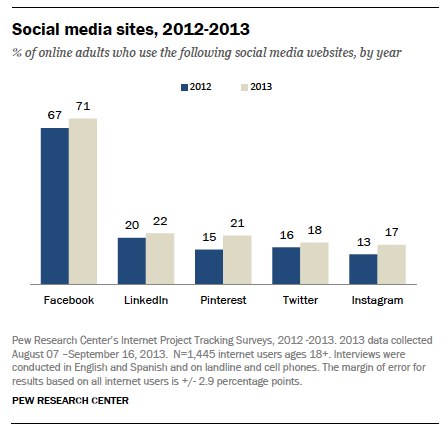
- Usage of Pinterest is already nearly as large as LinkedIn with 21% having a Pinterest account versus 26% on LinkedIn
- More than half of Pinterest users visit the site each day.
- We could be seeing just the tip of the iceberg for Pinterest’s growth. 38% of U.S. social media users plan to use Pinterest more often
- 70% of the site’s users are women and 64% of the site’s fans are under the age of 34. In fact, Pinterest is the third-most widely-used social network for women 18-44 (behind Facebook and Twitter).
- The most popular pins?
- Food
- Arts & Crafts
- Fashion
- Interior Design
- Family-Related Content
- Photography
- Here’s the big one: 27% of Pinterest users have purchased a product as a result of seeing it on someone else’s pinboard.
Pretty amazing stuff. How are you using Pinterest for your business? Or is it just for fun?
By the way, this is just one tiny glimpse into the amazing dataset compiled by Edison Research and the Social Habit report. This is a MUST HAVE and affordable resource for any agency, marketing department or social media professional.
Disclosure: I am an adviser to Edison Research.
Why do rich people get better service on the web?
Nov 13th
I’m involved in this fascinating new project called The Social Habit. We’re focusing the power and experience of Edison Research on the field of social media and it is producing some incredible results, including one that blew my mind.
Some of the most interesting and useful set insights have come in the area of social media’s impact on customer service.
Jay Baer, one of my partners on the project, wrote a superb post articulating some of the revelations about expectations of social media and customer service. A few highlights included:
- Among respondents to The Social Habit who have ever attempted to contact a brand, product, or company through social media for customer support, 32% expect a response within 30 minutes.
- 42% expect a response within 60 minutes.
- Our research found that among those respondents who have ever attempted to contact a brand, product, or company through social media for customer support, 57% expect the same response time at night and on weekends as during normal business hours.
Whoa. Huge implications for companies and their customers.
But a deeper dive into Social Habit data reveals a perplexing new insight about companies providing service through social media:
Rich people apparently get better service. Check it out:
Now, let me emphasize that this is no casual data set. This is a conclusion from robust research and there is a statistically significant difference between those in the income “over $100,000″ category and the others. Why?
I have three hypotheses but I bet you can come up with other possibilities in the comment section.
Hypothesis one is that perhaps rich people complain to companies who are more likely to provide an effective response via social media, like an airline or luxury brand.
The second possibility, and this has somewhat of an icky factor, is that companies are baking consumer profile information (including income) into their CRM systems and respond more effectively to the people with the fattest wallets.
My friend and {grow} contributing columnist Kerry Gorgone has a third fascinating observation: “There are a number of factors at play, but I’d say the rich expect better service online because they get better service ‘in real life,’ where the trappings of their wealth are more readily apparent to customer service people. Having gotten used to a higher level of service, they make it clear they expect a response quickly.”
In other words, have the wealthy developed better complaining skills because they have been conditioned to expect better service?
I really have no idea. All of these are just guesses. But there IS a difference.
What do you think? What is your reaction to this study?


You’re in marketing for one reason: Grow.
Grow your company, reputation, customers, impact, profits. Grow yourself. This is a community that will help. It will stretch your mind, connect you to fascinating people, and provide some fun along the way. I am so glad you’re here.
-Mark Schaefer