

There will be no social media apocalypse
Jan 30th
I like and admire Erik Qualman. I’ve met him a couple of times and he is a fellow author at McGraw Hill. He is a kind man, a legitimate intellect, and one of the top speakers in our field.
His insanely popular series of fast-paced “social media revolution” videos have been viewed millions of times and are standard fare to kick off a social media class or workshop. In under four minutes, these catchy factoid machines impress upon the viewer the power and importance of our society’s digital transformation.
But there is one “fact” that Erik has included in each version that makes me cringe:
“The ROI of social media is your business will still exist in 5 years.”
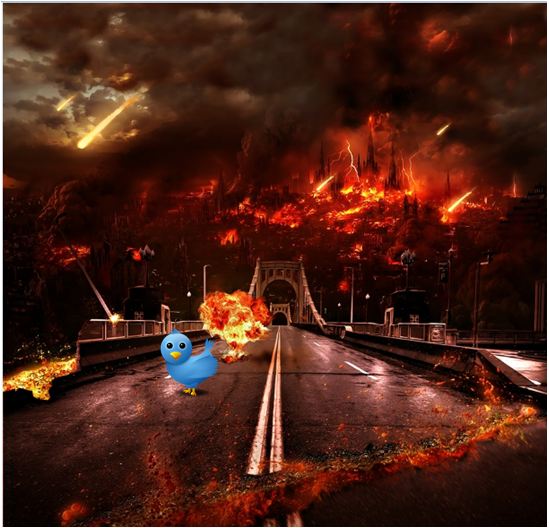
If you would believe Erik, we are on the cusp of a social media apocalypse. Without Facebook, Twitter and the all-important “listening,” we would expect companies to start going “poof” during the impending social media rapture event.
Ironically, Erik’s first video with this quote was about five years ago … and there has been no such end of the business world. Miraculously there are still plenty of businesses that don’t even have a Facebook page that are somehow making lots of money. Like Apple.
Let’s not sell fear
Certainly the digital revolution is real and any smart businessperson must consider the consequences and adjust. But adjusting to your changing competitive environment is just smart business and it always has been.
Business success is about far more than having an active Twitter account. A common problem I see is that businesses and many consultants peddle this fear and a notion that the lack of a social media strategy is a sure sign of doom.
In fact, that may be the least of their worries.
Let’s not lose sight that businesses need to identify and execute upon a sustainable point of differentiation, perhaps in a global marketplace. They need to create products and services that brilliantly address unmet or under-served customer wants and needs. They need to constantly adjust and innovate. Successful businesses need to manufacture their products through an efficient and reliable supply chain with consistent quality. Customer service levels need to meet or exceed customer expectations. The company needs to attract and retain the talented employees that will sustain the success of the enterprise.
And then we can talk about Facebook.
Social media does not assure business success
When social media gurus point to success stories, Dell Computer is always at the top of the list. Yet the company’s stock is at a five-year low. Let’s keep in mind that it takes a lot of moving parts to create business success and having an effective social media strategy is neither profitability pixie dust nor an insurance policy against demise.
I think the point that Erik tries to make — and I do agree — is that without considering digital relevancy, a company will be vulnerable. Today, it’s negligent to dismiss the digital revolution. I just think there is a better way to get that across than hyping doom.
What do you think? I’d love to hear your thoughts in the comment section.
Illustration based on art from BigStock.com
How Social Media Turned a Brand Into a Revolution
Feb 27th
As protesters in Cairo’s Tahrir Square faced off against government forces, they were prepared with this Facebook lesson from supporters in Tunisia: “Advice to the youth of Egypt: Put vinegar or onion under your scarf for tear gas.”
This exchange (as reported by the New York Times) was part of a remarkable two-year social media collaboration that began with bloggers calling for labor strikes and resulted in an energetic youth movement that is toppling dictators.
And I can’t help but wonder in a very public way, was I wrong?
Just a few months ago, I declared in “Is Social Media Creating a Generation of Cowards?” that I agreed with Malcom Gladwell’s now famous contention that “the revolution will not be tweeted.” He compared the heroic activism of the Civil Rights Movement to the “slacktivism” of today’s Facebook culture where involvement ends at “liking” a page. He boldly stated — and I agreed — that the weak connections and lack of organizational structure on the social web was unlikely to enable radical social change.
Was I wrong?
Yes, I was. I had completely missed a big idea that had nothing to do with organizational dynamics: Social media can be used to build and ignite a brand — even when the product is a political revolution! In fact, marketing has played an extremely important role in the shifting Arab political landscape.
Like the rest of the world, I was fascinated by the courage and discipline of the youth movement in Tunisia, Egypt and beyond. I’ve read as much as I could consume and although I do not have the benefit of a first-hand experience with the situation, I think that without question, social media enabled the movement, united protesters, and kept the revolutionaries one step ahead of the government counter-measures.
If you have any doubt about the courage displayed by the protesters or the critical role of Facebook and Twitter, click on the image above and watch a short video about the “Facebook Flat” in Cairo.
While the protesters relied on classic tactics of nonviolent resistance, they also owe their success to marketing savvy borrowed from Silicon Valley.
The mastermind of the movement was Wael Ghonim, a 31-year-old Google marketing executive. Inspired by bloggers such as Ahmed Maher, Ghonim had little experience in politics but an intense dislike for the abusive Egyptian police. While the underground revolution had actually been fomenting since 2005, it needed a business perspective to get off the ground.
“I worked in marketing,” he said. “And I knew that if you build a brand you can get people to trust the brand.”
The marketer’s first campaign was a Facebook group called We Are All Khalid Said, after a young Egyptian who was beaten to death by police.
Ghonim filled the site with video clips and newspaper articles about police violence. He repeatedly hammered home a simple and memorable brand message: “This is your country.”
Engaging the “customers”
He eventually attracted hundreds of thousands of followers to the site and the “brand” actively engaged with them. For example, when organizers planned a “day of silence” in the Cairo streets, he polled users on what color shirts they should all wear — black or white. Finally, after the Tunisian revolution on Jan. 14, Ghonim used the Facebook site to mobilize support for a public protest. He asked for a pledge from 50,000 followers to turn out in protest. More than 100,000 signed up.
“I have never seen a revolution that was pre-announced before,” he said. Or, another way to look at it: He was launching the brand.
When a protest started to become a movement, best practices were shared via Facebook from counterparts in Tunisia and Serbia. Young Egyptian and Tunisian activists brainstormed on the use of technology to evade surveillance, commiserated about torture and traded practical tips on how to stand up to rubber bullets and organize barricades … primarily over social media platforms like the April 6 Movement Facebook page and Twitter.
On February 1, 2011 (the day the Internet was turned back on), Egypt gained 100,000 new Facebook users.
Al-Jazeera, a news channel with an agenda, added drama and emotion to the brand by broadcasting heroic stories and swelling theme songs. The revolution became an ongoing music video.
Entering new markets
Like all popular brands, this is already reaching into new markets like Libya. Where could it go next to reach new customers? This entry from the Youth Movement Facebook page may provide a clue:
So that’s the story of how I was wrong … and so is Gladwell because he missed this point, too. We were both looking at historical events and organizational dynamics, not realizing that the new social media business models can be applied to a wide variety of human activities, even something as unlikely and startling as toppling a dictatorship.
I realize my characterization of this revolution as a “brand” is unorthodox and I don’t want to come across as disrespectful in any way. I would never diminish the truly heroic personal efforts and sacrifices made in the face of real danger.
But I also think it’s important to recognize these new communication and societal dynamics and how social media will be used in ways we could never imagine. Truly, the revolution is just beginning. For all of us.


You’re in marketing for one reason: Grow.
Grow your company, reputation, customers, impact, profits. Grow yourself. This is a community that will help. It will stretch your mind, connect you to fascinating people, and provide some fun along the way. I am so glad you’re here.
-Mark Schaefer

