Posts tagged social media strategy
The ultimate content marketing challenge
Oct 30th
The other day I was a witness to content marketing murder.
I was eating breakfast in a hotel dining room which was partially occupied by a BNI networking meeting. A local marketing “expert” was describing how he propelled a new dentist’s office to the top of the Google rankings through his content marketing genius. His story went like this:
“I found that one of the most popular search terms in the dental category was asking about dental care for children. So we created three videos answering those questions. Then we made very small changes to those videos that resulted in 50 more videos. By placing them in many online channels, we actually created 300 different content placements from the original investment in three similar videos. We now own the first nine spots on Google for this search term.”
Here is the sneaky little secret of content marketing. You don’t need to have the best product or service to win. You don’t need to be the best marketer to win. You don’t even have to create the best content to win. You just need to be first and overwhelming.
This is something that bothers me about the SEO-driven content marketing system. There seems to be such a huge advantage to the first-mover who creates a steady stream of content that I’m not sure there is a cost-effective way to catch up. I know some commenters will say that the key is to create even better content. But we all know that better content can’t win if it can’t be found in the first place.
So here is the ultimate content marketing challenge — what if you DO have the best product but you’re second to market? How do you cut through the persistent clutter of determined SEO gamesters to even have a chance in the search ranking war? What if you’re very late to the party and you’re getting your ass kicked?
Image courtesy BigStock.com
Social Media Good Samaritan donates tweets to save businesses
Oct 16th
By {grow} Community Member Pavel Konoplenko
The story begins like any sweet story should — with delicious ice cream.
I first visited Ray’s Candy Store, an old-fashioned, hole-in-the-wall family business, when I was strolling around New York’s East Village. The walls of the store were covered with vintage photos of desserts — like Instagram except in real life! There were also articles and reviews covering the history of this beloved 40-year business.
One article in particular caught my eye. The headline read, “Social media saves beloved East Village candy store.” How could social media, this recent tool of our information age, possibly be used to save the decades-old candy shop? After reading the article on the wall and having a brief chat with the man working the counter, I discovered a wonderful story…. the story of Matt Rosen, the social media Good Samaritan who crafted a social media strategy just because he wanted to save this little store.
The store’s owner 79-year-old Ray Alvarez, immigrated to America in 1964 and took odd jobs until he worked his way up to become the owner of the store. ”It’s my heaven,” Alvarez said in an interview in NYU’s Daily Student Newspaper. “I enjoy every minute of it. I came here from Turkey with no papers in 1964. I worked as a dishwasher, then waiter, then saved enough to buy the store.”
But after 36 years in the same location, increasing rent and taxes threatened to shut the little store down. Word began to spread that Ray was shuttering his business and loyal customers came out in full support of their beloved neighborhood store. Ray said, “They would buy anything and hand me a $20,” Ray said, “and then insist that I keep the change! They kept giving me money.”
But even this benevolence was not enough to keep Ray in business for long.
Matt Rosen, a long-time Ray’s customer and Internet-startup consultant, stepped in to help. It was clear that Ray needed something with massive reach at a low cost, and the social web seemed to be the perfect solution. So Matt volunteered to manage the pages on Facebook, Yelp, Twitter, and Foursquare that became the hub of an initiative to connect with the thousands of Ray’s customers throughout New York City and beyond.
Through PayPal donations, sales from Ray’s merchandise, and even a benefit concert, Ray was able to raise enough money to keep the store open. In fact, since his foray into social media, Ray has had his best year of business.
Matt was humble when describing his success. “It starts with the business,” he said, “and Ray himself. Without Ray, nothing we did on Facebook or Twitter would have mattered. The call-to-action was really doing something so we wouldn’t lose Ray.”
The goal of the social media effort, Matt said, wasn’t to get a million followers — that wouldn’t pay the bills. It was to keep Ray’s name out there on a regular basis and get somebody who buys one milkshake a month from Ray to buy two or three. Think of the impact on Ray’s bottom line if 200 customers do that.
“This is a simple, relatively painless way to keep Ray’s name out there.” Rosen said. “If my responding to a tweet or thanking someone who checked in on Foursquare brings them back in to the store, then that’s more business for Ray. We know this stuff is working. I can see the metrics.”
Speaking to a local newspaper, Mr. Rosen said he volunteers roughly 15 minutes a day to managing the assorted online accounts for two star clients. At the end of a typical day he searches for mentions on Twitter of Ray’s and responds to them.
In the first month of setting up Foursqure, 130 people had checked in to Ray’s Candy Store through Foursquare. “That’s tremendous,” said Mr. Rosen. “That’s two days-worth of revenue from Foursquare, and it took me just 15 minutes to set up.”
Social media buzz was a huge economic benefit for Ray, but it also brought his dilemma to the attention of a law student who helped him register his papers with Social Security and Medicare. Ray also recently got naturalized recently and is now an American citizen!
And what does Ray, who first saw his first computer a year ago, think about Matt’s efforts?
“Lots of young people are coming now with their iPhones,” he said. “They say, ‘If I do this, I get $1 off, right?’ I say, ‘OK.’” Ray continued, “[Matt] does advertising for me — it’s really high-tech. I still don’t have a television — I don’t know what Twitter is. This is a free country and you can do what you want,” Alvarez said. “How long am I going to keep working here? Until the end!”
Oh yes, follow Ray on Twitter won’t you?
Pavel Konoplenko, one of the most active commenters on {grow}, is passionate about social media and technology and their effect on today’s world. Connect with him on Twitter (https://twitter.com/pavelnovel)
Photo of Ray Alvarez Courtesy of The Villager
6 Factors that turn social media strategy into RESULTS
Oct 14th
After working as a marketing consultant for more than a decade, I know how exhilarating it is when a client really executes well on a strategy.
Unfortunately, I too often see deeply-embedded cultural baggage weighing down a company’s full potential to succeed. Here are the common elements that make the difference between a strategy document gathering dust on a shelf or becoming a dynamic business driver:
1) Active executive sponsorship
I was recently brought in to do a social media strategy workshop with a big health care company. The president of the company greeted me and said “I know we need to do this. We are counting on you to lead us in the right direction.” Not only did she verbally demonstrate support, she was actively engaged in the entire meeting and led the part of the program determining next steps. This active leadership is CRITICAL to organizational change.
There is no such thing as a grassroots cultural change. The person at the top must “get it” and make people accountable for the change. Measurable expectations for change must be driven into performance objectives. Here is the most important thing a leader can do to keep the change going week to week: Ask questions about it in staff meetings.
2) Immersive learning
“Can you just do this for us?”
When I hear that question, I know my client is not ready to commit to the organizational change needed to make a social media strategy work.
The big difference between a company “checking the box” and one that is really being transformed is that people are rolling up their sleeves and learning by doing. They’re not out-sourcing tweets and blog posts. They’re making “content” and customer engagement central to the company’s marketing mission and adjusting job requirements accordingly.
This is excruciatingly difficult. For 100 years, we have been conditioned to pay an advertising agency to handle our customer media and then sit back and wait for something to happen. Certainly advertising is still an important part of the marketing formula. But a content strategy must be organically linked to some extent between employees and customers for it to “take” in the company culture.
3) Patience + Resources
Starting a social media strategy from scratch is like putting a soccer team together while the game is underway — you still have a business to run. Certain players will rise or fall, certain strategies will work or be abandoned as we adjust to the competition and the reaction from the market.
To persevere in this rather chaotic transition, a team should be provided with the appropriate amount of resources and enough patience to allow them to gel and perform. The change is not sustainable if it is simply an “add on” to an already full plate. You wouldn’t take a cross-country trip in a broken-down car running out of gas. The first few miles might be fine, but for the long-term you need to have a vehicle and the fuel to help you get to your goal.
4) Focus
Chasing the shiny red ball is a strategy killer. If you have done the upfront research and planning, you should be confident in following a plan long enough to give it a chance to make an impact. Shifting priorities without following through on a plan will waste time and money faster than anything else.
5) Creative application
A few years ago, I might not have made this such a priority. Back then, it was probably novel enough just being on the social web! But today, everyone has a blog. Everyone has a Facebook page. Are you devoting creative resources to these efforts to really stand out and deliver the goods for your customers? That is becoming increasingly difficult isn’t it?
6) Measurement aligned with goals
Repeat after me. “I will measure my marketing efforts.” In today’s data-filled world, there is no reason NOT to measure. It’s just this simple: How do you know your strategy is working if you don’t measure? Don’t get caught up in the endless ROI debate. Pick meaningful KPI’s that are helping to move the needle for your business objectives.
Well that’s my take on what it takes to make a social media strategy work. What’s your view? Which one of these is the most important to you?
Business icons courtesy BigStock.com
How do you budget for social media marketing?
Oct 9th
I had a long discussion this week with an analyst trying to figure out how companies should be budgeting for their social media marketing efforts.
It’s always frustrating trying to answer a question like this because of course there is no cookie-cutter answer. A marketing strategy — and the appropriate budget — is going to be determined by your organization’s goals and the competitive structure of your industry.
However, to optimize the opportunities behind a social media effort, I do believe organizations need to commit to budgeting in a consistent and patient way. Here’s a traditional view of funding an advertising or promotional program:
Of course this is a very simplified view, but in a traditional media spend, you might run an ad campaign and, after some lag, awareness increases and then abruptly drops when the ad campaign spending is over. Of course this could be repeated over and over again and the persisting level of awareness would eventually increase because of the long-term commitment to advertising.
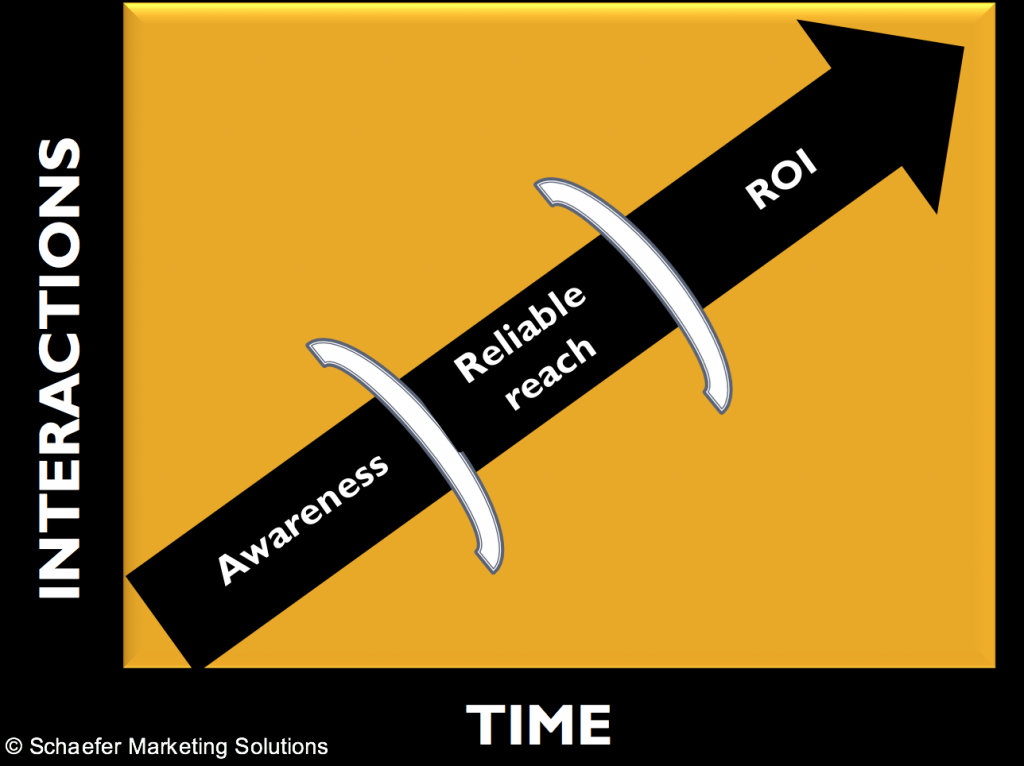
When approaching social media or content marketing, the commitment should be for the long haul. It’s unlikely that you’re going to strike lightning with your first few blog posts or Facebook updates. The idea is to drive relationships through consistent small engagements that eventually lead to awareness and bigger interactions, like a sale.
The idea behind this graph (again, very simplified) is that there is a start-up cost to build a social media competency but that it should become more efficient over time. Your costs will be level or perhaps even go down as you get into a groove. At the same time, there is no immediate affect on awareness like you might get with an aggressive advertising campaign. Unless you are already a well-established brand, it takes time to build an audience that trusts you and looks to you for meaningful content and engagement.
It’s likely that your company will invest in both paid and earned media and that the two will be integrated in some way. In that case, the expense of the integration and the effect on awareness would be blended:
So that is a basic framework to consider if you’re in the middle of your annual budgeting process. Again, there is no one-size-fits-all strategy or budget that you can apply uniformly across every company but I hope some of these fundamental ideas will help point you in the right direction. Make sense to you? How do these basic strategies differ in your company?


You’re in marketing for one reason: Grow.
Grow your company, reputation, customers, impact, profits. Grow yourself. This is a community that will help. It will stretch your mind, connect you to fascinating people, and provide some fun along the way. I am so glad you’re here.
-Mark Schaefer