Please. Make me feel something!
Aug 15th
By Mars Dorian, Contributing {grow} Columnist
Recently, I watched a talk that blew my mind. It was called “Why the best companies make you feel something”.
The speaker, John Kearon, dubbed as the “Steve Jobs of Market Research,” asked the audience which of the following states contributed the most to the success of an advertisement:
A) Purely Logical
B) Logical and emotional
C) Purely emotional
You’d probably pick B like most did, but Kearon claims that PURE emotion is the sole buying decision influencer — because it’s targeting
your oldest and most powerful part of the brain – the fight-or-flight REPTILIAN BRAIN. Grrrrrrr.
And in order to create the strongest reaction (e.g. making people ACT on your calls to actions), you have to create something that either pisses them off or excites them.
Kearon left his speech with a bold claim (I’m paraphrasing): ”We are feeling creatures. Content matters so much LESS than you think it does. Do something shocking or exhilarating in your marketing, but don’t be bland. If people feel nothing, they do nothing.”
Whether that’s 100% true or not, it made me think about my digital career so far. It also reminded me of this popular quote in the branding world:
“WE ARE NOT THINKING MACHINES THAT FEEL;
RATHER, WE ARE FEELING MACHINES THAT THINK.”
– ANTONIO DAMASIO
This order is important.
When I write with more FIRE (aka passion), I get more shares and comments. When I create work that’s more edgy and over-the-top,
I get more (and better) clients.
When you say that’s totally unreasonable, you’re abso-fricking-lutely right. But we humans are unreasonable creatures by default:
Buying a car for 60,000 bucks is unreasonable. The main reason for getting a car is that it takes you from point A to point B
faster and more conveniently than your feet. But who cares? A Kia simply doesn’t make you feel the way a Mercedes does.
What about the iPad ? (Ahh, no example without Apple. Those bastards.) When it launched no one needed it. It was too impractical to create work with it (that’s what the Mac’s for), and the app choice was rather meager back then. But people bought it like it has the cure for death inside. Because it wasn’t YOU who bought it — it was your emotive reptilian brain again. Grrrrr.
Oh let’s forget those high-class products … just look at what kind of content people spread virally online. Cats that fart and hiccup at the same time or a father that pierces his daughter’s laptop with a 44?
Come on, that kind of content has ZERO value, but it DOES evoke a strong emotional reaction in you, whether it’s laughter or disgust.
Totally unreasonable, but totally emotional.
Here’s my claim – in these social media times when everyone’s OBSESSED with stats and data, and how-to content, maybe it’s time to remember WHOM we are doing this all for — real, human beings. With reptilian brains.
Try it out for yourself — instead of worrying just about the content, focus more intensely on the emotional part of your marketing strategies :
How to infuse more emotional OOOOMPH into your marketing
- Be “too.” Some people say my site is too cartoonish and colorful – it looks more like a comic geek’s lair than a visual marketing biz. Well, they’re obviously not my clients. I attract the RIGHT clients who luv that style. What about you — what can you make “too?” Too edgy, too colorful, too friendly? Too over-the-top design? Find those edges. And walk right up to them.
- Concentrate on the feeling benefit of your products and services. Show pictures, words and/or videos of how people feel after they bought your product or services. What’s the state you want them to feel?
- Write visual. Using lots of latin-based words makes your ego think you’re one smart something, but it has the emotional power of a vacuum instruction manual. The easier it is to grab your sentences, the more your audience can picture it. And if they can “picture” it, they can feel it. Ambulate this direction? No. Walk this way.
- Include conflict. Me versus them. Our group against theirs. Your past self versus your new one. Whenever we include conflict and contrasts in our content, sparks fly. And emotions arise.
- Surprise. Email clients when they least expect it. Personally welcome every new subscriber to your email list. Send your best customers a real card on special occasions. Create a video for your brand that no one would expect (but still relates to the brand.) When that works, you have their full attention, and you can do something with it.
Remember what Kearon said: If people feel nothing, they do nothing.
So, go beyond the numbers and how-tos, and create an emotional response to make people ACT on your calls to action!
Have you tried this in your company? Are you going to try it now? How are you going to make me feel something?
Mars Dorian describes himself as a creative marketeer with a moon-melting passion for human potential and technology. You can follow his adventures at www.marsdorian.com/
Original illustrations by the author.
Adopting a Piggly Wiggly View of Social Media
Aug 9th
By {grow} Community Member Lou Hoffman
Companies understand the intellectual argument for embracing the digital world. Prospects, job candidates and other target audiences increasingly conduct due diligence on the Net before making decisions.
That’s the easy part. Most marketing execs get this and the need to come up the digital curve.
But expertise by itself isn’t the game changer.
Mark hit the nail on the head in a recent post: “… social media success is not going to be a function of marketing vision or budget. It’s going to rely on radical organizational transformation.”
Amen.
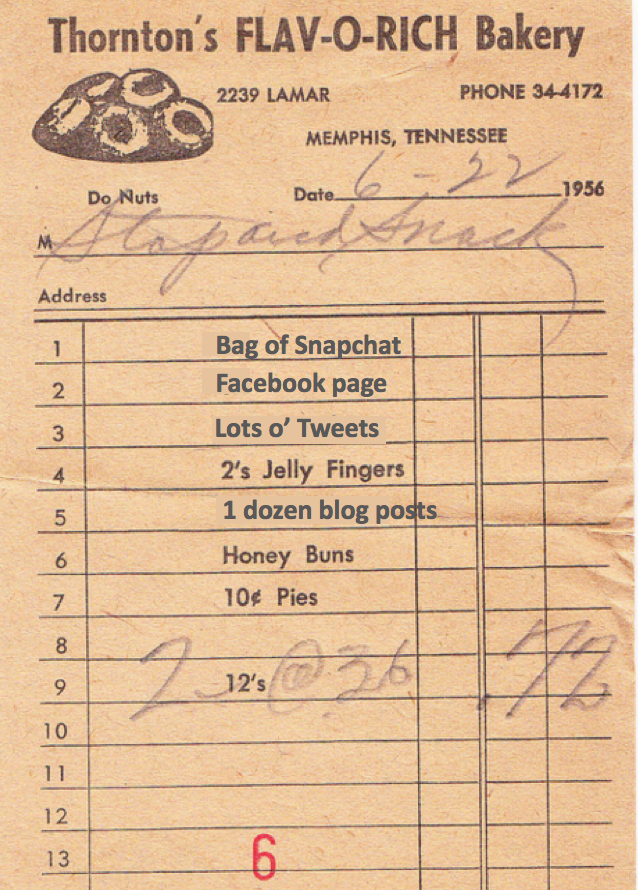
But this transformation goes deeper than org charts, training and replacing the Friday jelly donuts. I think the game changer lies in companies changing from a mentality of centralized control to one that cultivates a distributed approach of digital actions.
Getting Past the Fright
This is a scary proposition. I can hear the lament echoing in the corporate corridors:
“It’s tough enough that our comms team is deploying social media that generates real conversations, dialogue we can’t always anticipate and with people we don’t always know. And now you expect us to proactively put these tools in the hands of amateurs. Borrowing from Match Box 20, you might not be crazy, but you’re certainly unwell.”
The shift away from a command and control model always causes heartburn.
When the Piggly Wiggly invented the self-serve grocery store, the common wisdom was that customers would steal them blind. The idea of picking your own groceries from the shelves instead of ordering from a single counter was viewed as totally radical in the day.
As it turned out, people lived up to the trust.
Last year we went through the exercise of helping a client CMO sell the idea of a hybrid decentralized model – select employees from all functions across the company would be trained and guided in social media – to the rest of the executive management team. The CEO put the kibosh on the proposal. His rationale – as a public company, they carefully scripted what they’re going to say during each quarterly earnings call and the last thing they needed was some guy in procurement tanking the stock price with an off-hand tweet.
Being a glass-is-half-full type, I told the CMO this is a good start. At least your CEO knows what a tweet is.
Here’s the part the CEO hasn’t figured out.
It Comes Down to Trust
If Piggly Wiggly can trust customers, you can trust your employees. With the right training and guidance, their use of social media will become a net positive and expand the company’s digital footprint.
A few companies have the right spirit.
My favorite example of an organization willing to give up control in exchange for the multiplier effect of social media is the Department of Defense. In fact, the DoD established a SlideShare platform to support the rank and file on topics ranging from how to tweet to tips and tools for YouTube.
Look, I don’t pretend to have all the answers on how a company can harness the collective power of its employees in deploying social media.
But I do know this. If companies don’t start rethinking their centralized mindset, trusting their employees and trying new things, the answers will never come.
Lou Hoffman spearheads a global communications consultancy and writes about storytelling through a business prism at Ishmael’s Corner. You can follow him on Twitter @LouHoffman.
The Social Media Minefield: Five factors blocking your success
Jul 29th
When I work with clients on marketing strategies, we spend a lot of time working through the hurdles to implementation success, particularly if it is a large, bureacratic company.
Part of the process is to have a brain-storming session to think through all of the factors that could cause our ideas to fail. Then, one by one, we come up with proactive countermeasures to knock out those landmines before they blow our plans to pieces.
One Fortune 500 company I have been working with has been aggressively moving its marketing team into the digital age. They reported to me that no matter where they go in the world, the same five factors come up over and over again. As I compare this to my experiences working with organizations of every size and type, I think these five factors are universal. These seem to be the same obstacles EVERYBODY is struggling with:
1) Budget and resources
“We already have a full plate. We don’t have time for something new.”
“We’ll let the intern do it.”
“This will have to wait until next year’s budgeting cycle.”
2) ROI – KPI
“Until you can demonstrate an ROI for this, the project is on hold.”
“Social media is fine if you can fit this into our existing measurement dashboard.”
“We need to make social media a profit center that pulls its own weight.”
3) IT – Tech support
“Shouldn’t the IT department own social media strategy?”
“We’re too busy figuring out cloud computing to help with your Facebook app.”
“The IT department budget is fixed on project work like infrastructure.”
4) Legal and regulatory
“Federal guidelines prohibit us from having a social media presence.”
“The Legal Department will have to approve everything we publish each day.”
“The legal risk of responding to consumers is far too great. Say nothing.”
5) Culture and change management
“Facebook is for kids. This is not something for our company.”
“I tried Twitter and I hated it. Nobody on the board uses it either so our company doesn’t need it.”
“Our company is very successful with what we have been doing for years. If it isn’t broken, why fix it?”
Sound familiar?
Of these, “Culture” is the most pervasive challenge. It’s sort of an umbrella problem for all of these issues because even if you fix the others, if the company culture doesn’t align with the requirements of being a “social organization,” you will never create sustainable change.
As you create marketing plans for your own business — or if your current efforts are stagnating — maybe it’s time to step back and look at your own “landmines” that are keeping you from your goals. Focusing on removing the internal roadblocks will give you the only chance of long-term marketing success.
This takes time and patience, but if you don’t do this hard work upfront, even the most brilliant plan is destined for a slow, painful failure.
How does this resonate with you? How are you dealing with your Social Media Minefield?
The Secret Sauce for Creating Gold Medal Relationships
Jul 11th
By Stanford Smith, Contributing {grow} Columinst
My wife and I are infected by Olympics fever.
We watch the Olympic trials together every night. Inspired by track and field hopeful we have intensified our jogging and 5K training schedules. Our children have been enrolled in gymnastics and registered for mini-triathalons in an attempt to see if there is a future gold medalist in our midst.
We’ve got it bad.
The #1 reason for our obsessive devotion to the Olympics is NBC’s superb ability to tell a story. These stories pull the audience into the life of the Olympian. We feel connected to Gabby Douglas’ life, challenges, and triumphs as she lines up for her vault. Missteps and wobbles (on the rare occasion they happen) hurts us as if it were our own child or friend. We pump our fist and smile with pride when she sticks her dismount like we trained alongside her for years.
It occurred to me that businesses pay an enormous amount to earn the same loyalty and devotion from its consumers. You would think that the billions would translate into cult-like dedication. In some cases it has, try attacking Apple or criticizing Southwest Airlines and you’ll see what I mean.
But, most businesses have failed, despite their healthy ad budgets to achieve a fraction of the love my family shows to future Olympians we just met last night.
Why?
Here are a few causes:
1. Weak Storytelling:
I believe that consumers want to connect with the people behind the business. They enjoy hearing about the local grocer who only buys produce from farmers in a 10 mile radius. They want to know why a laptop was built with aluminum versus plastic. They care about a company’s effort to fight adult illiteracy in their community.
The problem is that businesses have their heads up their arses. They think that abstract soundbites and clever taglines are stories. They aren’t.
2. Wrong Hero
Have you ever seen a business Twitter stream choked with self-congratulatory tweets? How about the commercial that waxes eloquent about a company’s commitment and 100 years in business? While this information has some merit, it’s missing a key component – the customer. Customers pay attention to companies because they solve specific problems.
Successful companies craft their stories around the customers and position them as the hero. Their social media strategies create close bonds with their customers directing them to information that enriches their lives. In these stories, the company is the mentor and ally supporting and guiding the customer.
Pop quiz – who is the hero in the Harley-Davidson story? The motorcycles or the rider? Yep, the hog rider. The motorcycle is a prop that helps the rider live out their dreams of conquering the open road and connecting with other rebels.
3. Monologue versus Dialogue
It’s shocking that some companies still question the merit of openly interacting with their customers. Even now companies hide behind perfunctory press releases and turn-off their blog comments. This behavior supposes that customers need to be handled like a live grenade. Customer dialogue is confined to hermetically sealed focus groups and choreographed performances.
The problem is that customers expect transparency. In fact, customers distrust businesses that can’t empower their employees. Look to Comcast for a powerful lesson in employee trust and customer dialogue. Comcast knows that the “cable company” isn’t on the list of beloved companies. They seem to have the most to gain from carefully staging every interaction.
To Comcast’s credit, they committed to a different course. They put their reputation on the line by interacting with customers through their Twitter channel. At any time you can contact a comcast rep via Twitter. These reps are empowered to send offer advice and check on repair status. These conversation happen in plain view for customers and competitors to observe. While Twitter hasn’t completely rehabilitated Comcast’s reputation it is building the company’s position as a customer-centric organization.
Social Media’s Secret Sauce
With all of the breathless speculation about the latest trends and tools, It’s easy to overlook the simplicity of social media. It really comes down to telling a story that focuses on the customer as hero. From their invest time in creating relevant, informative, and transparent dialogue between your team and customers.
That’s the secret sauce and it’s critical that you use it now before your competitors do. Right?
Contributing Columnist Stanford Smith obsesses about how to get passionate people’s blogs noticed and promoted at Pushing Social, except when he’s chasing large mouth bass!


You’re in marketing for one reason: Grow.
Grow your company, reputation, customers, impact, profits. Grow yourself. This is a community that will help. It will stretch your mind, connect you to fascinating people, and provide some fun along the way. I am so glad you’re here.
-Mark Schaefer