Posts tagged social scoring
Influence marketing: What’s next?
May 19th
One of the things I took away from the recent SXSW conference is the frenzied search going on to find new ground for our marketing messages. The media landscape is a mess. TV, radio, and newspaper advertising are in a freefall. Online ad click-though rates are dropping. Nobody is quite sure how to master “native advertising” that cleverly embeds ad messages in content.
All the old “pipelines” for our content are drying up. So one viable alternative is to borrow somebody else’s pipeline.
Today, bloggers, podcasters, and home video producers are gaining consumer mindshare through their passionate and entertaining content. No wonder this is the new media gold rush — influencer outreach.
I have a 360-degree experience with this trend as I strategize with clients, advise agencies, and become a target for outreach programs myself. And what I see is not pretty. Sure we have tons of content. We have lots of wonderful new alternatives to identify influencers. Now, what do we do about it?
I think the core competency that needs to develop is a mindset transformation from a “purchaser of ad space” to a “developer of relationships.” Here is a model to get you thinking about this in a new way.
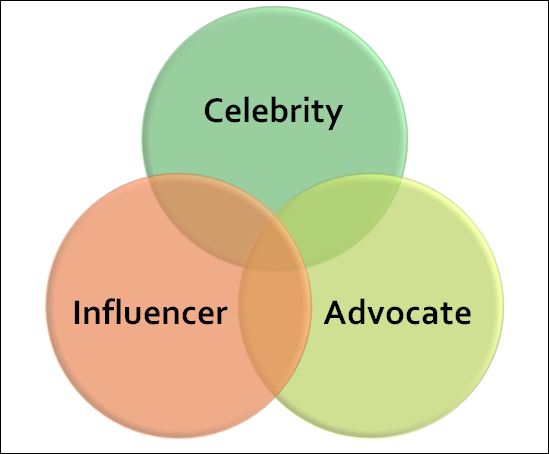
There are three social media influencer pipelines available to us today … let’s look at what this means.
Celebrity
Think in terms of Kim Kardashian and the huge and rapt social media channel she has developed.
- Influence is based on “being known”
- No “rich” content like blogs necessary
- Enormous “pipeline”
- Endorsement is purchased
- Little or no true brand engagement
- Goal: “Image.” Certain brands may pay to access this pipeline just to be associated with this person’s image and lifestyle.
Influencer
Think in terms of a blogger like Chris Brogan who might promote products through their content, including products unrelated to his core business
- Influence based on authoritative, original content and social proof of a large following
- Brand content may be sponsored (purchased)
- Large, engaged “pipeline”
- Limited brand engagement, i.e. probably no organic advocacy exists without sponsor dollars
- Brand goal = “Awareness”
Advocate
Think of a content creator who creates passionate videos about their favorite fashions and shopping experiences.
- Influence based on passion and authority
- Targeted, relevant “pipeline”
- Authentic content
- Organic, unpaid advocacy
- High brand engagement due to true belief in the product and company
- Goal “Drive word of mouth attention and sales”
All of these “pipelines” are legitimate options depending on brand strategy but in a short blog post, I can only cover this on a very high level!
Obviously there are many complications and nuances to this general idea. For example, as the diagram above indicates, there can be overlaps. An “influencer” like Chris Brogan can also be an authentic advocate (and he often is). An advocate can also be a celebrity, of course.
Arguably somebody like Seth Godin could fit in all three categories — he is a celebrity often featured through the mainstream media, he is a content-based influencer, and he goes out of his way to authentically advocate people and products he believes in, without compensation.
The transformational challenge
I think one implication of this development is that there is still an opportunity for quick “advertising” opportunities but many companies and agencies should also be thinking about a more holistic approach to their outreach efforts, including the patient and hard work of developing authentic, long-term relationships with advocates.
These connections are not established through money, sponsorships, and endless streams of infographics. They only occur through authentic helpfulness and genuine personal connection. This requires a change in approach from “buying space” to “earning hearts:”
- Aim to patiently develop long-term relationships
- Maintain consistent connection — even when you don’t expect anything
- Make a live connection whenever possible. This creates an irreplaceable bond.
- Aim to create a partnership or friendship, not a “target audience”
- Employ scarcity — Make them feel part of something special
- Provide useful content and services built on “trust” not “pay”
There is so much to think about here — I could literally write a post about each of these elements! But I wanted to get the general thinking out there because I see such a dramatic need for this in the marketplace right now.
What do you think about these ideas? Do you have an influencer outreach strategy for your company?
Top photo courtesy Flickr Creative Commons and thepinkpeppercorn. Influencer graphic Copyright Schaefer Marketing Solutions 2013. “Heart of Art” illustration by qthomasbower courtesy Flickr Creative Commons
Klout innovation will power search engine results
May 8th
Earlier this week Klout announced a significant commercial partnership with American Airlines — everybody with a Klout score of 55 or over gets rewarded with free access to American’s network of airport club lounges, even if they are not flying on that airline. But it turns out, that was only the beginning of Klout’s surprises for the week.
In a radical turn for the company, Klout will enable targeted and specific “influencer” content creation though an initiative called “Klout Experts” that will begin showing up as the lead items in Bing search engine results. You read that correctly. Your activity through Klout can propel you to the top of organic search results.
Why this matters
Obviously any new factor that could affect search results — even in a small way — is going to receive a lot of attention. This agreement with Microsoft seems to have profound and broad implications for the emerging world of “social influence” and the high-stakes world of search engine marketing.
First, a little background on why this development is important.
If I do a web search for “best car under $20,000,” the first results are probably going to appear because somebody behind the scenes has been optimizing an automotive firm’s website The results may not necessarily provide a useful or accurate recommendation on the best car, the best value, or even a car that is available in my area.
That’s why search firms are desperate to supply “warm results” that consider, who, when, and where a person is searching … and perhaps most important — what are the recommendations from those you trust? Both Google and Bing have been open about including more results from your personal “social graph” in results.
Influencers and search
“We have been experimenting with an idea,” said Klout CEO Joe Fernandez. “What would happen if we asked topical influencers to share their expertise? Would they be interested? Would they repond?”
In 2012 Klout ran a beta test to try the idea, introducing questions to a small group of influencers.
“If you wanted to know the secrets of growing beautiful tulips, or the best make-up for your skin type, wouldn’t you love to have a response from a passionate expert?” Fernandez said. “We found that influencers love to share their knowledge and help, so we are helping them do that through this new program called Klout Experts.”
“Our users are already the best content creators,” he said. “We are helping people realize the full impact of their influence through new, original content they provide on Klout. Every passionate content creator now has a chance for massive exposure through search.”
This new content will be “pragmatic” according to Fernandez, and direct — responses are limited to 300 characters. The best answers will show up at the top of the organic search results on Bing. There will be no “exclusivity” on the content so there is a chance the responses will show up somewhere on Google too.
Gaming Klout and search results
Fernandez is aware that he is creating a giant target for spam and SEO gamesters and is putting counter measures in place to keep the responses targeted, limited and relevant.
“Reputation has to come first,” he said. “If you’re not an established subject matter expert with a high Klout score, you won’t be able to participate.”
However, the top content results will not necessarily be determined by an individual’s Klout score, Fernandez said. “We are developing methods to sort through the content. Answer quality is most important and we have created a novel voting system based on user feedback and input from other topical experts to help us do that. You can only rank if you have influence on that topic. But feedback from other influencers will help determine what gets to the top.”
Klout has developed a system that randomizes the feedback mechanism and limits the ability to get votes from “friends” that would game the search results. ”We will also have visibility on what people are clicking on through our partnership with Bing,” Fernandez said. “We are working closely with the Bing team to keep the product pure and successful.”
Industry momentum
The American deal, and the Klout Experts announcement represent the fourth major commercial roll-out for Klout in two months. The company also introduced “Klout for business” this year, which provides a simple dashboard to discover and connect with topical influencers. Klout reported that it has now attracted more than 200,000 business accounts for its service. In early April, the company announced a partnership with telecom company Orange to bring Klout to France.
Despite fierce and growing competition in the influence marketing space, Klout seems to be at least winning the war on the PR front. The company’s financials are also improving, with revenue expected to double in 2013 to more than $10 million, although the company would not reveal any data regarding profitability.
25 social media influencers Forbes ignored, and why

Apr 23rd
Once a year, a fellow named Haydn Shaughnessy shows up on the social media scene and creates a list of the “50 Top Social Media Influencers,” which is published via the online version of Forbes.
This list gets distributed far and wide and has become an important badge of “social proof” for those on the list. Last year I criticized the methodology as incredibly lame (and I was on the list) and I think that weakness is apparent by just viewing who is NOT on this list. But before I get into that, let’s first look at how this deceptive ranking is formed.
The “Forbes” list isn’t a meeting of the minds or even a popularity contest. It is the singular creation of Mr. Shaughnessy. Now, I grant you that “Shaughnessy’s List of Influencers” does not have the same ring of authority to it, so it has become the “Forbes” list, even though the magazine is simply the pot that is carrying the piss.
Mr. Shaughnessy, who writes about enterprise innovation and co-authored a small book about a new wealth creation system called The Elastic Enterprise, bases most of his influencer insight on a Peek Analytics score called “Pull.” So what’s this all about?
Not so fast
First of all, the company declares on its website that its platform only evaluates Twitter. So Mr. Shaughnessy’s list is not a measure of social media influence, it is a measure of Twitter influence.
Or is it?
Let’s see how Peek Analytics describes their measure of “Pull” on its website.
“Social Pull is not a measure of a single individual’s “influence;” rather, it is an audience-based metric that is a direct reflection of the quality and size of the Twitter audience that has been “pulled” into following an account or mentioning a keyword @name, hashtag, or URL on Twitter.
Huh?
An influencer list … that is not a measure of individual influence?
So the Forbes List of Top Social Media Influencers is 1) created by an individual, not a publishing company; 2) based on Twitter, not “social media;” and 3) admittedly not a measure of personal influence.
Can I have a hear a collective “WTF” from the audience?
In summary, this is a suspicious methodology to define social media influence, and that is about as charitable as I can be. The people on the list don’t have to speak, blog, or write a book to demonstrate their influence. In fact, Shaughnessy describes one influencer, Jonathan Naferrete, as somebody who really doesn’t blog but does post images on Instagram.
Now, here is a LIST
I need to emphasize that there are tons of wonderful people on the Top 50 list and many legitimate social media titans I admire. But I’d like to highlight 25 amazing people NOT on the list to demonstrate that we need to take lists like this crazy Forbes mess with a grain of salt.
You want some social media thunder? These are just a few of the truly great social media influencers of the world excluded from the Forbes list. I’ve linked to their Twitter handle. Please follow them so perhaps they can make this “prestigious Forbes list” in 2014. Heh.
Charlene Li — Founder of the influential Altimeter Group and author of the seminal book Groundswell
Avinash Kaushik — Google’s chief digital evangelist and one of the most influential bloggers on analytics.
Brian Solis — Arguably the most prolific and successful social media author in the field.
Mike Stelzner — Creator of the Social Media Examiner properties — perhaps the most successful and influential social media blog, podcast and conference in the world.
Lee Odden — Leading thinker and speaker about integration of social and SEO. Author of the wonderful book Optimize.
Amber Naslund — One of social media’s most influential and respected bloggers and thought leader. Co-author of The NOW Revolution
David Armano — An integrated marketing thought leader, contributor to Harvard Business Review, managing director, Edelman Digital.
Clay Shirky — NYU professor and for my money, the most visionary thinker in the business. Author of Here Comes Everybody and one of my favorite big think books, Cognitive Surplus
Tom Webster — His Brand Savant blog packs a wallop every time, Pithy, clever, wise.
Danny Brown – Intellectual provocateur; the blogger’s blogger
Mark Ragan – CEO of Ragan Communications. Publisher of @PRDaily, PR Daily EU, Ragan.com, and about a million other useful publications
Joe Pulizzi – Single-handedly defined the field of content marketing through his Content Marketing Institute and wildly successful conferences and books.
Michael Chui – McKinsey Global Institute principal and expert in using social tools to enhance enterprise communications, knowledge sharing, and collaboration.
Gini Dietrich — Fearless Spin Sucks blogger who writes about the intersection of PR, digital, and social
Seth Godin — World-renowned best-selling author. Perhaps you’ve heard of him.
C. C. Chapman — Incredibly insightful thinker, Co-author of the important book Content Rules
Julien Smith — An observer of the social space who is painfully smart and co-author of Trust Agents
John Jantsch — The man who represents the intersection of social, small business and common sense. Best-selling author of The Commitment Engine
Marcus Sheridan — Passionate evangelist of social media and content marketing for business. Just got a new book deal.
Jeff Dachis — A business leader and entrepreneur pushing for data-driven social marketing through the influential Dachis Group
Shelly Kramer — Gutsy entrepreneur-ess and blogger who tells it like it is.
Geoff Livingston — Social media, social good, deep thinker, superb blogger.
Jason Falls — Pioneering social media blogger and straight-talking speaker
Don Tapscott — Wise observer of our world on digital. Futurist and author of Grown Up Digital: How the Net Generation is Changing Your World
Jay Baer – Perhaps the foremost social media entrepreneur on the scene. His new book is about to be released – Youtility: Why Smart Marketing Is about Help Not Hype
Mitch Joel – An important, prolific blogger/author/podcaster and a digital marketing visionary. His new book Ctrl Alt Delete is stunning.
I have no idea how many Twitter followers these people have. But they have all accomplished something.
I normally don’t make lists like this because I don’t want to hurt anybody’s feelings — there are dozens of other people who I could certainly shine a light on. And I haven’t even included the many innovators toiling at major companies and brands who are too busy to worry about the size of their Twitter audience.
And if you ARE on the Forbes list? Have some fun with it. Let your mom know about it. Put a badge on your website. Just don’t take it too darn seriously, OK?
Illustration courtesy BigStock.com
Book links are affiliate links.
Reflections on social media power and influence
Mar 19th
I wrote my first blog post about Klout about two and a half years ago. At that point, it was little more than another obscure social media start-up fighting for attention. Over the ensuing months, I wrote follow-up posts that criticized Klout and its competitors for some of the embarrassing mistakes they made.
But I grew fascinated by this topic of social influence. How DOES a person become powerful and influential on the Internet — an alternate universe that HATES any form of authority, titles, or rules? The more I studied and thought about this, the more interesting it became. I eventually wrote a book about the subject called Return On Influence, which launched exactly one year ago.
I studied this topic of online influence intensely for a year. I read books, academic research, and white papers. I interviewed more than 70 people ranging from brand managers and mommy bloggers to Dr. Robert Cialdini, arguably the leading expert on influence in the world and the author of the seminal work Influence: The Psychology of Persuasion. I got to peek inside Klout (at that point virtually the only game in town) and talk to its customers. And here are the three conclusions I made:
1) This is a historically important time where personal power has been enabled through our ability to publish on the web.
2) The nature of power and influence in the online world is vastly different than what we are accustomed to in the offline world. It’s important for businesses and individuals to understand this — your paradigm has to shift.
3) Klout is on to something.
A year later, I’m very proud of the acclaim the book has received from the press, reviewers, and thousands of readers from around the world. I haven’t written on the topic of social influence in awhile and I thought I would reflect on what has happened in the field since the book came out.
The good.
Moving the debate along — It has been great to see meaningful debate emerge from the book as people begin to understand the changing nature of influence. There have been some great blog posts examining the potential for corruption of these scores, the difference between advocates and influencers, and creative new ways these tools are being incorporated into traditional marketing. Almost every marketing conference now has some element of social influence discussion on the agenda. Some of the more interesting topics include:
- What are the differences and relationships between advocates, influencers and fans?
- How do we connect influencer outreach initiatives to measurable business gains?
- How can we integrate influencer data into traditional marketing initiatives?
- Now that we can find these legitimate influencers, what do we do with them?
New technical development — A group of new companies has emerged to challenge Klout, the acknowledged market leader. Some of them have been niche knock-offs, but others, like Appinions, offers breath-taking new opportunities for marketing insight and innovation. Appinions digs deep below the surface of mere social media input, leveraging patented Cornell University technology to cull insight from 5 million online sources. Now this is getting interesting!
Stabilization — Klout and its social influence comrades have the unenviable task of scaling fast and iterating in public. Being publicly scored and evaluated pushed a hot button with a lot of people and a rash of PR gaffes seriously hurt the credibility of the genre to the point that people could not get past the damage to rationally assess the potential of the technology. Thankfully a lot of that drama is in the past. Scores have slowly stabilized, scamming has been addressed, and the focus is on progress instead of PR spin. The debate is generally becoming less emotional and more intellectual, although many people are still rolling old tapes.
New commercial development — Nearly all the major social influence programs are finding footing with customers. Klout announced new partnerships with Microsoft and ESPN. Kred has introduced a dizzying array of features that slice and dice scores a dozen different ways. PeerIndex has evolved to become a UK-focused discount shopping site. Appinions is gaining ground with a subscription model. Almost every PR, advertising, and marketing firm is trying figure out how these useful new tools can be integrated into marketing campaigns, or even coming up with versions of their own. The idea of “social influence marketing” is moving into mainstream marketing budgets.
The bad.
The social influence feeding frenzy — In the past 12 months there has been a feeding frenzy of misguided PR and marketing people trying to hook up with “influencers,” in a desperate attempt to ride the wave. As somebody typically on the receiving end of this behavior, I can say that 99% of the activity is crap. I especially feel sorry for the most popular mommy bloggers who are deluged with offers and incentives. Everybody wants a piece of an influencer but most are clueless on how to do it well. It’s still about relationships, folks.
The Klout Addicts — There is an underground network of folks supporting each other’s Klout addictions. They are obsessed with elevating their scores and doing whatever it takes to grab more valuable loot. Swag-grabbing is harmless good fun, but I’m not sure what a connection with these folks really does for creating business results. I’m guessing the brands are starting to figure this out? This is one of the potential dangers I pointed out in the book and it seems to be coming true.
The Klout Echo Chamber – There are still a number of folks out there regurgitating the same tired, out-dated, and irrelevant criticisms of social scoring companies. As they repeat their rants among themselves, they have simply created their own Echo Chamber. The biggest problem is that these folks are stuck in an “offline” framework of power and influence or haven’t bothered to look beyond their emotions to understand the theory and psychology behind the scores. Some of the wearisome rants include:
- “Klout is just stupid and doesn’t measure anything.”
- “Justin Bieber has a higher score than Warren Buffet so that proves that Klout is meaningless.”
- “Klout says I’m influential about grapes so that proves that it is worthless.”
These were perhaps valid commentaries at one time but today it is simply running old tapes. Here is what a Klout/Kred/PeerIndex score provides: An indicator of a person’s relative ability to create content that elicits online sharing and reactions. A company like Appinions further applies these scores in the context of topics, themes, and sentiment.
No more, no less.
Like credit scores, social influence scores are imperfect and not necessarily an indicator of future behavior. And yet, both of these indicators are useful. How many careers today are dependent on a person’s ability to effectively move content on the web?
How am I influencing you right now?
It’s likely that you know little (or nothing) about me as a person. I’m not an “influencer” in a traditional sense in that I have any power over you through a title, an elected position, or an organizational chart. And although I can’t tell you what to do, you may actually take some action after reading this post. Will you tweet it? Forward it to a colleague? Save it for later? Will you spend your precious time to comment on it? Have I even changed your view or attitude? Made you angry? Made you interested enough in the subject to explore the book?
My source of power on the web comes from essentially one place: Having an ability to create or aggregate content that is shared and creates a reaction. Without having the ability to create and move content, most influential bloggers you admire today would probably be toiling in a cubicle someplace instead of speaking on a global stage.
In this limited context, does a social scoring number like a Klout score make sense? Can Brian Solis create and move content better than me? Yes. Can I do this better than many of my students? Yes. Social scoring is far from perfect, but over time, this is the valuation that is beginning to be refined – a relative ability to move content. And that is very limited, but also very useful to many companies and brands who want to find people who can create buzz on a topic or product.
In conclusion …
Thank you for supporting (or debating) these new ideas over the past year. I hope there are two main lessons you took away from the book:
First, this is an amazing time for everyone to find their own online power, their return on influence. It doesn’t matter what college you attended, the color of your skin, or how much money you have. You can publish on the web and you can find your own power. Now, what are you going to do about it?
Second, I encourage you to be a critical thinker and cut through the emotionality of a company that purports to measure your influence. Yes, that might seem distasteful. It’s icky to me too. But as a business professional, we must move beyond the noise of the debate and look for the signal. Take a clear-headed look at the real dynamics of online influence and the implications for you, your brand, and your business, and make an informed decision.
Disclosure on companies mentioned in this post: I have never received a gift or “Perk” from any social scoring company. I accepted a dinner from the president of Kred in 2012. Both Klout and PeerIndex provided Return On Influence as a premium to their customers in 2012 as part of a promotional deal with my publisher McGraw Hill. I have indirectly provided paid counsel to Appinions as an adviser to one of their outside marketing agencies. I provided unpaid marketing counsel to Dr. Cialdini’s company. Links to books are affiliate links.


You’re in marketing for one reason: Grow.
Grow your company, reputation, customers, impact, profits. Grow yourself. This is a community that will help. It will stretch your mind, connect you to fascinating people, and provide some fun along the way. I am so glad you’re here.
-Mark Schaefer