Posts tagged tom webster
8 Shocking New Social Media Facts
Jun 14th
I’m pleased to be a collaborator with Edison Research on the new Social Habit Project. Why? Because I’m a numbers geek so I’m overjoyed to finally get some social media data we can trust! Here are eight fantastic facts from the Social Habit’s latest study.
1) 7 percent of Americans have never heard of Facebook
So on this one, can I hear a big ol’ what the HELL? How can seven out of 100 people you see each day have no clue about Facebook? The social network has dominated ALL media, not just social media, for a couple of years now. TV. Magazines. The news. Even a movie. This is one mind-blowing fact. Who are these people? Even my mom knows about the “Facebox.”
2) 80 percent of Americans between the ages of 18-24 use this one product
Can you name any other branded product in the world that is used by 80 percent of the young people in the United States? I asked this question in a class once and somebody shouted out “toilet paper.” Ha ha. Very funny. That’s not a brand. But Facebook is, and the penetration of this single brand is beyond belief. It seems like that fact alone might be a reason some people would want to invest in Facebook. They are just so … THERE.
3) Facebook acquired one new user in the U.S. every second for three years
Check out this growth rate between 2009 and 2012. Over three years, Facebook acquired about 3,805 new users per hour. That equates to almost exactly one new user per second — and that’s just in the U.S. I wish I had the server installation and maintenance contract for this outfit.
4) 74 million Americans are passive aggressive
If these numbers are to believed — and they are — 74 million Americans are at least somewhat concerned about privacy issues on Facebook. That is one significant gaggle of people. Why is there no outcry? Why isn’t anybody DOING anything? How come there is no Occupy Facebook Movement? Seems a little passive-aggressive to me.
5) Look to your left. Look to your right. One of you is a social media stalker.
So how many social media users are active on the network but NEVER post? If you guessed about one-third it’s only because you looked at this graph first. Come on, you didn’t REALLY know that did you? I would have guessed about 5 percent. Shows how much I know. I guess I haven’t earned my guru merit badge yet.
6) Foursquare still sucks
Well maybe I took some liberty with that conclusion, but the data show that there has been a dramatic drop-off in both the use of location-based service and the amount of check-ins going on. Why? Boresquare is not delivering enough value to its users. We want free pastries and we want them NOW. Here’s the bright side. It has never been easier to become the fake mayor of your favorite donut shop.
7) Companies are rapidly figuring out social media
I think this chart is a real-eye-popper. Here’s my assumption. Since 2010, human nature has not necessarily changed so that we are more open to “following” brands and companies. I’m thinking that people aren’t waking up in the middle of the night with a cold sweat and a sudden realization that the simply MUST follow more brands on Facebook. The way I interpret this chart is that the brands are delivering more value so that people WANT to follow them. I think this is a pretty amazing validation that the money being spent on social media is at least having some impact on customer connections.
8. Content marketing is for real
Here’s another good news chart for marketers. A significant number of people are coming to our social media sites because they like the content, not just because they are getting a coupon. I would like to see more research about this as far as loyalty to coupons versus content, attitudes, conversions, etc. but this is pretty encouraging. Maybe there is an alternative to buying off fans and followers with daily discounts?
If you thought this information was interesting, wait until you see the whole report: The Social Habit. It is very well done and has lots of pictures of Beyonce and Justin Bieber. Well. No it doesn’t. But I’m suggesting it for the next report, along with free pastries. Somebody has to do it.
Many thanks to my partners Jay Baer, Jason Falls and Tom Webster of Edison Research for collaborating on this project.
Now, here’s how you can get involved. What question did we NOT ask that needs to be included next time? Give it your best shot in the comment section!
New research shows Facebook impacting behaviors in formative years
Apr 11th
Guest post by {grow} community member Tom Webster
My friend Mark Schaefer wrote a provocative piece in this very space yesterday about why Facebook will become the most dangerous company on earth. Perhaps he underestimated the problem.
One of Mark’s central observations — that a public company must find ways to grow, and Facebook’s only path to do that is through you and me — was particularly insightful and, for some, alarming. I’ve been studying Facebook for five years as a researcher, and after seeing our most recent data on social media behaviors I can tell you this: It’s scarier than you think.
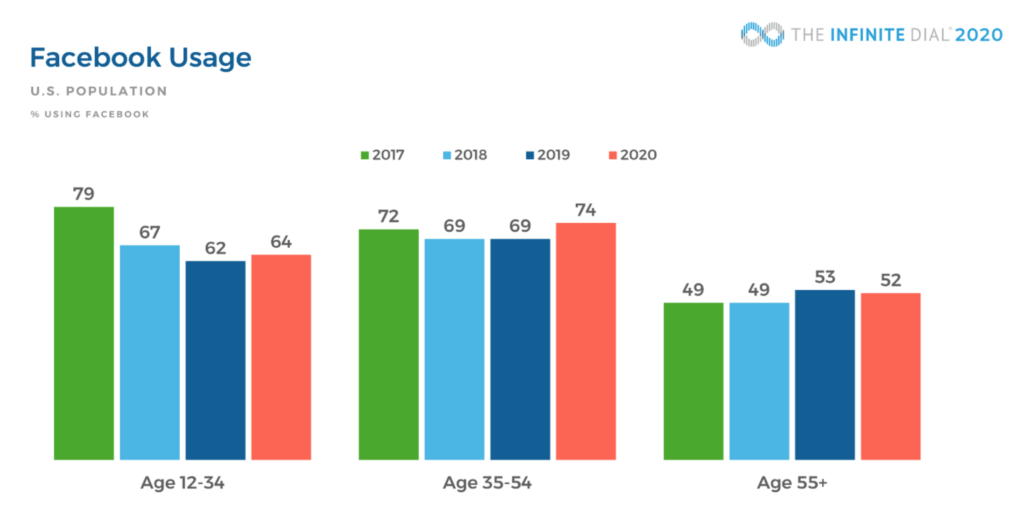
In data that my company (Edison Research) just released yesterday, we found that 54% of all Americans age 12 and over have a personal profile on Facebook. This represents some modest growth over last year’s 51%, but not hockey-stick growth, so one might be tempted to see Facebook’s rise as slowing down, especially when that growth is trended over the past five years.
Not so fast. Numbers like “54%” don’t tell the full story.
First of all, it is important to know this: in the same report, we show the percentage of Americans 12+ who have a personal profile on any social network as 56%, and no other network is even remotely close to Facebook. When we talk about social media in this country we are talking about Facebook, plain and simple. The other thing to note about that 54% is it’s an average that masks some intriguing demographic disparities. Note the breakdown of social media usage by demographic below: (and remember, Facebook is used by 96+% of these Americans)
There are two important stories here.
The first speaks to the saturation that Mark wrote about, but in a different light. For the second year in a row, the growth for Facebook has really been people aged 45 and over. Indeed, the 12-34 demographic has largely been static since 2010. Certainly, it isn’t wrong to think that it’s pretty much all ashore that’s going ashore with younger demographics. And, as Mark correctly pointed out, as Facebook’s growth with older demos slows, the company will need to find ways to wring more data out of us in order to feed their shareholders’ insatiable hunger for growth.
The second story, however, is more subtle. As I noted earlier, usage by the 12-24′s haven’t really grown appreciably since 2010. But look where they are “stalled” — at an 80% adoption rate. Now, getting 80% of American youth to do anything is an unbelievably powerful construct to get your head around.
You can’t find any other media property remotely close to that. Heck, 80% of 12-24s don’t have smartphones, or landlines, or read the newspaper, let alone use any one brand or product. That 80% use of social media (i.e. Facebook) is remarkable, to say the least.
Eventually, those 24-year-olds turn 25, and those 34-year-olds turn 35, and so on. Gradually, as these younger demographics age into older demographics, they will take these learned behaviors with them. In that sense, it’s like smoking. Facebook has changed the behavior of Americans in their formative years, and they will take those learned behaviors with them.
With nearly 8 out of 10 young Americans making Facebook the hub of their online lives — and, thus, their lives – the ways in which they consume and share information have changed irrevocably.
Consider the number of Americans who have the “social habit” and check their profiles several times every day — while Facebook’s Edgerank algorithm prioritizes the information they receive based upon our personal interactions — and you can begin to see just how much sway Facebook holds over what we know as Americans. These 12-24s are literally growing up with the news and information they are exposed to being curated by their friends. And by Facebook.
As a parent I am keeping a wary eye on this. Garbage in, garbage out, as they say.
What do you think? Am I overreacting? What do you see in the data?
Tom Webster is Vice President of Strategy for Edison Research, a custom market research company best known as the sole providers of Exit Polling data during U.S. Elections for all the major news networks. Webster specializes in drawing insight from social media data, and writes about these topics at www.brandsavant.com. Follow him on Twitter at @Webby2001.
Social Slam recap: Lessons from 430 house guests
Apr 18th
I had an incredible experience last week that had quite an impact on me.
I founded and helped host (along with Social Media Club Knoxville) a social media conference called Social Slam with more than 400 attendees from 17 states and Canada. It is probably the biggest social-media-related experience of my life so I wanted to share some lessons learned. (And here is fun and lively round-up of the event from Journalist Jack Lail).
Ship it. Seth Godin writes a lot about just “shipping the product.” That was definitely the approach we took on this event. We didn’t it have it all thought out from the beginning. We had a vision for a world-class conference that was affordable and inclusive, and we just went for it. This was a bit out of my box — putting my brand on the line with such public risk.
Although the event had sold out weeks in advance, and the planning was smooth, I really could not conceptualize what was about to happen until I walked into the convention center hall and saw a room filled with 430 chairs. Here is what I said out loud: ”Holy shit.” What if this sucked? Suddenly I felt the weight of 430 house guests — many of them close friends — on my shoulders. All it would take was one messed-up wi-fi connection, one last-minute speaker illness, or a million different possibilities that were out of my control to turn anticipation into angst … or even disaster. It was a scary feeling. But as Seth says, sometimes you just have to start and push fear aside. In this case, it worked.
When things go wrong. – Of course things went wrong. There were plenty of last minute kinks to our plans but as long as we could keep the kinks under the covers it all looked perfect to participants. When you get down to the wire, you just have to overcome and get it done. There was huge value in being able to make decisions on-the-spot without having to get approval from a company or committee.

An event of this size took hundreds of hours of volunteer work to handle everything from logistics to stuffing 400 gift bags!
Empowering others. The logistics and planning for an event like this is daunting. Thankfully we had an outstanding team of volunteers led by the awesome Nicole Denton and Brenna DeLeo of the Knoxville Social Media Club. From my corporate days I learned to delegate and empower but of course it’s a little riskier in a volunteer situation. Surrounding yourself with reliable and trust-worthy partners is essential in a venture like this.
Social giveth and social taketh – People flew in from all over the country based solely on word of mouth from the social web. Our advertising budget was zero. So in that respect, social media was very generous. As you would expect, people were tweeting like mad all day but a few characters who were not even attending the event hijacked the conference hashtag for their own “comedic” agenda. Who knows why? A sad and strange way to get attention I guess? It hurt because dozens of people had sacrificed countless hours to make this event shine for our city. But it was a good experience for me because I caught a glimpse of what companies must go through when they have to watch helplessly as somebody terrorizes their brand and their hard work. But it only lasted briefly and the tweets from the people actually attending the event were awesome. From this, I have a better appreciation of the peril of having no control of your brand on the social web.
The emotion of connection. This event was a celebration on many levels but it was also a homecoming for the {grow} community. Dozens of people who are loyal readers — and who I have never previously met — came to enjoy the event. If you have read this blog for awhile, you may remember a post I wrote about Jenn Whinnem, one of my first Twitter friends. Jenn flew in from Connecticut and when I first saw her walk through the door, there were tears in my eyes. This scene was repeated many times as friend after friend came into town to join the celebration. I was surprised at how emotional this was for me. Don’t let anybody tell you that you can’t build real relationships through the social web. For most people, the networking was just as valuable as the conference content.
The power of passion. Every speaker, panelist, moderator and worker volunteered their time and even paid their own way to present because they believed in what we were trying to accomplish — create an inclusive showcase for diverse and fresh perspectives on social media marketing. I cannot even describe how humbled I feel and indebted to these good and generous people. Yes, there is a lot of crap on the social web. But you also have the choice to surround yourself with bright lights. Here are some of the lights in my tribe that made Social Slam rock:
- Jay Baer
- Jeremy Floyd
- Anne Deeter Gallaher
- Glen Gilmore
- Amy Howell
- Jen Kane
- CK Kerley
- Billy Mitchell
- Chad Parizman
- Trey Pennington
- Shane Rhyne
- Ryan Sauers
- Jayme Soulati
- Jeremy Victor
- Tom Webster
- Brian Winter
- Deb Weinstein
Was it a success? We’re still collecting feedback, but many people commented that it was the best social media conference they have attended anywhere. We had many out of town guests who were impressed with our beautiful city of Knoxville. I’m proud that I was able to highlight deserving speakers and successfully lead this inaugural event — my primary goal. On a personal level, it was extremely rewarding to achieve something like this. It will take some time to assess what this meant for my career.
What’s next? Well, we got this ball rolling now! We’ve announced the next event for April 27, 2012 so if you missed it, mark you calendars for a truly amazing and inspirational event. And if you attended this year … well, you ain’t seen nothing yet!


You’re in marketing for one reason: Grow.
Grow your company, reputation, customers, impact, profits. Grow yourself. This is a community that will help. It will stretch your mind, connect you to fascinating people, and provide some fun along the way. I am so glad you’re here.
-Mark Schaefer