Social Media Good Samaritan donates tweets to save businesses
Oct 16th
By {grow} Community Member Pavel Konoplenko
The story begins like any sweet story should — with delicious ice cream.
I first visited Ray’s Candy Store, an old-fashioned, hole-in-the-wall family business, when I was strolling around New York’s East Village. The walls of the store were covered with vintage photos of desserts — like Instagram except in real life! There were also articles and reviews covering the history of this beloved 40-year business.
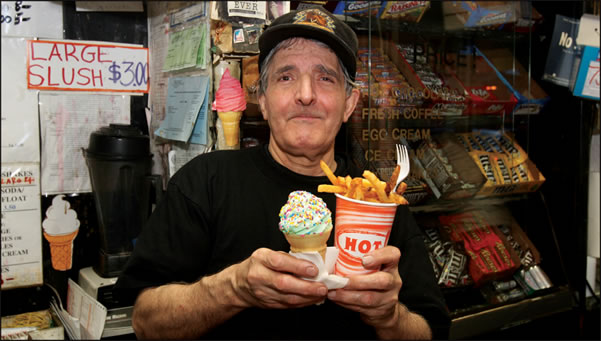
One article in particular caught my eye. The headline read, “Social media saves beloved East Village candy store.” How could social media, this recent tool of our information age, possibly be used to save the decades-old candy shop? After reading the article on the wall and having a brief chat with the man working the counter, I discovered a wonderful story…. the story of Matt Rosen, the social media Good Samaritan who crafted a social media strategy just because he wanted to save this little store.
The store’s owner 79-year-old Ray Alvarez, immigrated to America in 1964 and took odd jobs until he worked his way up to become the owner of the store. ”It’s my heaven,” Alvarez said in an interview in NYU’s Daily Student Newspaper. “I enjoy every minute of it. I came here from Turkey with no papers in 1964. I worked as a dishwasher, then waiter, then saved enough to buy the store.”
But after 36 years in the same location, increasing rent and taxes threatened to shut the little store down. Word began to spread that Ray was shuttering his business and loyal customers came out in full support of their beloved neighborhood store. Ray said, “They would buy anything and hand me a $20,” Ray said, “and then insist that I keep the change! They kept giving me money.”
But even this benevolence was not enough to keep Ray in business for long.
Matt Rosen, a long-time Ray’s customer and Internet-startup consultant, stepped in to help. It was clear that Ray needed something with massive reach at a low cost, and the social web seemed to be the perfect solution. So Matt volunteered to manage the pages on Facebook, Yelp, Twitter, and Foursquare that became the hub of an initiative to connect with the thousands of Ray’s customers throughout New York City and beyond.
Through PayPal donations, sales from Ray’s merchandise, and even a benefit concert, Ray was able to raise enough money to keep the store open. In fact, since his foray into social media, Ray has had his best year of business.
Matt was humble when describing his success. “It starts with the business,” he said, “and Ray himself. Without Ray, nothing we did on Facebook or Twitter would have mattered. The call-to-action was really doing something so we wouldn’t lose Ray.”
The goal of the social media effort, Matt said, wasn’t to get a million followers — that wouldn’t pay the bills. It was to keep Ray’s name out there on a regular basis and get somebody who buys one milkshake a month from Ray to buy two or three. Think of the impact on Ray’s bottom line if 200 customers do that.
“This is a simple, relatively painless way to keep Ray’s name out there.” Rosen said. “If my responding to a tweet or thanking someone who checked in on Foursquare brings them back in to the store, then that’s more business for Ray. We know this stuff is working. I can see the metrics.”
Speaking to a local newspaper, Mr. Rosen said he volunteers roughly 15 minutes a day to managing the assorted online accounts for two star clients. At the end of a typical day he searches for mentions on Twitter of Ray’s and responds to them.
In the first month of setting up Foursqure, 130 people had checked in to Ray’s Candy Store through Foursquare. “That’s tremendous,” said Mr. Rosen. “That’s two days-worth of revenue from Foursquare, and it took me just 15 minutes to set up.”
Social media buzz was a huge economic benefit for Ray, but it also brought his dilemma to the attention of a law student who helped him register his papers with Social Security and Medicare. Ray also recently got naturalized recently and is now an American citizen!
And what does Ray, who first saw his first computer a year ago, think about Matt’s efforts?
“Lots of young people are coming now with their iPhones,” he said. “They say, ‘If I do this, I get $1 off, right?’ I say, ‘OK.’” Ray continued, “[Matt] does advertising for me — it’s really high-tech. I still don’t have a television — I don’t know what Twitter is. This is a free country and you can do what you want,” Alvarez said. “How long am I going to keep working here? Until the end!”
Oh yes, follow Ray on Twitter won’t you?
Pavel Konoplenko, one of the most active commenters on {grow}, is passionate about social media and technology and their effect on today’s world. Connect with him on Twitter (https://twitter.com/pavelnovel)
Photo of Ray Alvarez Courtesy of The Villager
Should you out-source your tweets?
Sep 25th
Should you out-source your tweets? No.
But having said that, I recognize there is enormous pressure to do just that. It’s a reality of busy life isn’t it? We just want somebody to “do it for us.”
Let’s look at the risk of this strategy that I recounted in The Tao of Twitter: I have a friend who had been building a Twitter relationship with a business executive she admired. They had tweeted back and forth a few times and he had provided some helpful career advice to her. When they had a chance to finally meet at a networking event, she introduced herself and was met with a puzzled stare. He had never heard of her before, and sheepishly explained that his PR agency was tweeting for him. Obviously his reputation was ruined for this young woman … and also to all those she talked to about the incident!
In a well-publicized snafu, a PR agency rep tweeting on behalf of Chrysler Corporation sent out this tweet: “I find it ironic that Detroit is known as the #motorcity when no one here knows how to f**cking drive.”
He thought he was tweeting from his personal account but in fact, it came from Chrysler’s Twitter account by mistake. He lost his job and the agency lost the account.
Faking it on Twitter is dangerous business.
But you may be in a situation where you have no other practical choice than to “team-tweet” behind a brand name, then you could outsource or share the tweeting between a few trusted individuals. If you do outsource:
- Be clear and realistic on your objectives.
- Have clear lines of who owns what.
- Have a clear plan for content, tone and frequency.
- Be prepared to take advice and listen to it. Most experts know what they are doing and it’s in their best interests to make it work for you.
Make sure that you have a disaster recovery plan in case of a PR upset. If you’re using an agency, ask them to show you how they are managing your account distinctly from personal/other client accounts, so that tweets aren’t mistakenly sent via the wrong account – easy to do when you’re using a sharing platform. Ask to meet everyone that will be tweeting via your account and create some rules or guidelines for tweeting. Outsourcing doesn’t mean abdicating responsibility – make sure you are involved and holding everyone to account.
Before you outsource, carefully weigh the risks and benefits. One of the biggest opportunities of social media is “humanizing” the brand and even the biggest brands are finding ways to do that successfully. In the long-term, businesses should aim at involving their own employees to be “brand beacons” on Twitter instead of relying on an outside agency.
Agree?
Illustration: I doctored up an original illustration from BigStock.com
How many Twitter accounts should you have?
Nov 2nd
How many Twitter accounts should I have?
I have been asked this question three times in 24 hours, most recently by Edwin Mysogland of Indiana who writes:
I received your book for my birthday last month and I have found it to be a fascinating read. Forgive me in advance if I missed it, but what is your position regarding handles? For instance I have two accounts, business and personal. From what I can gather with the intent of making Twitter so much more personal I assume you would say one?
The beauty of Twitter is that it can be used by many people in many ways. But let’s start with my philosophy about it, which has also served many other people very well.
Twitter is not about being B2B or B2C. It’s P2P — person to person. Twitter is a powerful networking tool and a historic opportunity to connect with people you never would have met before. It’s an incredible opportunity to build a real, emotional connection with people who can lead to substantial new business benefits. And I’m sorry … but it is just really hard to build an emotional connection with a company logo or a picture of your building. I want to know YOU.
We’re all SICK of being marketed to, advertised to, and sold to. But we do want to make new friends who will pay attention and help us get by in this crazy world.
Twitter is no different than any other networking venue. If you attended a chamber of commerce meeting or an industry get-together, you wouldn’t cover your face with a logo and hand out ads. If you’ve done personal networking, you know it takes time, but after the fourth or fifth meeting, you start to recognize people, you know their stories, you find common interests, and you actually look forward to attending the meeting to see your friends.
And then one day, this is what happens. A friend from the networking group calls you up and says, “Hey, my client is looking for some (fill in the blank for your business). I thought this would be right up your alley.”
And the business benefits start to accrue.
I was on the receiving end of these conversations, all of them resulting from friendships that started on Twitter:
- “Would you be interested in working for the UK government?”
- “Rutgers University is creating a graduate-level social media education curriculum. Would you be interested in helping them?”
- “I’m looking for speakers for my national economic development conference. Are you interested?”
All of these calls resulted in significant new business opportunities. Even the seeds of the national Social Slam Conference I founded were planted with Twitter connections.
There are exceptions to every Twitter rule, but generally my recommendation is that to create an organization that is BEING social instead of DOING social you need to get your skin in the game and stop hiding behind corporate pronouncements and logos. That is not easy, which is why so few companies are succeeding in this channel.
The best practice is to have a social media policy that encourages your employees to tweet for themselves and your company. Why not have everyone be a beacon for your brand in some small way? This is a big decision for many companies. Put time into your policy, start small, experiment, have patience.
And above all, be human. It’s OK to tweet about your interests. It’s part of who you are. In most cases, you don’t need two Twitter accounts. Just be congruent and honest. Be you.
What do you think? What differing Twitter strategies are you employing?
Illustration courtesy of www.marriedtothesea.com

Take the Mystery Out of Twitter!
Click on the image for a Special Amazon promotion!
Finding the balance between personal and professional on Twitter

Apr 26th
I had the pleasure of being a guest at the Bliss PR Agency in New York City this week and the staff loaded me up with questions. Here was a particularly interesting one from Ben Weiss:
What is the proper balance between personal and professional outreach on Twitter? If I am using my account to promote company and client content, is it also appropriate to carry on conversations on a personal level about sports, a great recipe or my favorite charity?
This is a great question and one that I have to address on two levels, philosophical and practical.
At its heart, Twitter is a business networking tool … which is what many companies and individuals don’t understand. They view the platform as just another way to broadcast company press releases. By trying to force-fit old “broadcast” media thinking into this new platform they are sub-optimizing Twitter at best and hurting their brand at worst.
Think of yourself in another networking situation … say an industry conference or a chamber of commerce meeting. Would you stand there and read press releases? No, of course not. You would seek out great people to connect with, discuss subjects that are interesting to you and them, and look for ways to work together. Twitter can work exactly the same way.
So even if you are playing a business “role” on Twitter, there is no reason you can’t be yourself, unless you are a naturally mean and sucky person. If you are in that category, you either have to not be mean and sucky or not use Twitter. And if you are truly, chronically mean and sucky, you will probably will fail at business any way, let alone Twitter, so it’s better that you find out sooner than later I suppose.
When networking, the most powerful relationships are built on trust and friendship, so it’s OK to let people know a little bit more about what is going on in your life, including your love of sports, charity, and family. As you go throughout your day, just tweet what is interesting to you, as long it is appropriate and professional.
In most cases, I don’t think it makes sense to have both a personal and business account. You’re not two people and being yourself is not only a great way to build your business network, it humanizes your company brand.
Somebody told me yesterday: “I just do NOT follow a company logo account on Twitter. Why would I?” I think that sums up the sentiment for many.
Now let’s look at practical realities. Even if you have this concept down, maybe your company doesn’t. If your job is to be your official company Twitterer, you may have marching orders to follow a role or social media policy that has you tweeting behind a logo. Here’s what you should do in that case: follow the company policy. Don’t lose your job over Twitter. You can still work to change attitudes over time.
There are several compromises or hybrid strategies to blending personal and professional approaches on Twitter:
All business all the time. In some cases it is entirely appropriate to “broadcast” over Twitter. Here’s an example: Citi has a site that only broadcasts job openings. They really don’t need to engage in a conversation and they’re not even trying. Notice that they follow nobody. They have jobs, people want them … and they subscribe to the account. It’s that simple. They could probably work to build a community, but why?
Tweeting under cover – Many of the world’s most important brands have teams of tweeters engaging with the public behind a corporate logo. Like this example from McDonald’s Twitter account, the initials of the tweeter show up at the end of each tweet and following a link in the Twitter bio leads you back to profiles of the individuals providing the tweets. Certainly a great option to humanize the brand and still operate under one brand banner.
Blending personal/corporate — In some cases there are corporate accounts assigned to individuals. When that person moves on, the profile is still owned by the company. One example of this is @sharpiesusan who tweets on behalf of Sharpie pens. Susan has built up a faithful following but when she moves on to another job someday, this brand equity will stay with the parent company Newwell-Rubbermaid and Susan will simply be replaced.
This also works well in a customer service situation. In the example above, ATT has accounts set up for the representatives that can be moved over to other representatives as they change and take on new roles.
So those are a few examples and best practices but I’m sure there are many more. What challenges are you facing blending personal and professional content on Twitter?

Take the Mystery Out of Twitter!
Click on the image for a Special Amazon promotion!
Illustration: Sculpture “Janus Head” by Peter Burke


You’re in marketing for one reason: Grow.
Grow your company, reputation, customers, impact, profits. Grow yourself. This is a community that will help. It will stretch your mind, connect you to fascinating people, and provide some fun along the way. I am so glad you’re here.
-Mark Schaefer


Posts tagged Twitter strategy