Posts tagged Twitter
Research shows small business owners struggle with Twitter
Dec 10th

The latest research report from Business.com shows that small business owners are still trying to figure out Twitter … but those who have mastered it are seeing an advantage.
The expansive report covering 1,711 small business decision makers showed that of all the social media channels, Twitter was the least-used. Just 27 percent of the respondents were active on the micro-blogging site.
But even that figure may be deceptively high – the survey sample was of business leaders already using some form of the social web. Translation: This is why you are still getting blank stares when you talk to most small business decision makers about Twitter.
Although Twitter fell to the bottom of the list of most-used social media resources for business, those actively using Twitter are very positive about the business value. In fact, Twitter topped the write-in list with small business decision makers praising the ability to get quick feedback and access relevant business information. One typical quote:
“On Twitter, the people I follow provide me with more relevant links and information than any other tool. It saves me time and helps me learn about new technologies or innovative ideas, as they are happening.”
As we have come to expect, the Business.com research is thorough and fascinating, with detailed data segmented by industry, job type and company size. Study participants in the healthcare, retail and legal industries use significantly fewer social media sites/resources for business information.
Based on the findings, companies interested in using social media to engage small business customers and prospects would be wise to:
- Develop educational webinars and/or podcasts which address specific small business needs in the process of introducing company products or services. Businesses value convenience and speed in their information sources.
- Encourage, and carefully tend, online reviews of company products or services.
- Establish a presence on one or more major social networking sites and use this as a hub for corporate social media initiatives.
- Participate in more focused online discussions where it is easy to find and respond to questions specifically related to company products or services – such answering questions on Q&A sites like LinkedIn Answers or Business.com Answers, or in online business forums – rather than trying to work a promotional mention into discussions on 3rd party web sites and blogs.
- Further investigate how their target audience is using Twitter for business today and begin developing a Twitter strategy.
Source: Engaging Small Business Decision Makers through Social Media: A 2009 Business Social Media Benchmarking Study Report. Business.com, December 7, 2009, http://www.business.com/info/engaging-small-business-through-social-media.
The curious case of the Twitter Quitters
Nov 22nd

One of my customers is a brilliant management consultant. An engineer by training, he does not come by marketing instinct naturally and asked me to help.
This is a customer tailor-made for Twitter:
- Small business-owner
- Enormous, global market potential (needs a lot of awareness)
- Small budget
- No time to blog, develop content, etc.
- Tech-savvy
- Is a charming, bright person with engaging personality.
And yet he WILL NOT TWEET. I coaxed, cajoled and threatened. I’ve trained him patiently and even prescribed a daily Twitter regimen. I demonstrated the power of the platform when I found him a potential new business contact on the first day of operation. He didn’t follow-up and seems content with his tweet-free existence.
This may seem strange, but it isn’t. I’ve found similar resistance from many people who can benefit from this business tool. I asked my client ”why” and (published with his permission) here is his answer:
Not sure why really. I guess the idle chatter (which is mostly what I seem to see when I log on) just doesn’t make any sense to me. There’s obviously some self imposed barrier that I can’t or just don’t want to cross. You were kind enough to introduce me to Twitter, and I appreciated that. There’s the old expression about leading a horse to water. Guess I’m just not that thirsty for Twitter water… at least yet.
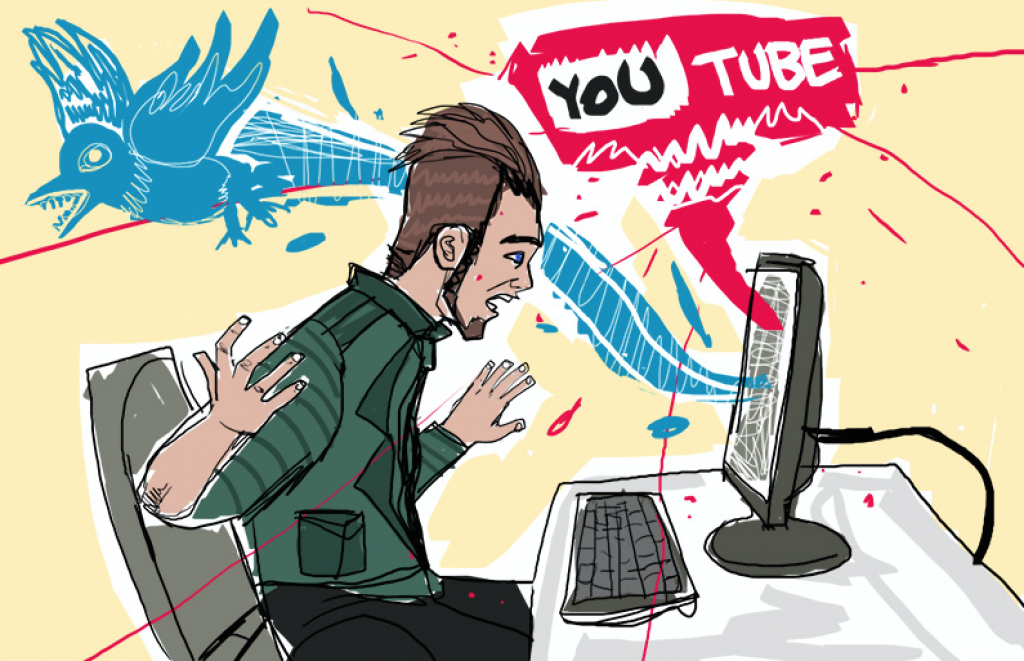
This type of reaction is not unusual. In fact I was a Twitter Quitter myself and had to really push through a few weeks of of this non-intutive communication platform before I had an expereince that changed my view forever …
I was bored one night and noticed a trending topic titled #newnameforswineflu. I clicked on it and was entertained for a half hour as people from all over the world chimed in with alternaitve names like “Hamthrax” and “The Aporkalypse.” Although this event was playful, it dawned on me that I was watching a real-time global brain-storming session. Now THAT was very cool. That was something that could never have happened before in the history of mankind. I got it. The light bulb went on for good.
I’m wondering, what did it take for YOU to “get” Twitter? Was it simply perseverance? The fear of falling behind? Or did it take an “a-ha” moment like me? For the 40 percent of us who didn’t quit after trying it, what lit the lightbulb for you?
Illustration: Natalie Dee
B2B’s biggest social media screw-ups
Nov 3rd
While the case for social media as a marketing channel is compelling for consumer products companies, I’ve been particularly interested in how it is being used … or not … by mainstream industrials. Earlier this year I assessed the social media presence of most of the major Fortune 500 B2B giants looking for case studies.
I found some great examples, but for fun, I’ve decided to start out with the WORST companies I found out there. With few exceptions, major industrial companies are not utilizing – and in many cases ignoring — social media as a stakeholder connection point. A few fun facts:
- Number of Top 25 B2B companies with more Twitter followers than me (None)
- Worst B2B corporate Twitter-er (by far) — DuPont. An example: “Back off weeds! 4 new herbicides are coming to get you …”
- Most popular corporate social media platform: Facebook
- Percent of companies with either Facebook or MySpace pages: 75%
- Percentage with both: 25%
- Most popular use of social media: A place to post press releases
With no further delay, let’s take a look at the Top Five biggest B2B social media screw-ups.
5. 3M Corporation – I love 3M. I’ve always cherished their heritage of innovation and product development. If any company in America could take advantage of the awesome power of global community it should be 3M. Where are you guys? We need you out here.
4. General Dynamics — There is a not-very-good techno rock band called General Dynamics who dominates the social media bandwidth. That’s a problem for a Fortune 100 company with the same name. This is the time for the company to flex some legal muscle and tell them they were there first! In the corporate world, this ID theft is tantamount to a porn starlet naming herself “Pepsi.” You have to take action on this, General Dynamics! Go kick some techno butt!
3. Oracle Corporation – You would expect an ego-laden company like Oracle to be sucking up the social media space, but not so. The Twitter account is exclusively a press release machine and their other sites are ill-attended placeholders. Larry, look at what SAP is doing with social media. Work it baby.
2. Johnson Controls — This Fortune 50 titan has had their name usurped on Facebook by a bunch of disgruntled employees. An example of social media gone very wrong when you’re asleep at the wheel.
1. Dow Chemical Company. The pinnacle of social media mayhem. The first search result for Dow on Twitter is called “spillspill” and the largest company-related Facebook page is called Fuck Chemical Valley and Fuck Dow (42 members). The MySpace presence has also been hijacked, complete with fake logos, fake employees and a mission statement that includes: “minimizing damage by angry citizens who have been affected by our pollution through legal suits and PR campaigns, making sure scientists who find our products to be dangerously toxic are not allowed to publish.” Dow has a proud history of PR fubars. The legacy continues.
Disclosure: My ex-wife had family ties to the chemical industry. While clinical tests have shown she is toxic to humans, she is not associated with the Fuck Dow campaign.
Warning: Social media may be hazardous to your health
Oct 29th
A lot has been written about the “danger” social media poses to companies and brands, but what about the real threat it poses to us as individuals?
Immediate, transparent, global, free communication is one of the most breathtaking information advances since the telephone. But when there is an opportunity for human corruption, there probably WILL be human corruption. Here are the biggest threats posed by the advent of social media:
Risk to personal security. For fun, I follow a few celebrities on Twitter, the digital Post-it note. The other day, one of them tweeted: “Down at Gino’s having a pizza with my boys.” Earlier in the day he had established the city he was in. With this kind of shoot-from-the-hip public broadcasting, it’s only a matter of time before we see the first Twitter-related crimes. Even for non-celebrities, how safe is it to post to the world, “My husband and I are off to Boston for the Web 3.0 conference.” Not very … unless you want your next post to be “Our house got wiped out by crooks while we were away!”
Risk to personal finances. Every time you register for a site, sign up for an app, or populate a social media profile, you are adding to a databank all about you. Strangers can find names, birth dates, family members, school and work history, e-mail addresses and much more. One blog writer recently quipped, “Honestly, it doesn’t take a genius to steal a person’s identity online.” Even more severe than identity theft and the obvious financial ramifications for an individual — we will begin to see online crimes being committed under the alias of another person.
Risk to personal reputation. Thankfully, nobody was holding a video camera in my face during my college years. But the lives of today’s youth are explicitly documented on You Tube, blogs, photo albums, and social media sites, creating a permanent online record. One corporate recruiter told me that a web search is more important to him than a resume. How will your Google-image affect your future job prospects, personal relationships, political aspirations? Did you read about the teen girls who took pictures of themselves in their bras at a sleepover, texted them to friends and then hours later ended up on porn sites? How do you erase something like that? Google never forgets.
Risk to data and information. A few weeks ago, a computer worm, using Twitter, infected tens of thousands of computers as it replicated itself across the Internet. The worm was created by a 17-year-old to “expose the vulnerabilities” in Twitter. The red-hot social networking/microblogging service has been scrambling to plug cross-site scripting and other Web site vulnerabilities to thwart worm attacks but, as one researcher points out, it’s much easier to misuse the Twitter API as a “weak link” to send worms squirming through Twitter.
Risk to personal health. Neurologists and doctors warn that obsessive immersion in screen technologies and social network sites will lead to short attention spans, sensationalism, inability to empathize, weight gain, and a tenuous sense of identity.
Risk to personal productivity. A friend recently told me that he needed to find a way to block himself from social media sites at work. “I’m hooked,” he said. “I can’t stop myself from getting online every minute that I can.” According to a U.K. study, British firms are losing $264 million A DAY on lost productivity due to undercover activities on Facebook. Businesses are starting to look for ways to deal with the social networking problem. Several companies in America already block social media sites.
So, where does this lead?
I’m a fan of social media. These new platforms have connected me to countless interesting people, opportunities and ideas. The purpose of this article is to serve as a counter-point to those who seem to be hypnotized by the hyperbole and beat the drum of social media while ignoring these certain consequences. There is virtually NO dialogue on the risks of the inevitable corruption that will result from having a free and pervasive window into YOUR life.
I’m hoping the dialogue will start now …


You’re in marketing for one reason: Grow.
Grow your company, reputation, customers, impact, profits. Grow yourself. This is a community that will help. It will stretch your mind, connect you to fascinating people, and provide some fun along the way. I am so glad you’re here.
-Mark Schaefer