Do you have to cheat to be successful on the social web?

Mar 6th
I spent a great part of my career in B2B marketing positions and the part I loved most was traipsing around the factory floor. I loved watching things work and being with people who were actually “making stuff.”
There was one manufacturing manager I knew who seemed to be a wizard. The guy always led the pack and found a way to hit his production numbers no matter what was thrown at him. He seemed too good to be true.
That’s because he was. He was a cheat.
Turns out, he would invest to improve his plant’s productivity and then purposely understate the manufacturing capacity of his equipment. So he was always holding back — in essence, lying and cheating the company so he could “make his numbers” and get that big bonus check. Of course he was fired.
He moved on to another Fortune 100 company, did the same thing, and was fired again.
You see, it’s not just about making your numbers. HOW you make the numbers matters too.
It’s all about cheating
This has been one of those weeks when I get really disgusted about the questionable games people play in business. For example, there has been a significant debate about the number of well-known authors who allegedly hire specialized companies to buy bulk copies of their books to nudge them on to the New York Times bestseller list.
I understand why people do this. They cheat, bump themselves on to The New York Times list for a day, and then claim that badge of social proof for their career forever. But it’s kind of like calling yourself an “award-winning author” for that third-place trophy you received in high school for the Kiwanis Club essay contest. What did you really accomplish?
The publishing companies apparently approve of this because it moves books. Even the New York Times seems to condone cheating. This blows my mind. I mean, it’s the New York freaking Times, the most respected newspaper in America. And they’re allowing the editorial section of their paper to be gamed? The fact is, it is possible — maybe necessary — to buy your way on to this prestigious list.
An addiction to social proof
I’ve written extensively about this idea of “social proof.” An indicator like “New York Times bestseller” is a short-cut indicator of quality when we are overwhelmed in a decision process. But this is a two-edged sword. It is undoubtedly a powerful indicator of influence, but it is also increasingly meaningless because nearly every “badge” can be faked.
Today, anyone can manufacture their own image of personal power. In Return On Influence, I wrote about a colleague who admitted to me that his entire social media presence had been faked. He bought his massive Twitter audience. He had somebody ghost-writing his blogs. He made up his client list. And people bought into it.
Another person I know created their own social media award and presented it to themselves so they had something to display on their blog. Nearly every day I get requests from people to vote for them for some crazy, made-up award. What the heck does winning a “Shorty Award” mean? Are you really the “best” of something?
The sad reality is, what you do may be less important than how you appear on the Internet. In a social media world that barks “Authenticity! Authenticity!” … there is precious little of that, in reality.
There was a time I was too concerned with social proof. I didn’t cheat, but I spent too much time comparing my “numbers” with other people. It was driving the wrong behavior for me and my business because instead of just doing good work, I was thinking about doing work that increased these meaningless metrics. The social proof on my blog included badges about the awards I had won, Ad Age Power 150, etc. I took them all down about a year ago (which means I am not even following my own advice about the importance of social proof!), but it was the right decision for me because today I am concentrating on business metrics that make a difference.
Leaving success on the table?
I do wonder if the world will pass me by if I don’t cheat. Will I ever have a bestseller? Will my publishers even support me any more if I’m not willing to pay a third party to buy my own books? Is it more important to write a great book or have the financial resources to make it look like a great book?
Will my blog readers eventually be more attracted to bloggers who display their awards and badges like a a five-star general?
Will clients hire speakers for conferences and workshops based on the number of Twitter followers or Facebook Likes they manufacture?
Does it matter that I don’t make “best of” lists or win social media awards because I don’t lobby my friends for votes?
Despite the business realities of social proof, life is too short to compromise myself to make a book list or fake my way to stardom. I feel like I am in a shrinking minority, but I still believe the lesson I learned on the factory floor so many years ago — How you make the numbers is important too. Even if other people can’t tell what is real, I know what is real.
Thanks for reading my post today. I would love to hear your thoughts on cheating and social proof in the comment section!
Getting your first book published: Lessons learned!
May 29th
Do you dream of writing and publishing a book some day? It was always something I’ve wanted to do and I was so fortunate to have the opportunity to do it this year. Here are some lessons that you might find helpful from my journey with Return On Influence.
How did I get a book contract?
I was in an unusual position. Beginning in 2010, publishers actually sought me out to write a book. Why? I think there were three things that boosted me into that position:
1) I had demonstrated my writing ability through my blog
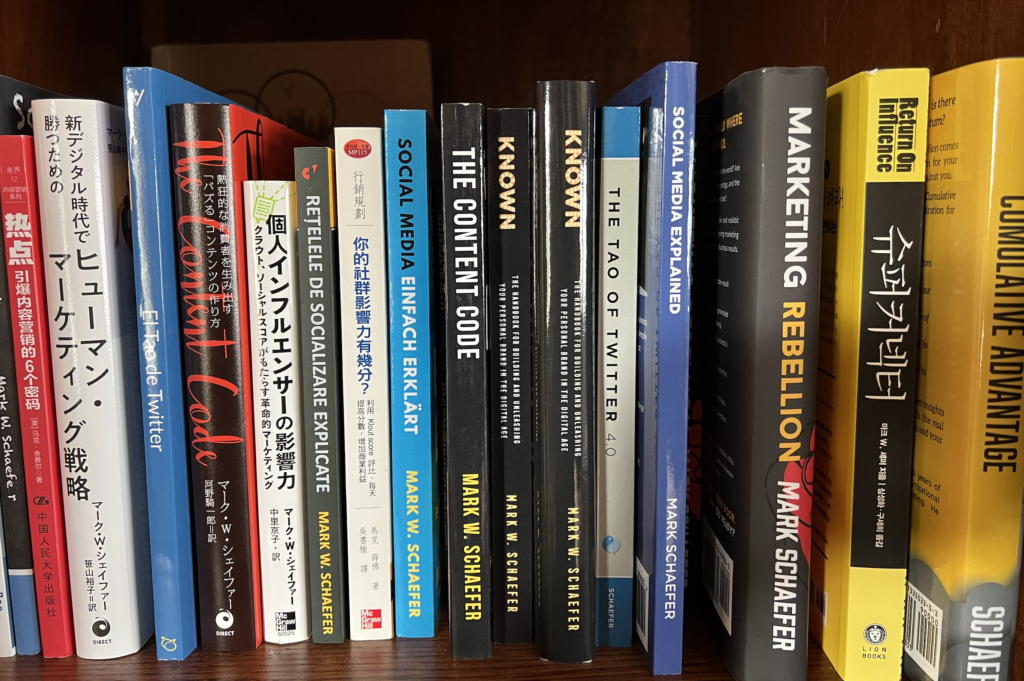
2) I had successfully self-published my first book, The Tao of Twitter (a great stepping stone!)
3) I had an engaged community who would be advocates for the book
I think this last part is particularly important. Like any content on the web, you have to be able to “ignite” it for it to be useful. Even if I had written the world’s greatest book, it would never sell if I couldn’t light the match. Establishing a blog or Facebook community seems like a good first-step for publishing today.
The good news is, these opportunities are available to anybody today to get them into a position to get a publishing contract. The bad news is, it takes a LOT of work to get there.
How did I choose a publisher?
After meeting with several publishers, I developed a good personal chemistry with the people at McGraw Hill. They really respect and support their authors. It ended up being a great decision.
When I turned in my proposal, it ended like this — “I really don’t know what this book is going to be about because the topic is entirely new. I don’t know what I will find and I have to let the research determine the outcome of the book.” They let me write it any way, which I think is cool. And the book ended up being 80% different than the original proposal!
How did I choose a topic?
There was no master plan, really. The emerging marketing trend of social influence was simply something I was interested in — Is there anything to this Klout stuff? How does power show up on the web? Why are companies scrambling to implement these Klout Perks?
If I was going to devote months of my life to a project, first and foremost, it had to be interesting!
I also realized that I had to write a book that had not been written before — something COMPLETELY different. Choosing this topic of social influence was a big risk. When I started the project, nobody had heard of Klout or social scoring — the trend was just emerging — but I thought this was going to go mainstream and I was right, thankfully.
What was the writing process?
The biggest challenge for me and other writers I have talked to is blocking out the chunks of time necessary to get the project done. A project this size cannot be accomplished with an hour here and there. Even when I reserved a whole week to write, I looked up at 9 p.m. on a Thursday night and not written a word — my week had been filled solving client problems. This was a panicky moment. How was I going to get this done?
So I blocked out another week and made a decision I have never made before or since — I was going to write, even if it meant disappointing customers. That’s gut-wrenching and wrong but I had to do it.
My wife helped me as a research assistant and also transcribed about 50 taped interviews. From start to finish it took about nine months to research and write the book, with about three solid months of intense writing and re-writing.
Editing and promotion
I completely under-estimated the time required AFTER the book was written. The manuscript went through four editing phases. Although the final product is probably 95% the same as what I first turned in, there were a lot of decisions about the title, the tone and direction of the book. McGraw-Hill wanted it to be a “how-to” book and that just didn’t align with my vision. They let me follow my own path, but all these discussions took a lot of time.
Once the book launched, I was doing 2-4 interviews a day for eight weeks. This time, I warned my customers ahead of time and I was able to put off some projects to allow enough time to properly promote the book. I took a financial hit but I realized that this was a once in a lifetime opportunity and I needed to go for it.
Did I make money from the book?
I knew going into it that the goal for this book was to expand my reach and reputation, not become rich from book sales. So I approached it realistically. Even though I received a generous payment upfront and the book is selling very well, on a per-hour basis, this would have been a bad economic decision.
However, I am already receiving the benefits of being a published author through new invitations to speak and consult. In that regard, I forecast that there will be a long-term financial benefit.
What’s next?
I feel really proud about where I am right now with Return On Influence. I proved to myself that I could do it and the publisher is happy with a best-selling book (the first printing sold out in eight weeks). My community and the reviewers have embraced the book.
I do have a few ideas for a new book but the scope of these ambitious projects is quite daunting because of the time it would take to pull it off. It will be a difficult decision to make but you can be assured that if I write a new book it will also be “out there.”
In the near-term, I’m happy to announce that McGraw-Hill bought the worldwide rights to The Tao of Twitter and a new edition with about 30 percent new content will be available by the end of the year.
So those are the highlights.
What other questions do you have that I can answer for you? Was this helpful?


You’re in marketing for one reason: Grow.
Grow your company, reputation, customers, impact, profits. Grow yourself. This is a community that will help. It will stretch your mind, connect you to fascinating people, and provide some fun along the way. I am so glad you’re here.
-Mark Schaefer