Posts tagged writing
What a blog post will look like in 2020
Mar 27th
By Mars Dorian, {grow} Contributing Columnist
I believe that if you want to have success in the present you must anticipate the future. No crystal ball required.
Why? Because you want to sniff out trends to ride them. If you only act on what’s already happening, you’re getting sidetracked to second, third or even worse, fourth place. Like driving a Ferrari with two feet slammed on the brakes. Screeeech.
So, how can one even try to predict how content marketing, in this case blog writing, will look in the future ? Well, we have to remember the fundamental laws:
- Nature is lazy, hence, we’re lazy. We want maximum results with minimum effort.
- Content in the future will be based on this principle: Consume the maximum amount of content with minimum effort, whatever, whenever, wherever we want.
The following predictions represent my opinion and not the truth, so if there’s a time traveler from the future in the audience, don’t eliminate me with your ray gun because my predictions didn’t all come true in 2020. Cool?
Let’s roll. Six possible futures of the blog post in 2020:
1) High-end, low-end blogging styles.
I believe the normal 500 – 1000 word blog posts will enter oblivion because content will serve one of the two emerging reader camps:
Snippet readers – According to FastCompany, Facebook updates make for the most memorable writing. Strange, but it makes sense. With the ever-increasing battle for attention, people crave minimalistic, write-it-like-you-say-it content. Mini-blog posts that can be consumed like fast food, not rich in nutrition, but they give you the essentials.
Long-form essay readers – On the other site we’ll larger sized articles (1000 – 7000 words and more). These are going to be evergreen, in-depth articles, almost mini ebooks, that require more sitting and attention but reward you with more brain nutrition (aka valuable information!). They can be offered for a minimal fee, let’s say .99 cents or 2 dollars (think Kindle-single) or will be infrequently published in longer time intervals.
2) Mobile optimized content psychology.
I’m not talking responsive design and bigger fonts. I mean writing specifically for the mobile person in mind.
In Japan for example, cellphone novels are all the rage. They are romance and paranormal based stories in messaging style, created in a way that makes them readable on the go. Smirk all you want, but these sell up to 400,000 units per digi-novel. Even if you don’t plan on writing e-novels, this comes with mass inspiration for possible blogging ideas :
One thought one paragraph. Wayyy more white space to allow eyes to breathe. Simpler structure and bite-sized chapters so people can read between breaks / commute / waiting. And even more white space.
America’s best-selling fiction author James Patterson already implements this style. Maybe we should too.
3) Real time blogging.
This is the old model: Write a blog post, publish it, share on social media, wait for comments = clumsy and time-consuming. In the future, live blogging could be the alternative.
A content creator could say: Real time blogging from me, every Monday and Thursday. At a specific time, people show up online and interact live with the creator.
Baratunde Thurston did something like this with his last book. Fans could go online and see the words on the screen as he was in the act of writing.
4) Co-created content creation (alliteration ahoy!)
Like the example above, the idea of the author writing “to” their audience will be outdated. It’s going to be more of a dialogue. Mark Schaefer has often said the comment section on {grow} is better than the original posts. Well, now the comments can BE the post, as he could live-write a killer post, and YOU, the audience, could participate and share your info and expertise directly into it, in real-time. Think of it as valuable commenting live-embedded into the post.
5) True global blogging.
Most native English speakers don’t understand how few people in the world actually speak and understand English.
I live in the so-called European Startup hub Berlin, and even here most people can’t understand English that goes beyond High School level. Meh.
The advancement of online translation will change that. Every person with zero English skills will be able to instantly AND perfectly translate your blog post into their native tongue. And I mean perfectly, not awkward Google translate style.
Forget about only Europeans and North Americans commenting on your blog. The next comment will come from a Nepalese village girl that digs your article on advanced social media metrics.
6) Blog posts will be screen independent.
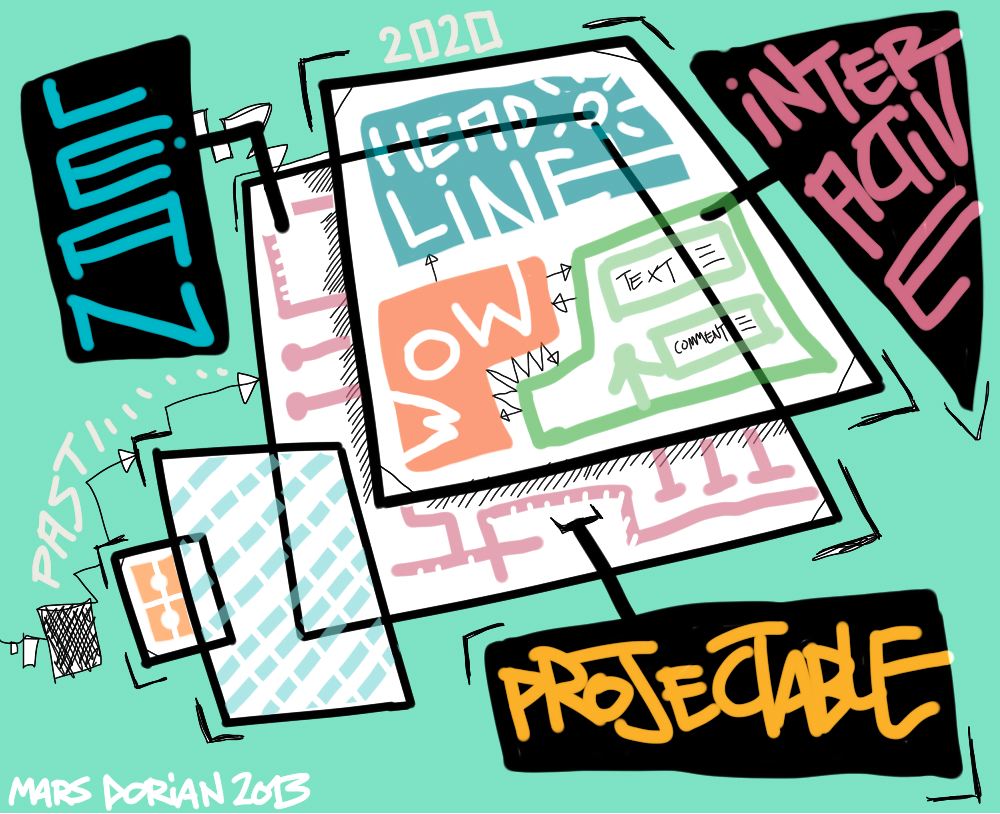
In a few years, people (including our future selves) will look back and laugh at our midget screens. In 2020, only savages will use static screens. Blog posts and digital content won’t be read on your portable screen, but everywhere “on” your surrounding.
How?
Well, you use your micro-chip infused glasses (like Google Glasses) and / or contact lenses to project the required information straight into your environment. Walls, streets, storefronts, heck, even your car could be used as a background for your digitally projected content. Information is going to be (screen) free.
Do you see where all this is going?
In a few years the blog post you know and love will no longer exist. Au revoir.
Just like diary-like journaling turned into blogging, blogging will turn into a different content style that will fit our ever-changing attention span and habits.
Forget how people do content marketing now and focus on how it will be done in the future. It’s time to blog back to the future.
Mars Dorian describes himself as a creative marketeer with a moon-melting passion for human potential and technology. You can follow his adventures at www.marsdorian.com/
Original illustrations by the author.
The Anti-Blog Post to Writing Better Blog Posts.

Feb 27th
I can’t read your blog.
In fact, I almost don’t read any social marketing blogs out there, because I’m done with wave bathing in the echo chamber. I’m done with it – people echoing echoes everywhere.
They read Seth Godin, a bit of Brogan, maybe a bit Gary V for the attitude, mash it all together and slam out another samey samey blog post. Bloggers in factory-mode.
I know this, because I was on this mode too. I kept repeating common advice, but I had nothing original to say. After a while, I burrrrned out. Like a TNT stick with both ends lit. Frizzzzzle. I knew it, and more importantly, my audience knew it. And after cranking out yet another lackluster post, one long-time reader remarked:
“Stop regurgitating, it’s getting pathetic. Tell me something original from your experience.”
Ouch.
It hurt, but the patient needed the medicine. I thought I was following all the blogging success advice, but it was leading me astray. Why ?
The answer may be James Altucher, who’s a notorious investor, entrepreneur and blogger. I don’t always like his work, heck, I often don’t even understand it. He’s irreverent and vulnerable, a human fly on my peripheral vision.
But he breaks every “blogging rule” there is to break, and breaks even the ones that don’t exist yet.
But there’s something magical about the way he writes. It’s like the wind, you can feel it but you can’t see it. His content is so unique and disarmingly honest you can’t help but smirk. It’s touching human hearts, and 5,000 to 10,000 Facebook likes per post(!) confirm that.
What’s the secret?
He doesn’t reside in the echo chamber. Everything he writes comes from him — his one-of-a-kind experience — the way he sees the world.
And that’s what inspired me to write the following anti-guidelines to craft content that’s not just another blasted re-hash on the perfect post, but a reminder of what makes great content truly special and compelling.
Now, don’t treat this like an exact formula, that would defeat the point of the whole post. Rather, it’s food for thought, by yours truly.
1) Everything’s related to everything. Use that to your advantage.
Without going too deep into meta-land, here’s a not-so-far-fetched revelation: People who only blog about what they read from other marketing bloggers have the scope of a tunnel view inside a straw.
They’re wallowing in the pool of idea incest. Instead of reading the same-old-same and echoing, extrapolate your niche knowledge from unrelated places :
- I have read posts from people talking about happiness when they’re stuck in a wheelchair, 24/7.
- I have read customer service advice from people dealing drugs on the street.
- I have read psychological advice from food decorateurs.
Every lesson you want to share with the audience can be linked to a more original example. Chose a unique experience from your life, and connect it with the point you want to make.
What has your recent Thailand journey to do with content marketing?
I don’t know. You tell me.
2) The more you systemize, the more you robotize
By now, there’s probably more blogging advice than bloggers out there. Follow it all, 1-2-3, and then you’ll succeed with viral posts that exceed 1,000,000 views. Right?
Nope. It’s the fast lane to mediocrity. The more I tried to find the golden formula of blogging, the more personality and emotion I lost between the lines. Whoosh.
Just as in Hollywood, most people (online) pretend, but nobody knows anything. The more systems and formulas you infuse, the closer you’ll robotize. Your post will be like an instruction manual for vacuum cleaners. Meh.
3) Cut to the core. Hack away the unessential.
This does not only mean a terse writing style, but also means finding the elephant in the room. Most people skate along the ice surface, but they don’t get below into the frozen water depths. All those shiny blog flares, like which share button to use or whether you should tweet at 9 or 9:05, are distracting you from making a point that will make your audience pay attention.
Give me the essence, baby, the one core thought that most people are afraid to address, but deliver it in a way only YOU can.
4) Style over substance. Sort of.
A lot of people will disagree with this, but here’s the thing – If all you provide is helpful information online, you’re competing with Wikipedia and thousands of robot algorithms that out-inform you. And with an unlimited choice of informational content, we humans pick the one that emotionally appeals to us.
So, style and attitude is what we come back for – whether it’s Seth Godin’s unabashed and clear writing, or James Altucher’s irreverent and vulnerable guide to life.
5) Allow your personal truth to shine through
Another biggie I struggled for almost two years — Keeping a cool, perfect and professional online presence seems to be the way to go, but it also got the emotional pulling power of a frozen brick. Marketing is all about evoking emotions.
It’s tough to go personal and open yourself up, especially with all those trolls out there, but that’s the only advantage you have over robots and computer-generated content. In a world where your potential customer and reader is a click away but also countries apart, separated by lifeless screens, there’s a huge emotional gap.
I want you to close that gap.
Conclusion
Before you create your next content, step back for a second and be still.
Are you creating an original piece of work, or are you merely soaking up the sound waves from the echo chamber? Tell yourself the truth. Then slap your face left and right.
Forget about all the average posts about which WordPress theme to use, how we all should have a tribe, and why we need a manifesto.
Been there, done that.
Instead, craft a post from the edge of your mind, with all the mojo, vulnerability, personal experience and original opinions — a little, uncomfortable masterpiece only you can come up with.
Give it to me.
Mars Dorian describes himself as a creative marketeer with a moon-melting passion for human potential and technology. You can follow his adventures at www.marsdorian.com/
Original illustrations by the author.


You’re in marketing for one reason: Grow.
Grow your company, reputation, customers, impact, profits. Grow yourself. This is a community that will help. It will stretch your mind, connect you to fascinating people, and provide some fun along the way. I am so glad you’re here.
-Mark Schaefer